By Bjorn LomborgGuest contributor
Sept. 6, 2026 3 AM PT
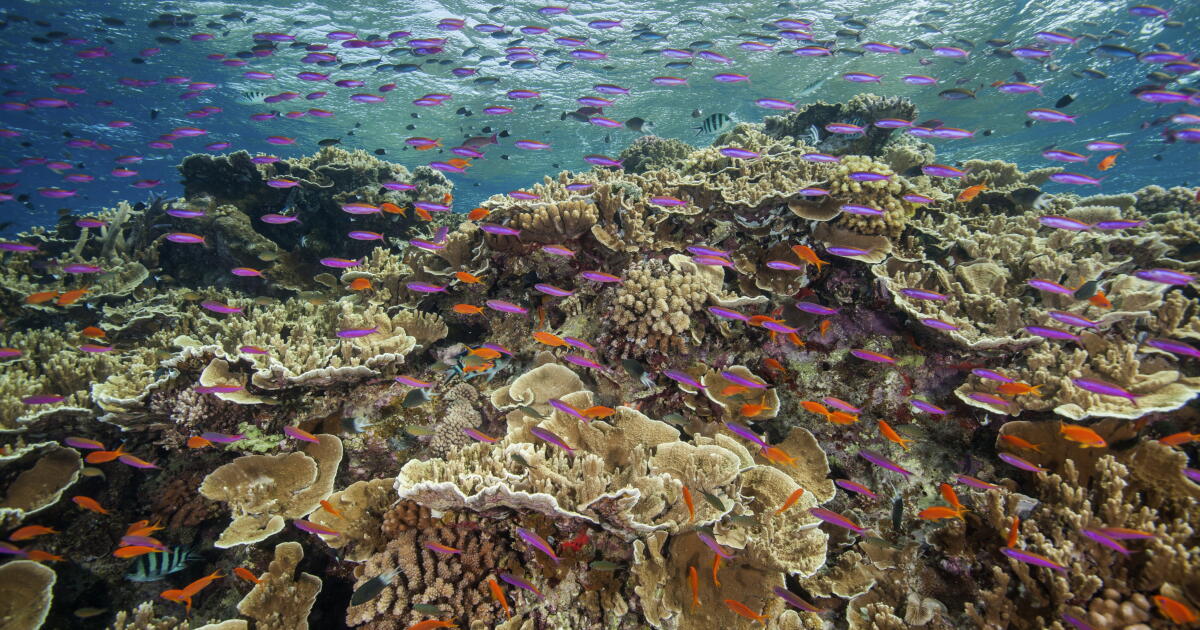
Australia’s marine scientists released their annual audit of the Great Barrier Reef last month, and it contains news you almost certainly haven’t heard: Coral cover held steady or increased across most of the reef. The scientists measure the percentage of living hard coral cover, and in the 40 years of systematic study, the five best years on record are the five most recent. That is the sound of a catastrophe not happening.
You haven’t heard the good news because the reef has an entire public relations industry built around predicting its imminent demise as a result of global warming. In 2012, researchers from the Australian Institute of Marine Science reported that the reef had lost about half its coral cover since the mid-1980s — falling from 28% to just 13.9% — and projected that cover could halve yet again by 2022. In 2014, the Guardian published an interactive obituary for the reef. In 2016, Outside magazine agreed, declaring the reef dead at age 25 million.
The patient, it turned out, hadn’t read the notices. By 2021, coral cover was higher than at any point since measurements began in 1986. It stayed at unprecedented levels through 2022 and 2023 and climbed to a new all-time high in 2024. The reef answered two decades of death sentences with more coral than anyone had ever measured.
The scientists even stopped publishing the reefwide statistic — making it harder for the layperson to easily see that the reef was defying long-held predictions. But researchers from AIMS continued publishing regional averages, making it possible to effectively re-create their reefwide average — which clearly kept increasing.
This posed a problem, which the doomsayers solved with a new annual ritual: Report the positive news and number, then smother it in warnings. When coral surged back in 2021, the monitoring institute insisted the outlook remained “very poor.” When 2022 set records, the BBC granted that cover was the highest in 36 years but still “highly vulnerable.” In 2023, with the reef still near record highs, the official report was headlined as a “pause” in recovery. At 2024’s peak, scientists declared the reef one disturbance away from losing it all. The reckoning was always due next year. Next year kept arriving, and so did the coral.
In 2025, the media decided the reckoning had finally come. “Great Barrier Reef suffers worst coral decline on record,” announced the BBC. CNN pronounced the reef “devastated.” What the headlines omitted was that the drop came off the highest level ever recorded, and 2025 still ranked as the fourth-best year in four decades of measurement. In any other field, a fourth best-ever result would be a triumph.
The doomsayers pressed on, undeterred. In July, two prominent marine biologists warned the reef faced a very high risk of “ecosystem collapse.” Weeks later we now have the actual data: coral growing again in the north and center, stable in the south, helped by a late monsoon that cooled the water. The collapse has been rescheduled, as it is every August.
When catastrophe fails to arrive, a second story stands ready: Take a bow and send the bill. Australia’s federal and Queensland governments have spent more than 5 billion Australian dollars on reef programs since 2014, and when UNESCO declined in July to put the reef on its “in danger” list, Australia’s ministers hailed the decision as recognition of the country’s world-leading reef management. It takes nerve to spend decades forecasting an ecosystem’s death and then claim credit for its historically high coral cover and remarkable resilience.
The reef’s swings have little to do with Canberra’s checkbook. The main spending that has a proven impact on coral cover is dealing with the crown-of-thorns starfish. When populations spike, these predators consume massive amounts of hard coral. The best estimate is that Australia’s spending on killing these starfish has delivered half a percentage point more coral cover. That is clearly not the main reason for the reef’s 10 to 25 percentage point rebound.
Coral cover falls when cyclones, heat waves and crown-of-thorns starfish strike, and rebounds because fast-growing branching corals do what they have done for millennia. Government spending does not summon the monsoon. And if the billions spent really did explain the record years, what would explain the 2025 drop? Did the money briefly stop working?
None of this means the reef faces no threats. Bleaching events have hit six times since 2016. Coral cover fluctuates, and next year’s survey may well be lower. But fluctuation is not death, and an ecosystem that has just delivered the five best years in its 40-year record cannot plausibly be called moribund.
Every August the audit arrives, the doom does not, and those who predicted the reef’s demise go unchallenged. That should change because the exaggeration is not harmless. Crying wolf has a well-known ending. Despite years of funeral music being blasted by the world’s media, the Great Barrier Reef is still going strong.
Bjorn Lomborg is president of the Copenhagen Consensus Center, visiting fellow at Stanford University’s Hoover Institution and author of “False Alarm” and “Best Things First.”
Insights
L.A. Times Insights delivers AI-generated analysis on Voices content to offer all points of view. Insights does not appear on any news articles.
Viewpoint This article generally aligns with a Center Right point of view. Learn more about this AI-generated analysis Perspectives
The following AI-generated content is powered by Perplexity. The Los Angeles Times editorial staff does not create or edit the content.
Ideas expressed in the piece
- The column contends that recent monitoring shows the Great Barrier Reef’s coral cover has held steady or increased across most of the system, producing the five strongest years in the 40‑year record and indicating that a widely anticipated ecological collapse has not occurred.
- The article argues that earlier scientific reports and media coverage, including obituaries and declarations that the reef was effectively “dead,” focused on a period of decline without acknowledging the subsequent, substantial rebound in coral cover that followed.
- The piece suggests that changes in official reporting — such as discontinuing a simple reef‑wide coral cover statistic and describing record‑high coral levels as merely a “pause” in recovery or as still “very poor” — have made it harder for the public to see the extent of the reef’s resilience.
- The column maintains that widely publicized headlines about the “worst coral decline on record” in 2025 failed to note that this drop occurred from an unprecedented high and still left coral cover at one of the best levels recorded, and therefore reflected normal fluctuation rather than ecosystem collapse.
- The article contends that billions of dollars in government spending on reef programs have had only modest, quantifiable effects on coral cover, particularly through crown‑of‑thorns starfish control, and argues that attributing record coral levels to management interventions overstates the role of policy relative to natural drivers such as cyclones, heatwaves and monsoon‑driven cooling.
- The piece acknowledges that bleaching events and other disturbances are genuine threats and that future surveys may show declines, yet emphasizes that an ecosystem delivering its best‑ever recorded years should not be portrayed as moribund and warns that repeated exaggerations about the reef’s imminent death risk “crying wolf,” undermining public trust in environmental warnings more generally.
Different views on the topic
- Reef monitoring reports from the Australian Institute of Marine Science describe the 2024 marine heatwave and subsequent 2025 surveys as producing the largest annual drop in live coral recorded in key regions since systematic measurements began, with losses of roughly a quarter of coral cover in the north and about a third in the south, and they frame these results as cause for serious concern about the reef’s trajectory if extreme events continue[1][2][5].
- Scientific briefings and condition summaries emphasize that the historically high coral cover seen in 2023–24 preceded the record heat stress and mass bleaching, and they characterize the current situation as one in which coral cover remains moderate but repeated bleaching, cyclones and floods — all intensified by a warming climate — are eroding long‑term resilience even though short‑term recovery is possible[1][2][3][8].
- Marine scientists highlight that recent surveys still document widespread bleaching and significant local losses, with official updates noting sharp declines on many individual reefs and describing the overall outlook as mixed, stressing that the reef’s apparent recovery masks continuing vulnerability to future heatwaves and other disturbances[1][2][6][7].
- These reports also note that average coral cover in some areas, particularly the southern Great Barrier Reef, has fallen below long‑term regional averages after the 2024–25 events, underscoring that the record highs of 2024 were temporary and that parts of the system remain in a degraded state relative to historical baselines[1][4][8].
- Ecologists and reef specialists caution that focusing on total coral cover can be misleading because it does not fully capture shifts in species composition; fast‑growing branching corals may rapidly dominate after disturbances while more heat‑sensitive, structurally complex species decline, potentially reducing habitat quality and biodiversity even when overall cover appears robust.
- Environmental advocates and many climate scientists argue that portraying the reef as “refusing to die” risks downplaying the seriousness of cumulative damage and may weaken public and political support for aggressive emissions reductions and local conservation measures that they consider critical to preventing more frequent mass bleaching and a possible ecosystem‑level collapse.
- In contrast to the column’s skepticism about the impact of public spending, government statements and international assessments are cited to credit extensive management efforts — including water‑quality initiatives and targeted crown‑of‑thorns starfish control — with helping the reef maintain enough ecological integrity to avoid being formally categorized as “in danger,” even while acknowledging that climate change remains the overarching threat to its future.