
Your support helps us to tell the story
From reproductive rights to climate change to Big Tech, The Independent is on the ground when the story is developing. Whether it’s investigating the financials of Elon Musk’s pro-Trump PAC or producing our latest documentary, ‘The A Word’, which shines a light on the American women fighting for reproductive rights, we know how important it is to parse out the facts from the messaging.
At such a critical moment in US history, we need reporters on the ground. Your donation allows us to keep sending journalists to speak to both sides of the story.
The Independent is trusted by Americans across the entire political spectrum. And unlike many other quality news outlets, we choose not to lock Americans out of our reporting and analysis with paywalls. We believe quality journalism should be available to everyone, paid for by those who can afford it.
Your support makes all the difference.Read more
Donald Trump has said the historic state election victory for the far-right AfD party in Germany was sparked by the country’s “horrible” immigration rules – and claimed the party is “on the rise”.
The regional election in Saxony-Anhalt has caused a political earthquake in Germany, with chancellor Friedrich Merz saying he was “deeply shocked” after the anti-immigration party got 44 per cent of the vote in what he called as a “seismic” defeat.
Trump, who along with members of his administration has vocally defended the AfD despite its classification by German intelligence as a “proven right-wing extremist organisation”, weighed in one day later.
“Wow! The Populist Party in Germany just had a really big night,” the US president wrote on Truth Social. “They finally got tired of the absolutely horrible Immigration rules and regulations which have hurt Germany so badly. THEY ARE ON THE RISE, and not going to take it anymore! MGGA [Make Germany Great Again]!!!”
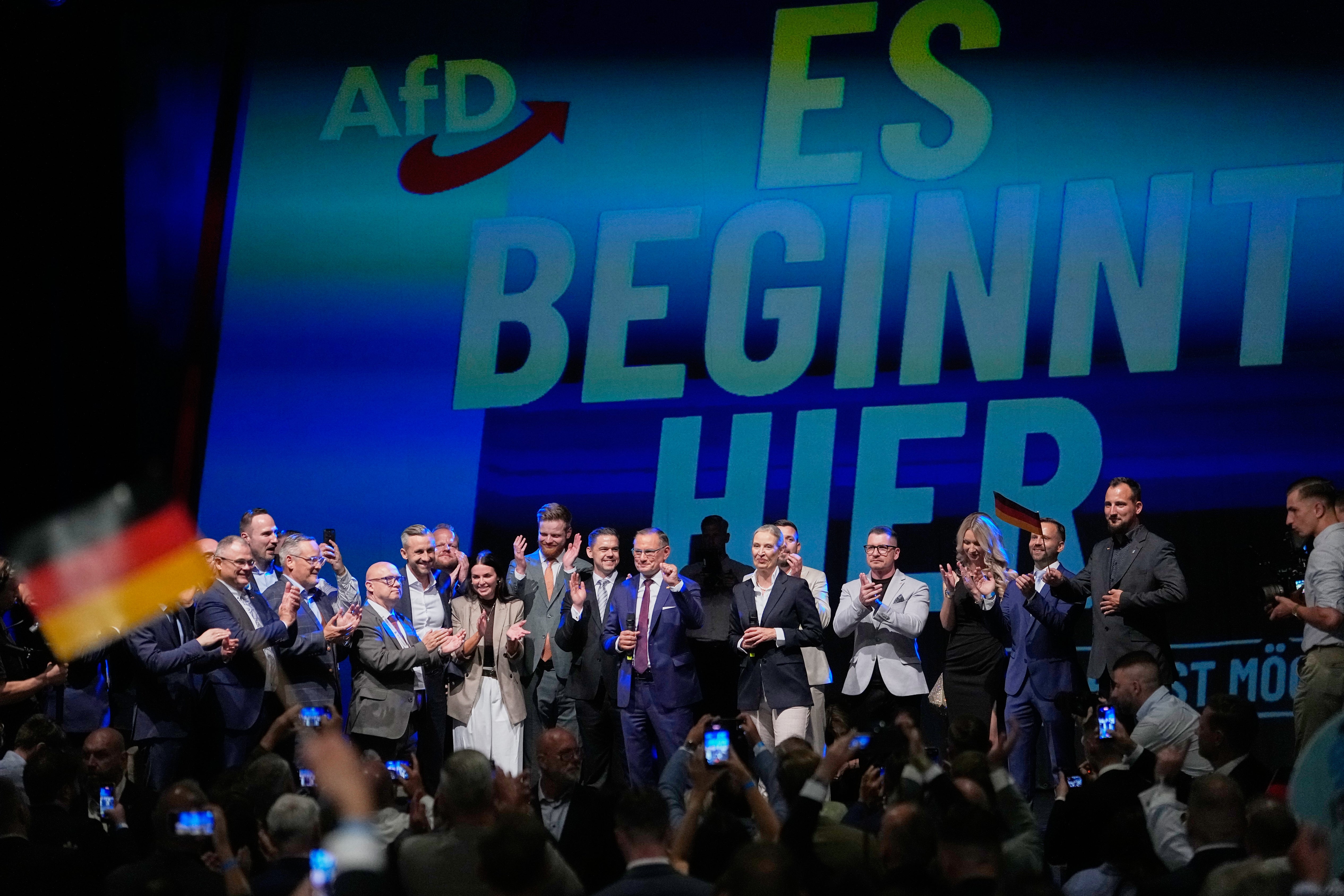 Top candidate Ulrich Siegmund and party leaders Tino Chrupalla and Alice Weidel, speak to party members in front of a reading “it starts here” at an election party of the “Alternative for Germany” (AfD) (AP)
The AfD, led in the state by 35-year-old former fragrance salesman Ulrich Siegmund, won nearly 44 per cent of the vote on Sunday, but fell short of an absolute majority in the state legislature.
It hopes to poach individual conservative lawmakers to be able to govern with a majority, but if several opposition parties manage to patch together an alliance, they could yet be kept out of power.
The Trump administration has become increasingly supportive of the AfD. US vice president JD Vance met with the party’s co-leader Alice Weidel at last year’s Munich Security Conference, and used his 2025 speech to urge German politicians to end the “firewall” against far-right parties. Secretary of state Marco Rubio has described the ‘extremist’ designation by German intelligence as “tyranny in disguise”.
Few have been more supportive of the AfD than the world’s richest man, Elon Musk, who vocally endorsed them and appeared by video link at one of their election rallies ahead of the parliamentary elections in February 2025 and has declared that “only the AfD can save Germany”.
AfD co-leader Alice Weidel met with US vice president JD Vance at last year’s Munich Security Conference, and used his 2025 speech to urge German politicians to end the “firewall” against far-right parties.
.jpg) Members of the Trump administration have been supportive of the AfD (AFP/Getty)
Members of the Trump administration have been supportive of the AfD (AFP/Getty)
But in Europe, the election has caused grave concern about the rise of the far-right in Germany and beyond. Mr Merz has said it will be impossible to return to “business as usual” but that “giving up is not an option”, when asked what it would take for him to step down.
Most other parties in Germany are part of a so-called “firewall”, the principle that they will not form a coalition with the AfD in parliament.
Pedro Sanchez, the socialist prime minister in Spain, told his party that the result proved that the “extremist threat, largely thanks to the surrender of the traditional right, is gaining ground in Europe and in the world”, according to The Guardian.
Poland’s foreign minister Radoslaw Sikorski told Radio Vox FM on Monday the election was a “very worrying sign”.
Meanwhile French finance minister Roland Lescure said German business leaders were “extremely concerned”, adding in an interview with RTL radio station: “This shows that we face a major challenge in the face of a populist wave which is spreading around the world today and which we must resist.”