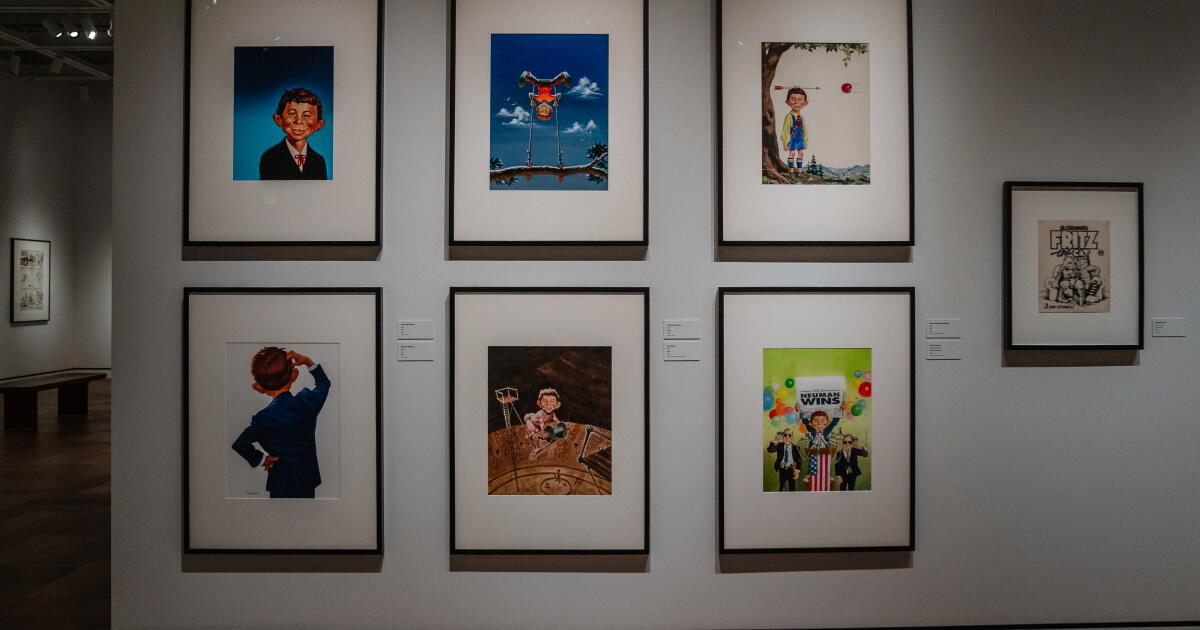
The Lucas Museum of Narrative Art, with an eclectic collection of more than 40,000 works ranging from Frida Kahlo to R. Crumb, is diving headlong into one of the oldest and most fraught conversations in the art world: What belongs in an art museum?
Storytelling is the guiding principle for presenting pieces that include props and costumes from “Star Wars,” manga, graphic novels and comic books, placed alongside established masterworks, traditional paintings and a large-scale photographic reproduction of the Sistine Chapel ceiling. The museum calls it “narrative art,” defined as art “created to tell stories through images.” George Lucas and his wife, Mellody Hobson, have also described their collection as “the people’s art.”
The Lucas Museum is opening as other institutions question traditional art-historical categories. The Los Angeles County Museum of Art’s new David Geffen Galleries organize much of the collection around oceans and the cultural exchanges they enabled, while Tate Modern has long arranged its displays thematically. The Lucas Museum pushes that approach further by making storytelling — not chronology, geography or medium — the organizing principle for an entire institution, placing illustration, comics and commercial art inside a curatorial framework.
Whether that amounts to an art-world revolution is less certain. Narrative painting has always occupied museum walls, and thematic displays are increasingly common. What may be arguably new is treating the audiences for historically marginalized forms of art as central rather than peripheral.

A painting of Eloise, the titular character in a series of children’s books written in the 1950s by Kay Thompson and illustrated by Hilary Knight.
(Ariana Drehsler/For The Times)
“The cracks in the canon began 15 or 20 years ago — the idea that there were many voices excluded in what museums were collecting,” said Lucas Museum board member Laurie Norton Moffatt, who recently retired after 40 years as director and CEO of the Norman Rockwell Museum.
“It really is about that discovery, and there is no hierarchy,” said Lucas Museum CEO Tracey Bates, adding that the museum does not rank one artist above another. Indeed, the museum does not even provide wall text describing the art viewers are seeing, or in what context it matters. Nor does it tell guests where, exactly, in the 100,000 square feet of gallery space they can find particularly celebrated works of art including pieces by Artemisia Gentileschi, Ernie Barnes, Frida Kahlo and Grandma Moses.
Mark Hilbert, whose 10-year-old Hilbert Museum of California Art exhibits California scene paintings, animation and illustration, predicts that the Lucas Museum will “upend the art world” by displaying art that “tells a story.” Hilbert and his late wife, Janet, had a similar motivation in starting their museum: “to present art that strikes to the very deepest chords of who we are as humans” — something he believes Lucas Museum is doing on a much larger scale.
“For too many years, there’s been such a push towards non-objective art,” Hilbert said. “And we’re just rebalancing the scale a little bit more based upon what the population wants,” he said of both museums.
Not everyone sees virtue in collapsing those boundaries. Former Times art critic Christopher Knight argues that much of the imagery the museum collects belongs to a media landscape that no longer exists.
“Mass culture and art culture are different in lots of ways, but the Lucas [Museum] seems determined to collapse those distinctions,” Knight wrote in a recent email. “In the wild wake of the digital revolution, the art culture niche might be struggling, but mass culture is just about dead. The Lucas is where the bones are buried.”

Miniatures are part of the “Star Wars in Motion” exhibition at the Lucas Museum of Narrative Art in Los Angeles.
(Ariana Drehsler/For The Times)
What is narrative art?
According to Ryan Linkof, the museum’s senior curator and head of film programs, Lucas began collecting original comic art as a college student in the 1960s, later expanding into illustration and fine art. Hobson, an established collector in her own right, helped broaden the collection’s representation of Black artists. Lucas declined to be interviewed by The Times, but said in a recent interview with Vogue that “art is emotional, not intellectual,” a philosophy reflected in the museum’s curatorial approach.
Like the Broad, the Norton Simon, Hammer and J. Paul Getty museums, the Lucas Museum is built around a founder’s collection and cultural vision.
“Humans have used images to tell stories, and the stories have shaped the world,” said Linkof. “That’s the core of what this project does.”
Linkof does not present the approach as a sea change in curation. Its more significant departure from established norms, he said, is its sustained attention to illustrators and commercial artists, “who tended to be on the margins of, or even fully ignored by, traditional museums, art museums specifically, and the discipline of art history, which is defined around canons.”

“Take Your Medicine,” left, and “Three Boys Fishing” in the Norman Rockwell gallery at the Lucas Museum of Narrative Art in Los Angeles.
(Ariana Drehsler/For The Times)
The museum, Moffatt said, will allow visitors to encounter familiar images as original works: “They’ve only seen it [them] as reproductions, and it’s completely different when you stand in front of a Rockwell or a Maxfield Parrish, or see the storyboarding and art behind a film.”
Lucas also approaches illustration as integral to his own creative process, Moffatt said. “The ‘Star Wars’ films involved many, many illustrators who were involved in idea creation through imagery.”
Illustration lost critical standing with the rise of abstraction, according to Moffatt and author Leo Braudy, professor emeritus of English and art history at USC.
However, Braudy noted that “narrative art has never been excluded from museums.”
“No one has thrown [Jacques-Louis] David or Caravaggio out just because they’re telling a story,” he said.
Nor does Braudy see an inherent conflict between the kinds of work the Lucas Museum fuses together. “Popular culture … and high culture … aren’t antagonistic to each other. They fit together somehow. They belong to different aspects of the same tradition,” he said.
Museums, he added, are moving away from older categories that may no longer produce the insights they once did.
Lucas board member and LACMA Chief Executive Michael Govan said Lucas has “special insight” into narrative art because “he’s a human being who spent his whole life thinking about telling stories. … He’s truly an expert.”

Kadir Nelson’s “Art Connoisseurs,” 2019, which the Lucas Museum acquired in 2020.
(From Lucas Museum of Narrative Art, Los Angeles; 2019 Kadir Nelson)
With 20 works in the Lucas Museum’s collection, Los Angeles artist Kadir Nelson embodies the overlap between popular visual culture and fine art. His “Stickballers,” depicting children playing stickball, shares a throughline with other artists depicting scenes of everyday life in the collection, including Ernie Barnes.
Nelson said his work focuses on “the hero and the story of the hero,” an approach he sees echoed in Lucas’ films and curatorial strategy.
Such work could enter an encyclopedic museum like LACMA, Govan said, but the Lucas Museum offers a breadth and depth not found elsewhere.
“It really is very different,” Govan said of the Lucas. “And therein lies its power.”
Changing the museum audience
The Lucas Museum hopes comics, “Star Wars” and Banksy will attract people who might not otherwise visit an art museum — and introduce them to overlooked artists, as well as greats including Kahlo and Diego Rivera. (The “Star Wars in Motion” display is just a small part of the offerings by design, occupying only 7% of the museum’s exhibition space, according to Bates.)
USC media scholar Henry Jenkins, co-author of the “Frames of Fandom” book series, said devotees arriving in search of a “Star Wars” museum must be made to feel welcome.
“There needs to be bridge-building for pop culture to be integrated into the museum world,” he said, calling for “on-the-ground community building” through science-fiction programming at the museum, as well as outreach to comic book stores and universities.

Comic artwork hangs at the Lucas Museum of Narrative Art. The museum is planning outreach to attract fans through events at comic book stores.
(Ariana Drehsler/For The Times)
Bates said that work is underway: Comic artists have been invited to previews, and the museum is working on a project involving comic book stores, according to a spokesman.
Former Los Angeles Mayor Eric Garcetti, who helped bring the museum to the city, said its reception among the public may ultimately matter more than acceptance within the art world, where the collection has already drawn skepticism.
“A lot of art snobs [ask], ‘What is a narrative art museum? Is that really a category of art?’ ” Garcetti said. “I’m a small-d democrat, and I think that people will vote with their feet and will embrace this museum as their own.”
Whether the Lucas Museum upends the art world may depend less on whether other museums adopt its philosophy than on whether audiences embrace the connections it attempts to draw. Its curatorial methods may not force a reconsideration of how to rethink a museum, but giving audiences of nontraditional forms of art the weight of an entire institution could prove more consequential.