
In the days after England’s harrowing World Cup defeat by Argentina, Thomas Tuchel felt what he now describes as a beautiful kind of pain. To Tuchel, the agony of that night was real but it had made him feel “alive” to experience football in all its gory glory, raw and visceral, like a perfect punch to the stomach.
Over the following weeks he spoke to other World Cup managers to share emotions of a hazy summer in North America. One revealed how, hours after their team had been knocked out of the tournament, they sat alone in their hotel room wallowing in desolation while players and staff jumped in cars to the nearest airport. “Their biggest pain was actually that it ended with a whistle,” Tuchel said.
So he was grateful that England’s story didn’t end against Argentina. Three days later, England took part in the game no one wanted to play and beat France 6-4 in a wild and frantic bronze match. In doing so they soothed some open wounds. The match was like “therapy”, Tuchel said. “We had this medicine and I think it helped us, and helped me massively to live with it.”
The hurt, he said, is part of the game. “It sounds a bit masochistic but it’s also the beauty of high-level sports. You can’t always win, and it makes you feel alive – not in a very nice way – but you feel that pain of these high-pressure moments … Knockout football in one match can be very, very demanding and brutal.”
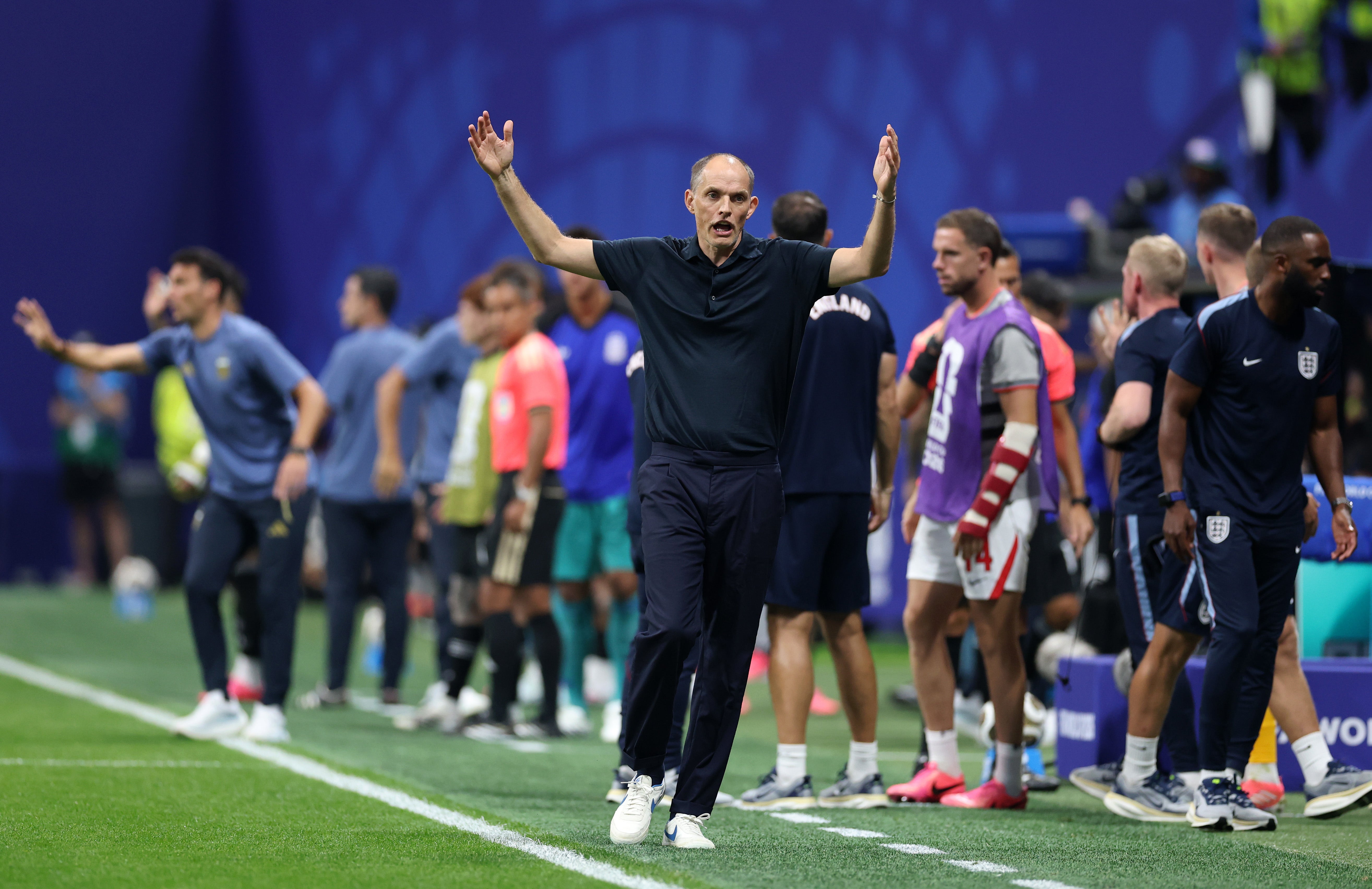 Thomas Tuchel watches on as England are beaten by Argentina (Getty)
The obvious question after an exit as limp and humiliating as England’s was to wonder whether Tuchel was still the right man for the job. Would he learn the lessons of those fateful 30 minutes when England froze and his dream of “a second star on the shirt” disappeared? Can the players still trust him to lead them over the line? Will they still hang on his every word?
In the immediate aftermath of that semi-final, Tuchel was understandably defensive of his controversial substitutions. He even hinted that his tools were to blame, questioning English football “DNA” after the players’ infamous retreat against Argentina.
But this week he struck a more conciliatory tone, acknowledging that a detailed review of England’s World Cup with CEO Mark Bullingham, technical director John McDermott and assistant manager Anthony Barry was a chance to “get better”. Tuchel, who was speaking at Wembley after revealing his 27-man squad for upcoming Nations League games against Croatia, Czechia and world champions Spain, joked that he had been “told off” by FA chiefs for his tactical substitutions.
“We had several reviews, which is a bit unusual because you don’t have the time in club football to do so many. But it’s a part of moving forward, and it’s a part to learn. It’s sometimes painful, sometimes emotional, sometimes beautiful.
“There was a very special moment before the Mexico game where we had a talk, and my bosses told me, ‘We know that anything can happen in a football match, and we know that anything can happen in a match in Mexico in a World Cup match, but don’t worry, we see what’s going on, and we want to continue like this’. This was a beautiful moment for me as a coach, and I felt this kind of freedom to take my choices and to just coach freely.
“There was never a doubt in my mind that we will continue together, and there was obviously never a doubt in their mind. We have critical reviews that will stay, of course, behind closed doors. I am the biggest critic of myself, and reflection is sometimes necessary to get better. Experience is a crucial part of coaching.”
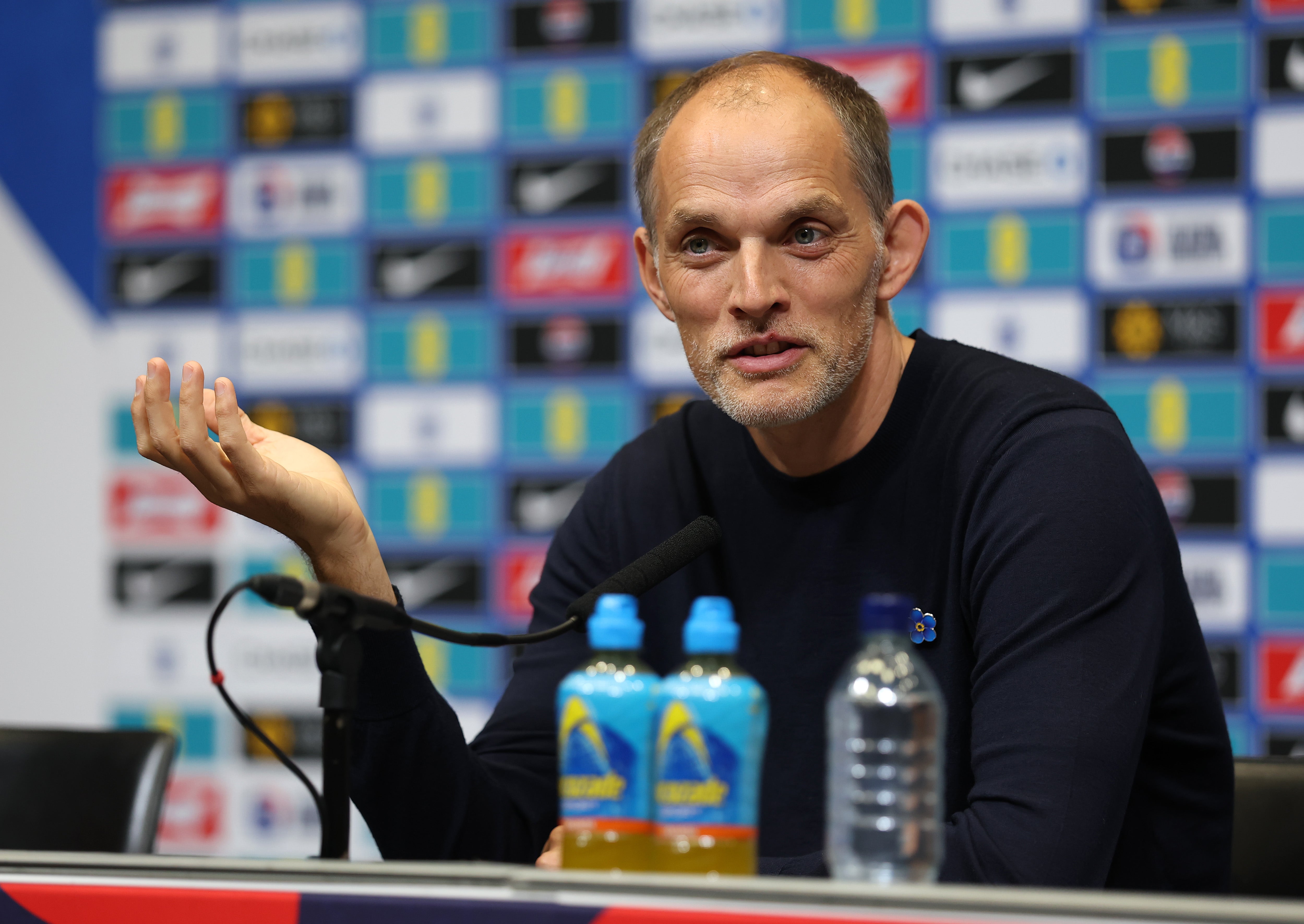 Tuchel speaks to the media at Wembley on Friday (Getty)
Tuchel has ideas to evolve his England side to something with a little more “control”, as they look to Euro 2028 in the UK and Ireland. The final will be played at Wembley and Tuchel has been trusted to lead this hugely talented England squad once more, in what might be their best chance to win a trophy since 1966.
Tuchel wants to remould England to have more stability in possession, an element of the game that frittered away in those disastrous final minutes against Argentina, a tide which neither the players nor the manager could turn. But he also knows he cannot write an entirely new footballing identity. England will inevitably be influenced by the high-tempo “chaos” of the Premier League.
“[Control] would be the wish, that we become for 10 minutes a little bit more like Spain, here and there. But the more I reflect on it, it’s maybe more about buying into our strengths and playing more minutes like we played the second half against Croatia, and more minutes like we played the first half against France, and buying into these strengths because I think we get a lot of value out of it. We get a lot of connection to the fans. This is what the Premier League reflects.
“Seeing football without any control is sometimes hard to digest for a coach, if you look at the 6-4 against France, but people talk about it like it’s one of their nicest experiences ever to watch a football match. So maybe I have to compromise in my urge for control, for a little bit of more chaos – embrace the chaos – and maybe it brings out the best. We will adjust our style, but always to the strengths of the players.”
There was a hint at this evolution with the return of Trent Alexander-Arnold to the England fold. Tuchel, like Gareth Southgate before him, has not previously trusted Alexander-Arnold’s defensive instincts, and it is not as though the defender has been shining for Real Madrid this season. So a surprise recall hints at fresh thinking, with a view to increasing the technical quality to go with England’s energy and physicality.
 Trent Alexander-Arnold is back in the England setup (PA)
The entire squad looks a little more dynamic with Lewis Hall, Jarrad Branthwaite, Rio Ngumoha and Alex Scott added for the four fixtures over the next three weeks, and without Dan Burn, Jordan Henderson and Ivan Toney, even if injuries forced Tuchel’s hand to some extent.
There remains a lingering question about how good this England team really are. They finished third at the World Cup but made heavy weather of a tournament in which they survived scares against DR Congo, Mexico and Norway and rarely played fluently. So perhaps this is where the Nations League serves a purpose, providing serious competition between major tournaments.
Tuchel insists the next two-year cycle began when England beat France in that third-place play-off. Next weekend, Spain come to Wembley, and there is no greater test right now. To win the Euros, England are probably going to have to crack Spain and their “control” game.
“It was a very impressive win [against France], and I think that directs the narrative for what’s coming,” he said. “The next match is now straight away against Spain. We feel the gap is closing, and we feel that we are close, and we want proof of that point. The stadium is sold out. It will be very exciting. Motivation cannot be higher to play against the world champions.”