
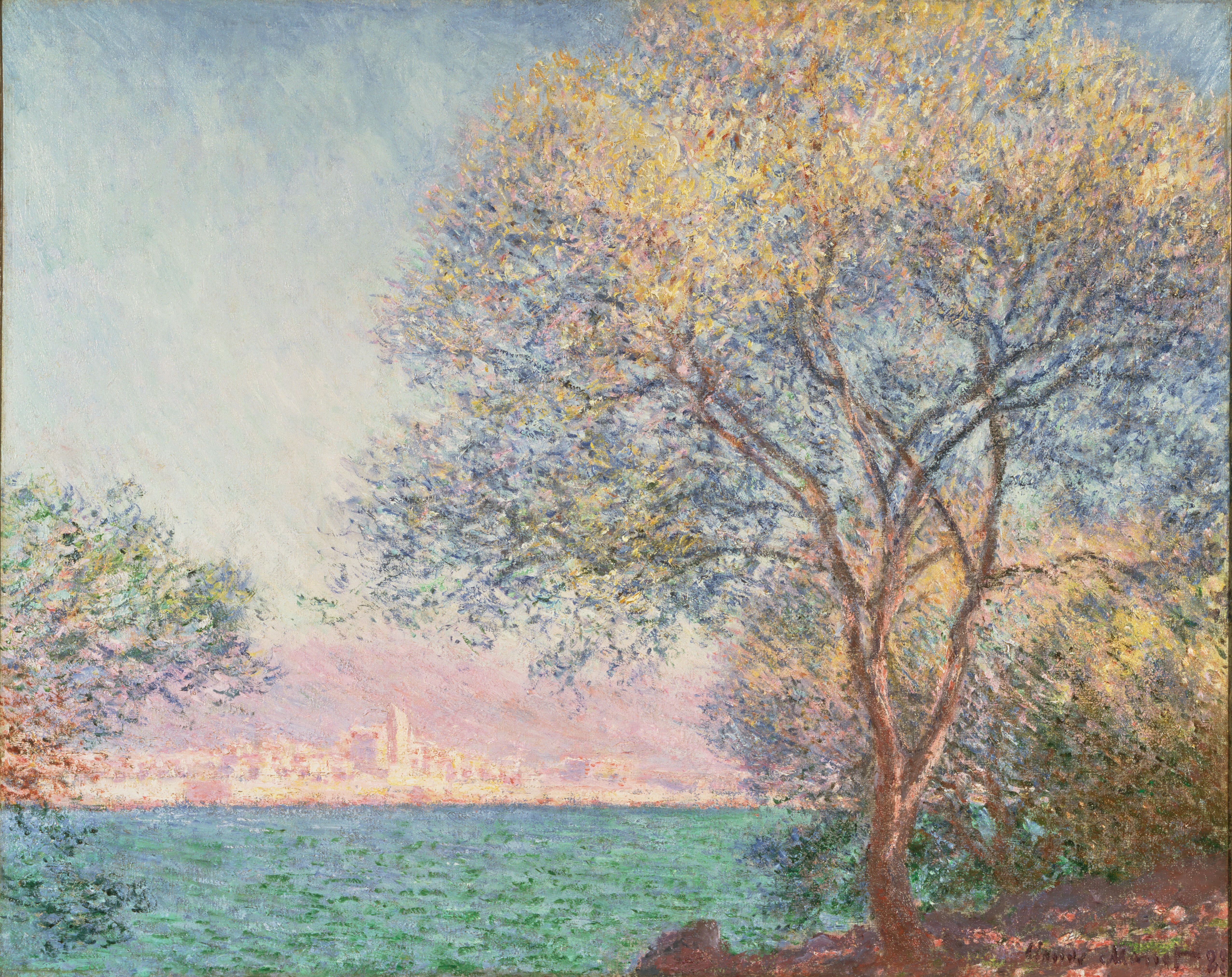
 Claude Monet, Morning at Antibes, 1888. Oil on canvas, 65.7 x 82.1 cm. Philadelphia Museum of Art: Bequest of Charlotte Dorrance Wright, 1978-1-22
With 120 works on show in the Royal Academy of Arts’ new autumn show ‘Painting the French Riviera’, it may seem perverse to start with what colour the walls are, but it’s notable. A deep, unmistakably Mediterranean blue in the first gallery is almost imperceptibly lightened in subsequent rooms as the exhibition progresses, ending on a bright white background in the final space, a room devoted to blue itself, as seen by Yves Klein. It’s both a clever device by exhibition designer Cécile Delos to ensure smaller pieces are not lost in the huge spaces, and a statement of intent: This show is about a kind of light. And that statement is important, because it makes sense of some on-the-face-of-it confounding inclusions and exclusions.
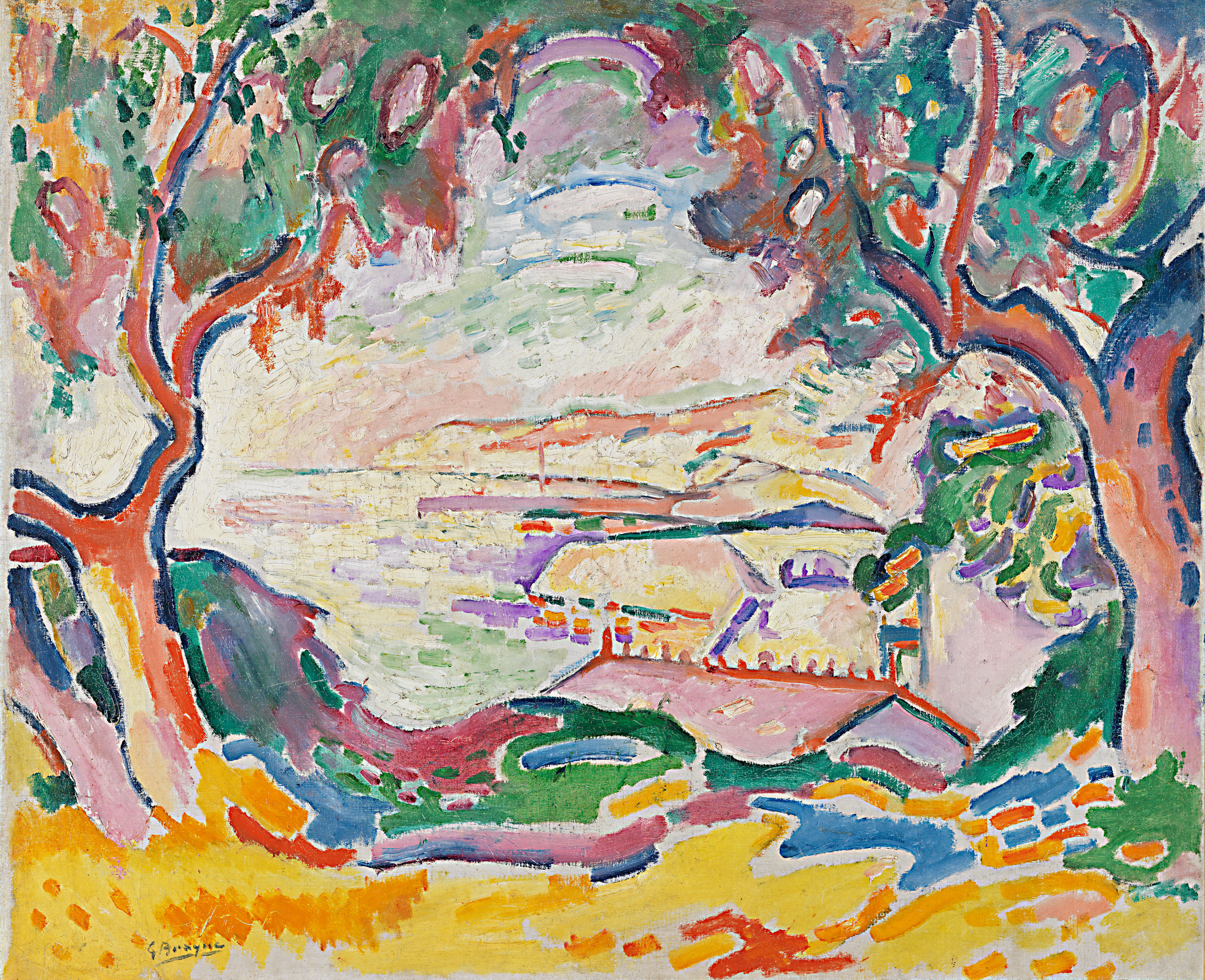 Georges Braque, Seascape, L’Estaque, 1906. Oil on canvas, 59 x 72.4 cm. Museo National Thyssen-Bornemisza; Carmen Thyssen Collection. © 2026 ADAGP, Paris and DACS, London
Painting the French Riviera is not a show that focuses on making a claim for the art historical impact of individual artists; rather, it proposes that the role of a very specific geography, at very specific historical moments, played an outsized impact on the development of art. But with an inexhaustive presentation that chooses to focus on a handful of the most influential artists in each time period, the exclusions must be seen in the light of the exhibition’s own very specific geography and very specific historical moment. Because a choice has been made to pull focus from the very lively politics of the era examined in favour of something more restful, this is not a show that seeks to contextualise the work of lovers of home comforts such as Cézanne and Matisse within the political and social context of the time. In ‘Painting the French Riviera’, L’Estaque, for example, is always a haven for artists, never the working, migrant-labour industrial village, and later refuge for Spanish Republicans that it was. And this is, perhaps, a decision driven by compassion for the exhibition’s audiences.
In Albert Camus’ conception of la pensée de midi (Mediterranean Thought), nature, beauty, and the present moment are paramount – a way to think less in absolutes, to allow the brilliant light to limit the impact of history on today. One reading of his work holds that Mediterranean thinking is shaped by a geography that reminds us that humans are ineluctably part of a physical world that includes the sun and the sea, which exist outside of human politics. The Mediterranean landscape is, in this way, conceived as a tangible respite from difficult thoughts and realities, and one view of the intentions of co-curators Ann Dumas of the RA and Heather Lemonedes Brown of the Cleveland Museum of Art would be that the focus on brilliant light, luscious landscapes and softly curved bodies set in the bluest of blues and a simplified political reading of the history of art in the region is a generous act of Mediterranean Thought.
 Pierre Bonnard, The Gate of the Villa du Bosquet in Le Cannet, 1944. Oil on canvas, 61.6 x 49.8 cm. Loan courtesy of the Muskegon Museum of Art, Gift of the L.C. and Margaret Walker Foundation
Certainly, to be immersed in the rich, tangled green and gold of Monet’s gardens in Bordighera and Antibes, Cézanne’s verdant, sparkling inlets, or the dappled shade of Renoir’s palm tree is to understand the arcadian pull of the region almost viscerally. The relief of these artists, fleeing conscription, war, pain, or creative exhaustion, imbued the work they made and, in doing so, reframed a landscape that had until then been seen as mostly appealing to the crazy English, and then only in winter. This palpable delight became the bedrock of a view of a stretch of coastline that calcified over time into a kind of unchanging nostalgia, despite depending largely on industrial, social and creative innovations to exist at all.
From the advent of the Paris-Lyon-Méditerranée (PLM) railway bringing artists and an ever more fashionable, often royal, clientele to the coast, to the invention of synthetic ultramarine and viridian, industrial innovations created the possibility for creativity. Key parts of the French Riviera itself only became French in the mid 19th century when the Kingdom of Sardinia ceded Nice to France, while the positioning of the region as luxurious owes much to Monaco’s need for funds driving its rebranding as an upscale gambling resort after losing its historic tax bases of Menton and Roquebrune. The conditions in fact combined to create a perfect, comfortable base on which to continue to fabulate a soothing, restorative vision of la France profonde by the sea. And it is this nostalgic vision that ‘Painting the French Riviera’ presents.
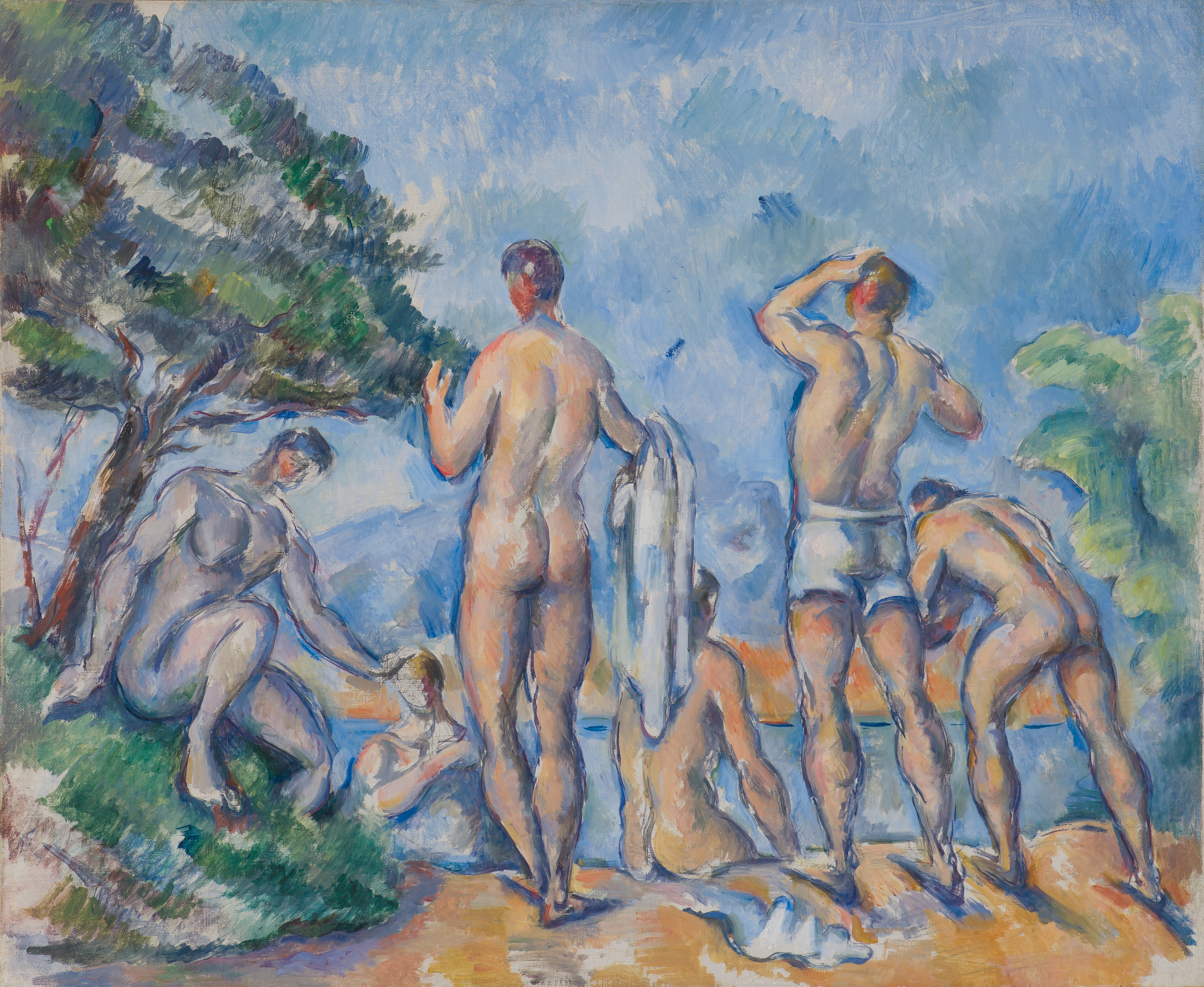 Paul Cézanne, Bathers, 1890-92. Oil on canvas, 54.3 x 66 cm. Saint Louis Art Museum, Funds given by Mrs. Mark C. Steinberg
A focused selection of works tracks significant creative developments through pieces by artists working in the region, with a heavyweight line-up including Cézanne, Matisse, Renoir, Morisot, Monet, Signac, Seurat, Bonnard, Picasso, Braque, Picabia, Dufy, Chagall, de Staël, Soutine and Klein. Each creates that sense of relief, respite and delight that was, after all, their original selling point, and to visit the exhibition is to put aside today’s ceaseless horrors for a moment and enjoy the visceral joy of the glimmers of light on water framed in soft blooms.
It might be felt that the exhibition loses some focus where it strays into filmmaking, travel posters and literature; however, for some visitors, this too will be a generous act – a way into a feeling that they may not achieve through painting alone.
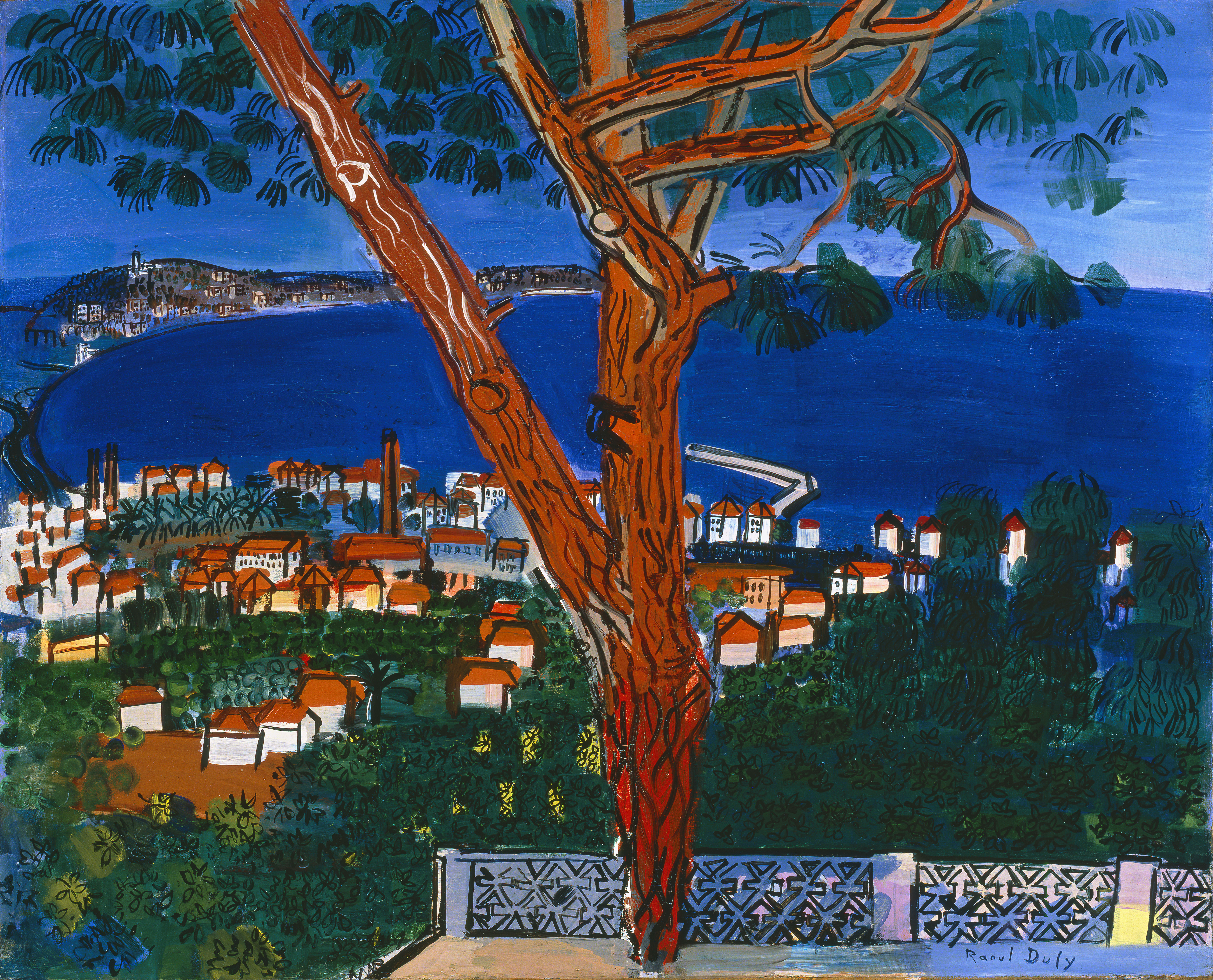 Raoul Dufy, Golfe Juan, 1927. Oil on canvas, mounted on board, 81.8 x 100.6 cm. Collection of the McNay Art Museum, Bequest of Marion Koogler McNay, 1950.38
This is, in the end, a show made possible by an historic meeting of innovations within a purely Mediterranean context and in choosing to show only aesthetic innovation, it weakens its own premise. For Albert Camus, the power of the Mediterranean in shaping thought is twofold; its brilliant light means that we may not be fully constrained by history, but that same sun shines on poverty and need. The idea that despite the light, not all is well is a nuanced view that Camus saw as a path to a compassionate, universally human way of being. The luxe, calme et volupté of the nostalgia on show at Painting the French Riviera is successful in giving us the escape – but in missing social and political context, falls short of its own subject matter.
 Henri Matisse, Interior at Nice (Room at Beau-Rivage), 1917-1918. Oil on canvas, 73.7 x 60.3 cm. Philadelphia Museum of Art; A. E. Gallatin Collection, 1952-61-79
Painting the French Riviera, 2nd October 2026 – Sunday 31st January 2027, Royal Academy of Arts
Admission from £24; concessions available; under 16s go free (T&Cs apply); Friends of the RA go free. 25 & Under: 16 to 25 year olds can access a half-price ticket (T&Cs apply). Advance booking with pre-booked timed tickets is recommended for everyone, including Friends of the RA. Tickets can be booked in advance online (royalacademy.org.uk) or over the phone (0207 300 8090).
CategoriesTags