

The Mayor of London, Sadiq Khan, has today published a new report and map to help show where 4G and 5G mobile (mobile broadband) networks are falling short. In addition, the mayor proposes ten “practical steps” via a new framework that boroughs can take to support improvements.
Despite plenty of progress being made to improve mobile coverage in recent years (e.g. 4G and 5G deployments across the London Underground), some Londoners still experience weak signals and slow or unreliable mobile data connections. Demand for mobile data continues to grow, and even where coverage is available, the report finds that busy networks can still “struggle to deliver the performance people need“.
NOTE: The report offers broad overview of mobile coverage and performance in London, yet it doesn’t appear to split these results down by EE, O2 and VodafoneThree (Vodafone and Three UK), which is disappointing as some operators will be stronger in certain areas than others. Understanding that difference would show who needs to make improvements and where.
The London Mobile Connectivity Evidence Report, developed with support from Ookla (RootMetrics), looks beyond traditional coverage measures to also assess mobile broadband download speed, upload speed, signal strength and latency — the time it takes a network to respond. This provides a more complete picture of Londoners’ experience of mobile services and helps identify where improvements are needed.
The supporting London Mobile Connectivity Map also helps residents to see the different levels of signal strength and mobile broadband performance for where they live, albeit again without enabling you to split the results by operator. In addition, it doesn’t extend down to street or premises level, which in a city is kind of important.
Key Findings
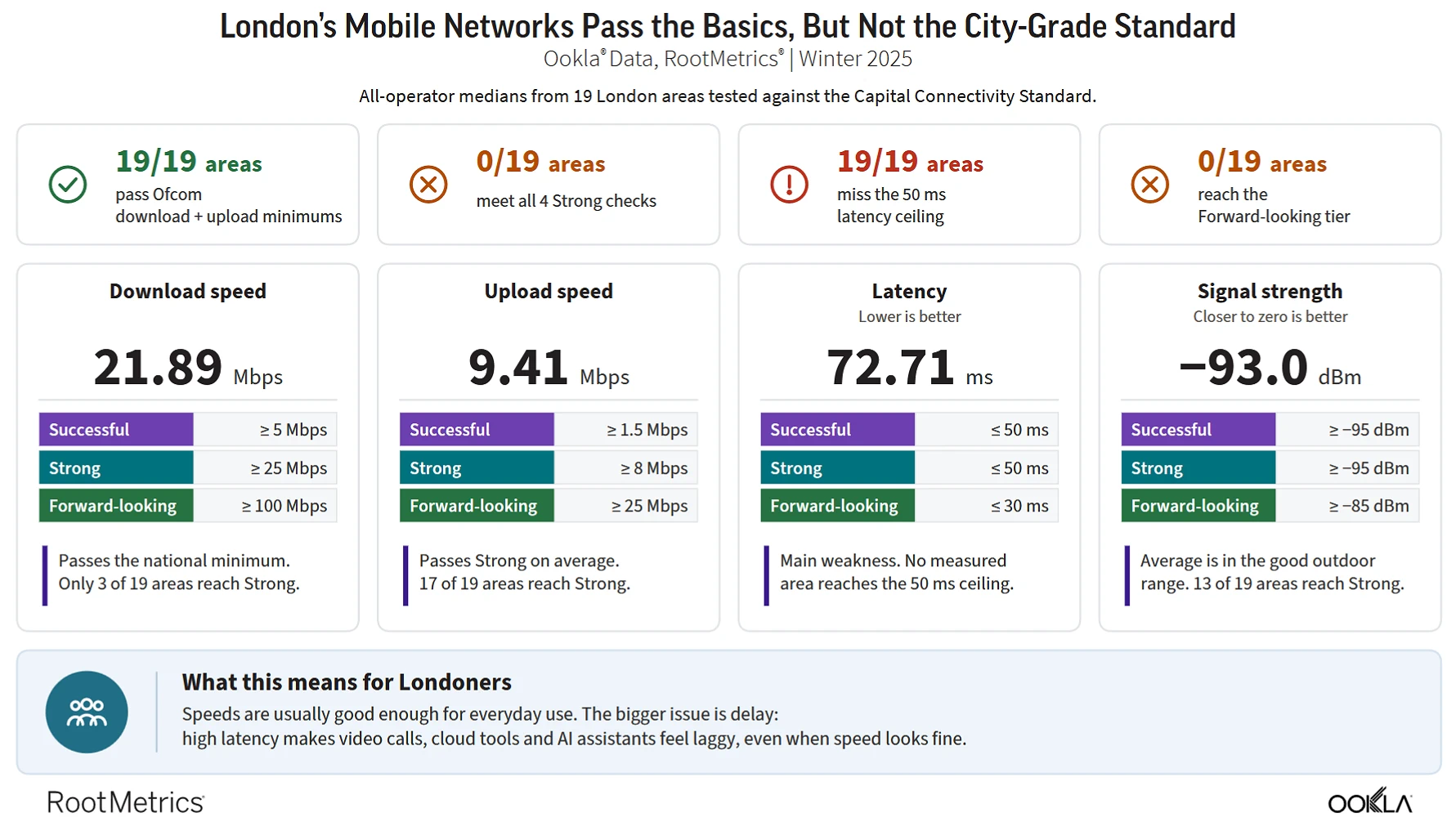
1. London passes Ofcom’s minimum standard on speed in every area we tested, but no area yet passes all four Strong checks. Fleet Street and Cheapside come closest, passing three of four (failing only on latency, where every area in London falls short). Twelve more areas pass two of four. Dalston, and Eversholt Street/Somers Town, fail all four. No area in London yet meets the Forward-looking tier.
2. Network response times (latency) are too high across the city. Latency is the time it takes for your phone to send data and get a response. It was above Ofcom’s 50-millisecond target in all 19 areas. Latency is what makes the difference between a smooth video call, a responsive online game or a natural conversation with an artificial intelligence assistant, and a frustrating, lagging experience. This is a London-wide issue, not a problem with any one network.
3. The quality of your mobile experience depends on which network you use and where you use it. No single network is best everywhere. In some areas one network performs strongly while another lags; a few miles away the picture can reverse. This report does not recommend any particular operator. It highlights that performance varies sharply by location, and that this variation is shaped by infrastructure decisions that the city, planning authorities and operators jointly influence.
4. There is a ‘doughnut hole’ of weak performance in inner north and east London. Most measured areas in Camden, Islington, Hackney and Tower Hamlets sit at or below the Strong signal threshold. By contrast, every area in the City of London, Kensington and Chelsea, Newham, Lambeth, and Hammersmith and Fulham passes (with Leadenhall Market sitting at the boundary). This pattern points to a concentrated cross-borough planning and infrastructure challenge.
5. 5G is widely available but unevenly deployed. Nearly 90 per cent of our tests detected 5G. Where 5G is available, speeds are 4 to 9 times faster than the older 4G technology. But areas such as Brick Lane, Dalston and Eversholt Street have weak or absent 5G coverage, and customers on networks with patchy 5G are systematically worse off in those locations.
Take note that mobile operators are commercial companies and thus responsible for investing in, building and running their own networks. The Mayor does not directly control their network coverage or investment decisions, but can help address barriers to improvements through planning policy, access to TfL assets and coordination between boroughs, landowners, developers and industry.
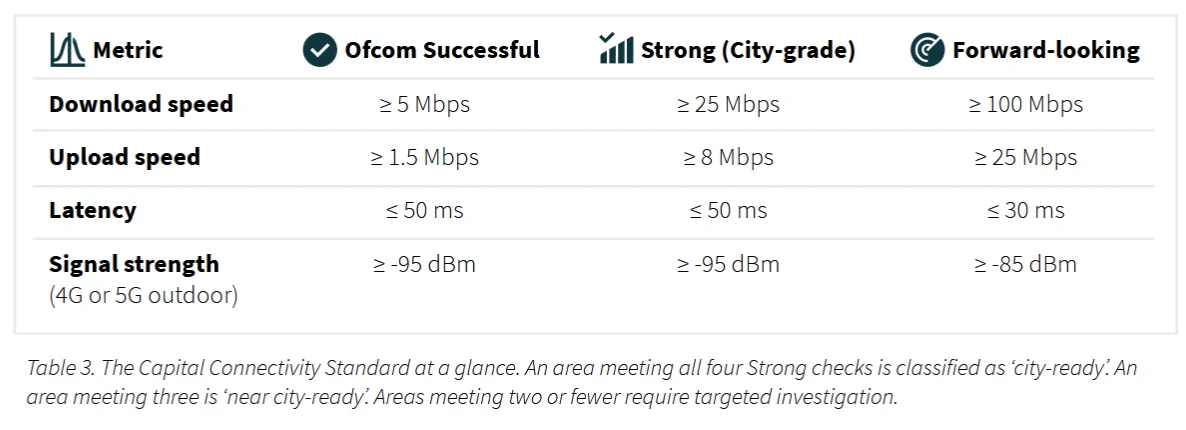
Speaking of which, the report also introduces the Capital Connectivity Standard, a new benchmark designed to assess whether mobile performance meets the needs of a busy global city. It builds on Ofcom’s existing ‘Successful’ baseline to provide a more demanding measure of connectivity and helps partners identify where further action is needed.
The Mayor of London, Sadiq Khan, said:
“Reliable mobile signal is essential to everyday life in London, whether you’re working, running a business or keeping in touch with family and friends. Although huge progress has been made, many Londoners still experience frustrating gaps in service.
This new evidence and map will help us understand where improvements are needed and work with boroughs and mobile operators to deliver better connectivity, building a fairer and more prosperous London for everyone.”
The new London Mobile Connectivity Framework that accompanies all this sets out ten practical actions boroughs can take to support improvements. These include appointing a dedicated mobile connectivity officer, identifying council-owned buildings and land that could host mobile network equipment, and ensuring plans for major developments consider mobile connectivity from the outset.
The 10 actions at a glance
Leadership
1. Appoint a mobile connectivity lead
2. Collaborate across teams
Planning, assets and infrastructure
3. Create an asset register
4. Review telecoms planning performance
5. Establish regular operator engagement
Planning and growth
6. Assess developments through a connectivity lens
7. Streamline access to rooftop assets
8. Review infrastructure at risk of displacement
9. Include connectivity in growth and regeneration programmes
Monitoring and improvement
10. Report on performance annually
The catch is that this is all advisory and turning such things into tangible practical improvements is rarely an easy task. For example, both O2 and Vodafone have recently been complaining about bad “planning measures“ in the city, such as those that force them to take 4G and 5G network sites offline (masts and other cell sites) – at the request of property owners – without first ensuring an appropriate replacement location (here and here).
However, the flip side of this is that mobile operators can hardly expect to hold much sway over major property developments, particularly when they’re often paying only relatively small rental sums to the landowners. Mobile infrastructure isn’t installed in a vacuum and planning authorities also have to consider public opinion, visual impact, safety and other factors etc. Not to mention the arguably bigger challenge of delays caused by under-resourced planning departments.
So while a lot of the Mayor’s proposed actions are positive, actually changing the core aspects of the planning system that they involve frequently ends up being fraught with difficulty. As usual there are no coverage targets being set here or new public funding being proposed, although identifying what sort of performance Londoners should expect from their mobile operator is a good start.