
Van Rysel has updated its RCR-R aero/lightweight bike, which it launched in 2024. Decathlon’s performance bike brand says the update is the outcome of two and a half years of development, resulting in an improved mix of aerodynamics, low weight and stable descending.
At a claimed 705g for a size M frame, Van Rysel says that the new RCR-R Pro is the lightest frame it has ever developed.
It’s aiming high with the new bike, with Van Rysel race product manager Jérémie Debeuf saying, ‘The new RCR-R brings Van Rysel’s ambition to fruition – to design the world’s highest-performing equipment with the aim of securing victory at the Tour de France.’
That project has started well, with Paul Seixas winning Il Lombardia on the new bike last month, become the race’s youngest ever winner in the process. ‘
The bike is lighter, more aerodynamic and, above all, more stable on descents,’ Debeuf says. ‘When you’re travelling at over 100kmh, confidence in your kit is paramount.’
Co-developed with Decathlon CMA CGM pro team
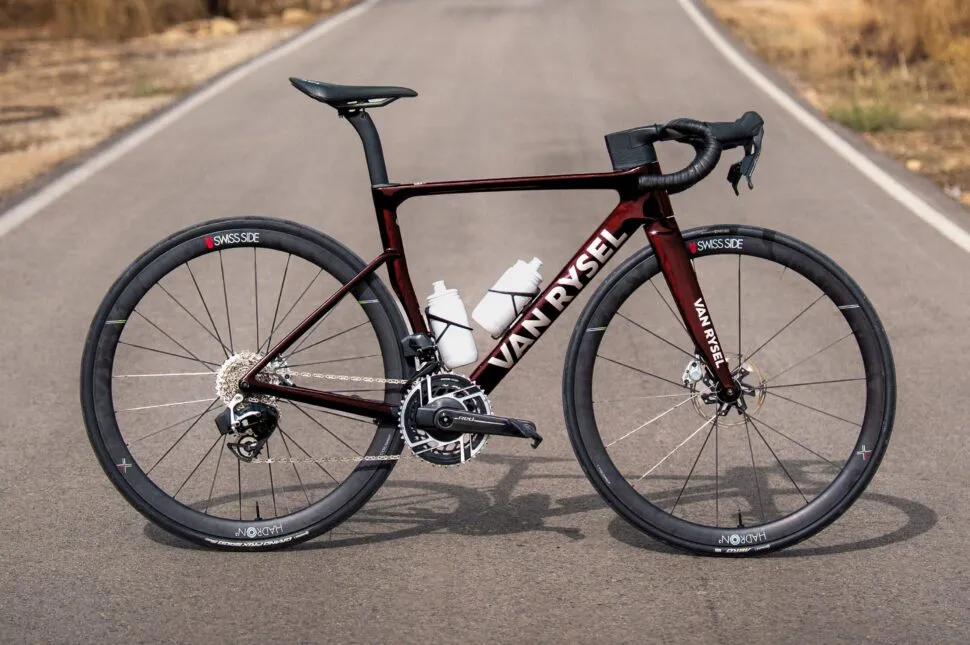
Van Rysel says it used computational fluid dynamics (CFD) to develop 13 prototypes for the new bike, of which five were wind-tunnel-tested. The main changes from the first generation RCR-R appear to be concentrated at the front end, with a deeper head tube and fork legs, which would mirror the changes typically seen in other recent bike updates, such as the S-Works Tarmac SL9.
Van Rysel has also designed a new aero bottle cage, claiming it can save as much as 6.3 watts at 45kmh, with further details to follow.
The Decathlon CMA CGM pro riders rode the new bike in races and high altitude training in the Spanish Sierra Nevada, helping Van Rysel’s product development team to refine the final design.
According to Decathlon CMA CGM pro Nicolas Prodhomme, ‘There’s a real improvement in terms of lightness and aerodynamics, but it’s the bike’s overall handling that impresses me most. The bike is responsive when you need to accelerate, whilst offering stability, particularly on fast, technical descents.’
Two frame grades, each in four specs
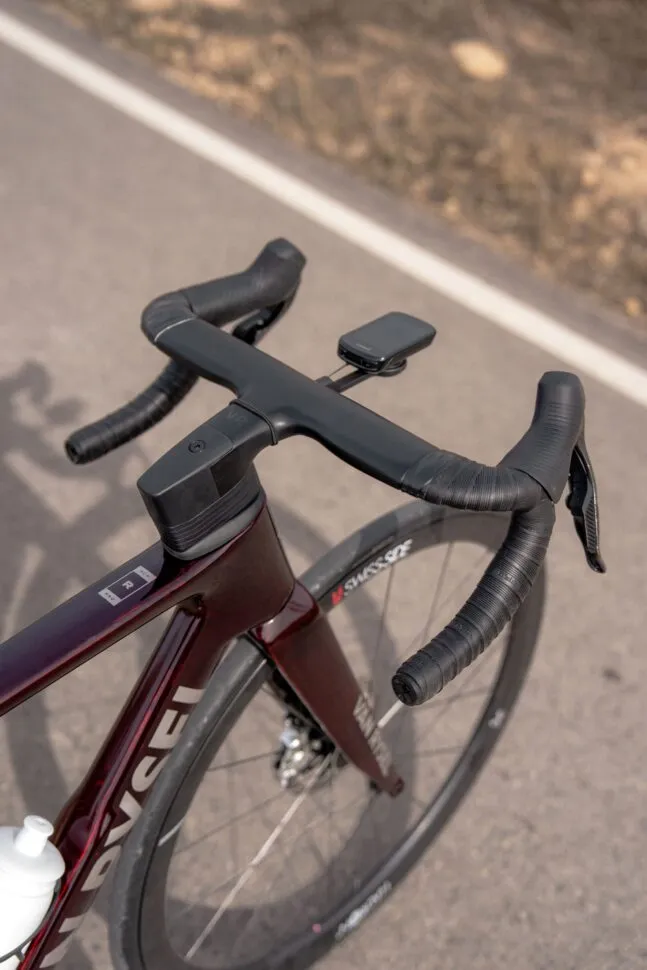
As with the first generation bike, the top specs of the new RCR-R will be available with the premium Pro frameset, which is made of what Van Rysel describes as ‘a combination of super-high modulus and high-modulus carbon fibre’.
It claims a 705g frame weight in size M for the RCR-R Pro, with a 360g fork weight – a reduction from the claimed 790g frame and 380g fork of the first generation bike.
The RCR-R Pro will be available with SRAM Red, with a 6.6kg claimed weight, Shimano Dura-Ace, with a 6.9kg weight, and SRAM Force AXS and Shimano Ultegra, both with a 7.1kg claimed weight.
The lower priced non-Pro frameset has a claimed 883g frame weight in size M and is fitted with the same 360g fork as the RCR-R Pro.
Van Rysel will sell the standard RCR-R with SRAM Force AXS, with a 7.5kg claimed weight, Shimano Ultegra (claimed weight 7.4kg), Shimano 105 Di2 (claimed weight 7.8kg) and SRAM Rival AXS (claimed weight 7.9kg).
Euro prices range from €3,299 (approx £2,760) to €8,499 (approx £7,100), with prices in other currencies to follow. That top-spec pricetag is a little lower than the €9,000 price for the flagship RCR-R Pro when it was launched in 2024. The new RCR-R and RCR-R Pro will be available to buy from January 2027 across Europe, the UK and North and South America.
Over the past few seasons, Decathlon’s pro riders have generally chosen to ride the RCR-F Pro aero bike over the previous generation lightweight/allrounder RCR-R Pro, so it will be interesting to see if they now change allegiances to the updated RCR-R Pro.