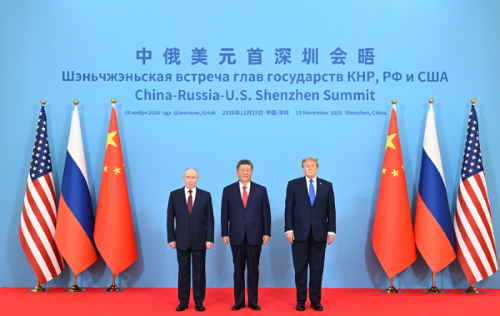
At Yalta in February 1945, three leaders discussed the future of Poland. No Pole sat at the table. In Shenzhen on 19 November 2026, the presidents of China, the United States and Russia issued a declaration on peace. Ukraine went unmentioned. For Vladimir Putin, that omission was almost as valuable as the invitation. He stood alongside Xi Jinping and Donald Trump as one of the men entrusted with preserving international peace, and the declaration asked nothing of him about the war he began.
When Franklin Roosevelt, Winston Churchill and Joseph Stalin met at Yalta, Nazi Germany had yet to surrender. The Allies had urgent decisions to make about the occupation of Germany and the future of Europe. For Poland, whose invasion had brought Britain into the war, the stakes were painfully clear. The three powers agreed on the broad course of its eastern frontier, envisaged a government of national unity and promised free elections. The Red Army was already on Polish soil. Stalin had the means to decide what those promises would be worth.
Defending the agreement in the House of Commons on 27 February 1945, Churchill asked a question more enduring than his defence of the settlement itself. “Are they to be masters in their own house?” He was speaking of the Poles. Ukrainians have every reason to ask the same question today.
No Ukrainian frontier was redrawn at Shenzhen. The three presidents agreed to pursue talks on reducing nuclear risks, a worthwhile undertaking in its own right. Yet each went home with something different. Xi established China as the host to whom both Washington and Moscow would come. Trump could tell Americans he had brought two nuclear rivals to the same table. Putin secured perhaps the most valuable prize. After years of European efforts to isolate him over the invasion of Ukraine, the American and Chinese presidents publicly received him as a peer. Moscow can point to that photograph long after the wording of the declaration is forgotten.
Ukraine stands to lose the most. Ukrainians have buried their dead, seen their towns destroyed and raised children far from home. Now they must reckon with the prospect that Moscow will invoke Shenzhen as a precedent for settling questions of war and peace directly with Washington and Beijing. Only Ukrainians can decide what terms they can accept. They will be the first to discover whether a security guarantee is worth the paper it is written on.
Europe comes next. By the end of June 2026, EU institutions and member states had allocated €85.7 billion in military support to Ukraine alone. Europeans have also welcomed Ukrainian families and helped keep the Ukrainian state functioning. Their solidarity deserves respect. Their taxpayers deserve an answer. Having committed so much to Ukraine’s defence, what guarantees are European governments prepared to honour when the fighting ends, and who has the authority to negotiate on their behalf?
There was another table. In Berlin, President Volodymyr Zelenskyy met American envoys and more than 40 European leaders. Trump joined by telephone after the Shenzhen talks. The contrast between those two gatherings exposes Europe’s failure of leadership. Europe can bring dozens of leaders into one room, yet it still looks to the American president, even by telephone from the other side of the world, to give a discussion of European security its political weight.
As Türkiye’s former chief negotiator with the European Union, I believe Europe could have become a far more influential power had it drawn fully on three countries outside the Union. Türkiye brings its position on the Black Sea and the ability to speak to both Kyiv and Moscow. The United Kingdom brings a nuclear deterrent, a permanent seat on the UN Security Council and a longstanding defence relationship with Ukraine. Norway brings the energy supplies that give European governments room to withstand Russian pressure. Britain chose to leave the EU, Norwegians chose to remain outside it, and Türkiye pursued membership only to see its negotiations stall. None of those histories prevents Brussels, Ankara, London and Oslo from shaping a common European peace proposal today.
Mustafa Kemal Atatürk gave Turkish diplomacy its enduring motto, “Yurtta sulh, cihanda sulh” — peace at home, peace abroad. It has guided our Foreign Ministry and the Republic’s foreign policy across generations. President Recep Tayyip Erdoğan’s efforts for global peace gave that principle practical expression in Istanbul in 2022. Working with UN Secretary-General António Guterres and keeping channels open to both Kyiv and Moscow, he helped broker the Black Sea Grain Initiative. Ukrainian ports could again ship grain to world markets. For families thousands of miles from the fighting, the value of that diplomacy could be measured in the price of bread.
Europe’s ability to shape peace also faces a test closer to Brussels. During my recent visit to Thessaloniki, I was struck by how much that city’s name should still mean to the Western Balkans. It was there in 2003 that EU leaders affirmed the region’s European future. More than two decades later, a young Bosnian born that year is old enough to ask what became of the promise. Peace in the Balkans remains vulnerable. Bosnia and Herzegovina’s difficult constitutional balance and the unresolved relationship between Belgrade and Pristina should disabuse anyone of the idea that time alone will deliver reconciliation. Every Balkan country still outside the Union deserves a credible path to full membership. Each should advance on its own merits, and each should be able to trust that meeting the conditions will open the door. Europe’s own peace project will remain unfinished until it embraces the whole region.
At Yalta, Churchill had a chair and Poland had a promise. Europe should remember which proved more valuable. If Europeans are absent from the table when the terms of their security are decided, they could find themselves on the menu. European leadership can begin with a practical act: sit down with Ukraine, Türkiye, Britain and Norway, agree on the guarantees each is prepared to honour, and take that offer to the other powers together. That would give Europe something worth bringing to the table. It would also leave the answer to Churchill’s question where it belongs, in Ukrainian hands.

Egemen Bağış, PhD
Egemen Bağış, PhD, is a Turkish diplomat and former Minister for EU Affairs and Chief Negotiator of Türkiye. He previously served as a member of the Turkish Parliament and as Türkiye’s ambassador to the Czech Republic.