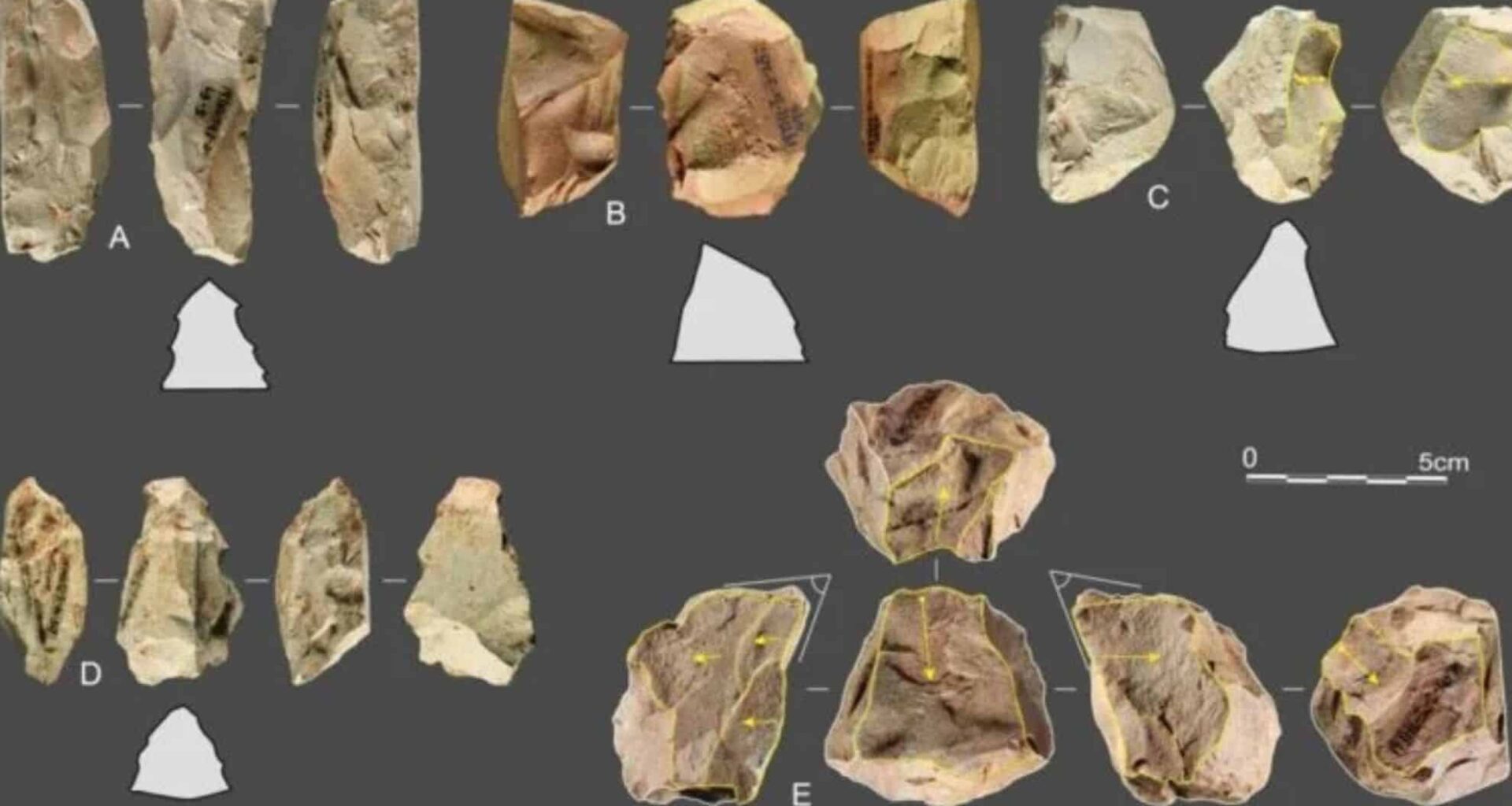
A groundbreaking study published in the Proceedings of the National Academy of Sciences has revealed the discovery of 50,000-year-old tools at Longtan, a site in southwest China. These tools, linked to the Quina technological system, were previously thought to have been exclusive to Europe. This new evidence raises important questions about human migration, innovation, and evolution, suggesting that East Asia’s Middle Paleolithic period may have been far more dynamic than previously believed. The study opens up fresh discussions on the potential connections between Denisovans, Neanderthals, and other ancient human ancestors, pushing the boundaries of our understanding of early human history.
A New View on East Asia’s Paleolithic Era
The discovery of these Quina tools is a major shift in how researchers view the Middle Paleolithic in East Asia. This period was once thought to be relatively stagnant, especially compared to the rapidly advancing cultures in Europe and Africa. However, the findings from Longtan have opened new doors for understanding early human development in this region.
Ben Marwick, a co-author of the study and professor of archaeology at the University of Washington, emphasized the significance of this discovery, saying: “This is a big upset to the way we think about that part of the world in that period of time. It really raises the question of, what else were people doing during this period that we haven’t found yet? How is this going to change how we think about people and human evolution in this area?”
A Surprising Connection to Europe
The Quina tools found in China have been linked to those used in Europe around the same period, suggesting that human migration or cultural exchange might have been more widespread than previously thought. The tools, characterized by asymmetrical scrapers, were likely used for tasks like scraping and shaping materials such as bones and wood.
“We can try to see if they were doing something similar beforehand that Quina seemed to evolve out of,” Marwick said. “Then we might say that development seems to be more local — they were experimenting with different forms in previous generations, and they finally perfected it. Alternatively, if Quina appears without any sign of experimentation, that suggests this was transmitted from another group.”
Reassessing the Role of East Asia
For many years, researchers have adhered to the view that East Asia remained relatively isolated and unchanging during the Middle Paleolithic. However, this discovery challenges that idea. As Marwick explained: “The idea that nothing has changed for such a long time in East Asia also has a tight grip on people. They haven’t been considering the possibility of finding things that challenge that. Now maybe there are some scholars who are interested in questioning those ideas.”
Searching for Human Remains
While these tools open new possibilities for understanding early human culture, researchers are also eager to find human remains that could provide further answers. “That could answer the question of whether these tools are the product of a modern human like you and me,” Marwick said. “There have never been any Neanderthals found in East Asia, but could we find a Neanderthal? Or, more likely, could we find a Denisovan, which is another kind of human ancestor? If we can find the human remains associated with this period, we might find something surprising — maybe even a new human ancestor that we don’t know about yet.”