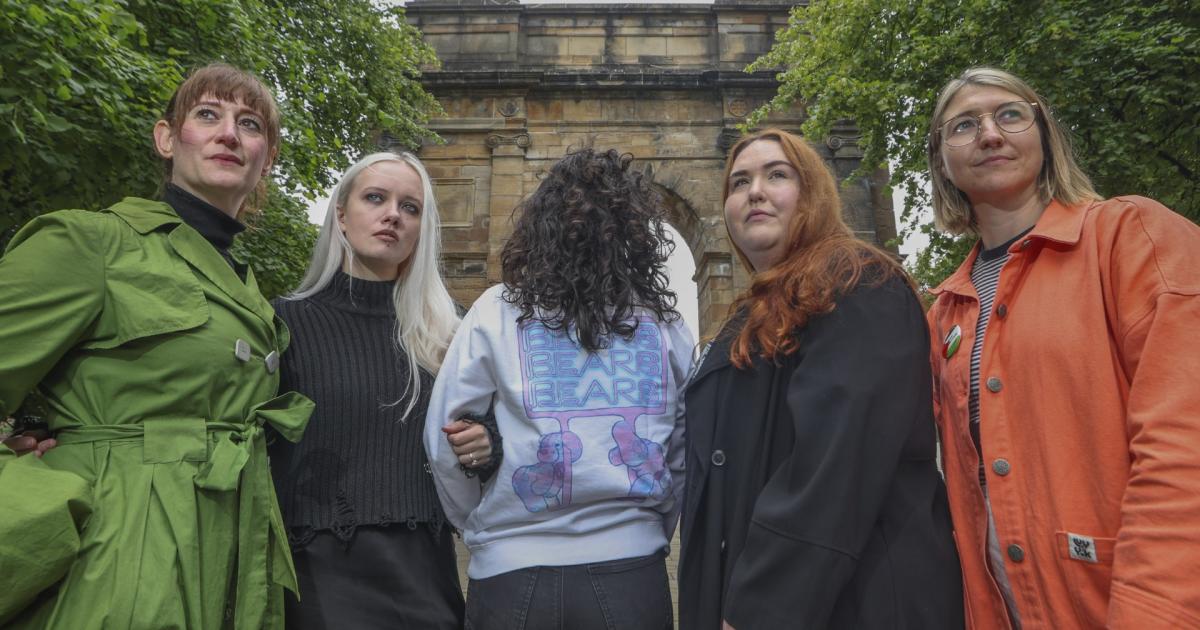
Listening to Emma is a group of other sex workers, all part of the organisation Scotland For Decrim. They want sex work decriminalised and are campaigning against proposed Holyrood legislation to introduce what’s called the “Nordic model”, which makes it an offence to pay for sex.
Sex workers like Emma and the others believe this would put their lives at risk. Criminalising “clients” would drive them underground, making life more dangerous. They’d become poorer and find it far harder to quit sex work.
If the Nordic model had been in place when Emma was in her 20s, she would have been unable to flee the dangers of her family home.
“I wasn’t able to access help for women experiencing abuse at home. The women’s sector – especially charities for women suffering violence – is on its knees. I had to rely on sex work to get the money to get out,” she says.
As Emma explains how dangerous the situation was, her voice breaks and her eyes fill with tears. “If sex work hadn’t been an option. I wouldn’t have been able to leave and I’m not sure I’d be alive today.”
A wave of emotion overcomes her. Amelia, Nina, Lynsey and Cid immediately offer her support, saying how much they love her, how courageous she is, and how important it is that she’s shared this story.
Demonstrators during a vigil outside the Scottish Parliament in Edinburgh organised by sex worker-led charity Scot-Pep to mark International Day to End Violence Against Women (Image: Jane Barlow) Cid says: “Thank you, Emma, for showing people that sex workers are human beings.”
The Herald on Sunday has been invited to meet with the sex workers who run Scotland For Decrim in order to get an understanding of their lives. Laura Baillie, the organisation’s political officer, is also here. She’s a university academic, who studies decriminalisation.
The truth about sex work is far more complicated and nuanced, the group says, than the public imagines. They feel demonised, and forced on to the margins of society. If society really cared about vulnerable women, they say, politicians would tackle poverty, the cost of childcare, low wages, high rents and the pervasive culture of misogyny.
Each of them is “feminist to the core”. The group finds it “intolerable” that “middle-class feminists” – and many men – think they have the right to decide what’s best for them.
“Nobody asks sex workers what they want,” says Laura, “yet it’s only sex workers who know what they need.”
Scotland For Decrim has members across the country, as well as supporters who are academics, charity workers and trade unionists. It was launched to counter efforts to introduce the Nordic model, and to campaign for decriminalisation.
Dangers
THE Nordic model presents real dangers, they believe. Women who work on the street will be under increased risk. As the Nordic model criminalises men who buy sex, “customers” fearful of arrest will seek to meet women in dark, secluded areas, increasing danger.
Women will have less time to assess if men are dangerous.
“Many will have to rush to get into a man’s car,” Laura explains.
Men who don’t want to harm women will stay away, they say, while men who plan to hurt women won’t be deterred and will find it easier to commit violence.
Women working in places like saunas will have to either move on to the street or into other underground locations – again heightening danger.
Under the Nordic model, sex workers increasingly go to men’s homes rather than places where they feel safe like hotels or their own premises, where they have safeguards like door cameras. Women who work in their own homes will also be at heightened risk under the Nordic model.
It may surprise the public, the group explains, but most escorts run security checks on clients who come to their homes. They ask for deposits before meetings, which allows them to see names on bank transfers, and often ask for ID. That deters men who might want to hurt them, and ensures that if they are attacked then the man can be traced.
These are limited protections, but they are protections nonetheless, the group says. Women working in their own homes would become targets for police surveillance under the Nordic model, as officers would seek to arrest their customers.
The group notes with grim irony that when the Alba MSP Ash Regan, who is behind the Nordic model bill, was asked about the risks of driving sex work “underground”, she appeared to take the term literally.
She was quoted as saying: “There is no basis for any of those assertions. If you even think for one second, you cannot possibly drive prostitution underground. If you had a lot of women in underground cellars with a locked door, how would the punters get to them?”
Emma says that when she read Regan’s comments, she thought: “Are you f*****g kidding me?”
Laura adds: “It shows her complete lack of understanding. She shouldn’t be speaking about something she has so little understanding of, let alone trying to pass legislation that affects people’s lives.”
Decriminalisation is the safest model, sex workers believe. “It means no sex work that’s consensual is criminalised,” says Amelia, who is 29 and works as a dominatrix.Amelia worked in hospitality, until bullying and sexual harassment by bosses shattered her mental health.
Brothels
DECRIMINALISATION brings greater protection, the groups says. Under the current system, soliciting is illegal. It’s also illegal for two women to work together, which is often done for protection. If two or more women work together they can be charged with brothel-keeping.
The Nordic model vastly undermines the “methods of safety” used by sex workers, particularly those on the street. Sex workers are safer when they can take time assessing men. Under the Nordic model, men will want to complete “negotiations” almost immediately for fear of arrest.
Nina says: “If they’ve just minutes before clients drive off, then it’s more likely they’ll get into the car straight away because they need the money. Whereas if there’s a safe zone [under decriminalisation], sex workers can take time chatting to clients and figuring out if it feels safe. Their colleagues can also check licence plates and note that down.”
Nina is educated to Masters level, but could only find low-wage jobs. Escorting allowed her to buy her own home, she says.
Cid says decriminalisation would begin to remove “stigma” from sex workers. She became a sex worker because “poverty prevailed”. Today she’s also a harm-reduction worker.
Sex workers are seen as “deviant and immoral” rather than women who simply need money, Cid adds. “We’re dehumanised. Sex workers have lives, we have families. Someone you love might be a sex worker.”
The title of the proposed bill offends the group. It’s called the Prostitution (Offences and Support) (Scotland) Bill. Sex workers reject the term “prostitute”. It stops them from being seen as “workers” like the rest of society, and keeps them marginalised and demonised.
Documentation accompanying the Bill claims sex workers are not “whole human beings”. The group says this is profoundly dehumanising and anti-feminist.
“How does this help women who are sex workers?” Laura asks. “How does this help women who want to leave sex work? It’s astonishing.”
Among the group, Lynsey Walton is the only member who has been a sex worker and is happy for her identity to be used. She’s “retired”, and now runs the organisation National Ugly Mugs. It began as a support group warning sex workers about dangerous clients – the “ugly mugs”.
Today, it offers a range of services from therapy and exiting sex work to housing and financial advice.It has thousands of members.
Lyndsey worked in corporate HR while she was a sex worker. Her sole aim is to “end violence against sex workers”. The Nordic model isn’t the way to achieve that, she says. “Only decriminalisation means increased safety. It means folks can screen clients more carefully, they can work together for safety.
“It boggles my mind that the advice we give our daughters when they go out at night – stick together – is the very thing sex workers can’t do.”
Violence
THERE has been increased violence against sex workers in countries where the Nordic model operates. Introduced in Northern Ireland, researchers for the Justice Department found that “assaults against sex workers have increased by 225%”.
Around 10% of sex work is on the street, the group says. Cid said: “The Nordic model is promoted as progressive but it exacerbates harm.” The media ignores these facts, “which just highlights our erasure”.
The “narrative” about sex work is “driven by elites”, Cid says, mostly powerful politicians who can shape the story the media tells. “It’s another mechanism of control,” Cid adds.
If sex workers aren’t being portrayed as “deviant” then they’re seen as too weak and stupid to know what’s best for them, the group says. “We’re never consulted about our own lives,” says Amelia.
Sex workers who call for decriminalisation and oppose the Nordic Model – which is nearly all sex workers, the group explains – are accused of “falling for the myth of the good client”.
The group finds that deeply patronising and insulting.
“Why don’t these people sit down and speak to us about clients?” Amelia asks. “Why don’t we actually discuss what sex work is like, so laws can be passed which are valuable to us?
“People are deciding what’s best for me, without asking me. They aren’t my parent. I’m not going on the naughty step. My view is there should be nothing about us, without us. But, unfortunately, that’s not the route being taken.
“That’s why they’re getting this so wrong. We’re being infantilised. People are telling us what we need when nobody has asked us what we want.”
Laura adds: “The simple fact is that the Nordic model deters clients who are safe, while the most dangerous, violent and abusive clients remain unaffected.”
Similar to the proposed Scottish Bill, the Irish Republic introduced the Nordic model claiming no more women would be arrested. However, says Laura, women are still being arrested. Migrant women were jailed for brothel-keeping because they worked together for safety. Two years after the introduction of the Nordic model in Ireland, only one man had been convicted for buying sex.
“It’s a common misconception to think that the Nordic model means women won’t be arrested. It’s not true,” Laura explains.
Under the Nordic model, a sex worker’s partner faces arrest for living off the earnings of prostitution. Landlords would face brothel-keeping charges. The group says this risks women being made homeless and having to work on the street rather than in their own premises.
“Landlord don’t want labelled as pimps,” says Laura. “There’s such a lack of factual information as well as so much misinformation out there around the Nordic model.”
The legalisation model, used in Germany, isn’t supported by sex workers either. It gives government too much control over sex workers’ lives in ways that other workers don’t experience.
Read more
Pimps
FOR instance, sex workers must carry what’s called a “whore’s passport”, which is “obviously stigmatising”. They must pay the state to work – effectively making the government a “pimp”, the group says.
Under the legalisation model many women remain reluctant to tell the state they are sex workers. Migrant women are unable to get official documents and so must work underground, putting themselves at risk. Women who don’t register cannot report violence as they would face prosecution for illegal sex work.
Lynsey says registration costs for a “whore’s passport” means that the most desperate women are forced into illegality. Some women turn to sex work to feed their children. In such dire circumstances, there’s neither time nor money to apply for official documentation.
“People think legalisation is a good thing, but it’s not,” she adds.
The sex workers say legalisation puts women under the spotlight of police as they must continually prove their status. Sex workers universally fear police. There have been cases of officers mistreating sex workers and even subjecting them to sexual abuse, the group explains.
“Police are the last people we’d trust – just look at Wayne Couzens and the murder of Sarah Everard,” Emma adds.
The group says that even as “privileged sex workers” – privileged in the sense that they work indoors independently – they fear the Nordic model.
Amelia adds: “If we’re scared, what about brothel workers and street workers?”
Nina fears police “starting to watch my flat” if the Nordic model is introduced “to see who goes in and out”. That would provide officers the intelligence needed to “arrest my clients. That will lead to my clients getting more edgy and more anxious”.
There is a risk that women who work indoors are driven outdoors under the Nordic model, Laura explains. Men may fear coming to flats where they might be under surveillance, meaning indoor work dries up and women must risk the street to earn money.
Men will stop giving ID or deposits, says Nina, which she requires from new clients. It’s difficult enough to run these security checks, she explains, as men fear blackmail or discovery by partners.
“Now, if someone doesn’t want to pay deposits, I’m like ‘okay, go find somebody else’. But under the Nordic model, clients would be even more hesitant – especially the clients I consider good and decent. The dangerous ones won’t care if they break the law.”
Amelia says that clients who “want to arrive do the booking and go – who won’t bother you, stalk you, harass you – they’ll stop seeing sex workers. But the clients who were going to hurt you in the first place, they won’t care if it’s criminal to see sex workers as they were committed to harming you anyway”.
Under the Nordic model, a Swedish sex worker, the group claims, was arrested because she lived with her partner and was accused of brothel-keeping. She was arrested in front of guests, with her children at home, and outed.
“It’s not true that under the Nordic model only men are arrested,” Nina says.
Ash Regan wants to change the law (Image: Staff)
Police
IF Sex workers are assaulted in their own home under the Nordic model and then go to the police, they face their property being placed under surveillance by officers who want to arrest clients.
“So how can you go to police?” Amelia asks.
Couple this with the fact that men would refuse to provide ID or deposits which identify them and the threat to women increases.
“If you criminalise my client and he won’t give me details about himself and he then comes into my home and assaults me, what do I tell police?” Amelia says.
“I don’t have his name, his phone number, I don’t know anything about him. How is this law going to keep us safe when we’ve no protection if we’re assaulted at work?
“The current model is atrocious, but at least under it I feel more comfortable getting details from clients. I’d love to take the people who propose the Nordic model through the booking process so they can see the reality of our lives.”
The group says the Nordic model will damage sex workers financially. Men will pay less due to the risk of arrest, and there will be fewer clients. That will, in turn, make women rely more on sex work and have to take more clients.
Nina says: “Let me assure you that I’m fine. I want to be here. Nobody else is profiting off this. I’m truly independent.”
Some of her clients are already getting jumpy and “really worried about the changes in the law that might happen”. She recently arranged to meet one client in London to spend the night at a hotel.
“He was really nervous that he was doing something wrong and could get in trouble with police.”
The group explained that some sex workers, particularly those with disabilities, hire assistants to help run their business. Assistants would be criminalised under the Nordic model.
“It puts people in a worse position. If decriminalisation existed we could work the way we want,” said Cid.
Women who want to “exit” sex work will be forced to continue working longer under the Nordic model, the group says, as the new law will make earning enough money to quit much harder.
Amelia says: “I want to say to those pushing this law: if you want less sex workers, then start with universal basic income, affordable childcare, higher minimum wage, rent caps, affordable housing, decent benefits, and better mental health services. Why don’t you go to the root causes of why people consider this job?
“It’s failures by government that women who don’t want to do sex work end up in sex work. It’s an embarrassment to this country. I want to make clear that the first people who don’t want others to consider this job are us – the people with lived experience.”
The group is outraged that organisations like theirs were referred to as “pro-prostitution” in documentation related to the proposed new legislation.
Amelia says: “I’ve never promoted this job. I constantly talk about the realities.”
Laura adds: “We’re not pro-prostitution, we’re pro-decriminalisation.”
They are also angered by Ash Regan referring to opponents as “the pimp lobby”.
Read more by Neil Mackay
HIV
LAURA adds that there will be additional pressure on women not to use condoms under the Nordic model. Dangerous men often try to coerce women – especially street workers – into unprotected sex. Due to reductions in the number of clients under the Nordic model, women could find themselves with no option but to go hungry or put themselves at risk of HIV.
Police also use condoms as criminal evidence.
“Across the board,” says Laura, “the Nordic model reduces safety and increases health problems.”
As Scotland For Decrim’s political officer, Laura intends giving evidence before Parliament on the Nordic model.
“Nobody is going to shut us out or shut us up,” she explains. “MSPs have an amazing amount of power but little accountability. I want to make sure they’re accountable for their actions.”
The group believes that despite claims to the contrary, the Nordic model won’t remove existing cautions for prostitution from police records. These cautions prevent women quitting sex work as employers won’t hire them if they check their past.
Prostitution cautions effectively remain on record for life. One woman was refused employment who hadn’t even been cautioned. She discovered she’d been listed as an escort after reporting a crime.
“That was her only interaction with police,” Lynsey said. “You’re branded for life.”
Siobhian Brown, Scottish Government Minister for Victims and Community Safety, wrote to the criminal justice committee this week saying she had “significant and deep concerns about the quashing of previous convictions as set out in the Bill.
The quashing of convictions is exceptional… That is not a step that can be taken lightly and would require significant stakeholder engagement”.
Quashing wrongful convictions related to the Post Office scandal cost £804,000 for 200 people in Scotland, the letter noted.
“Since 1982, 10,459 women have been convicted under the soliciting offence,” it reads.
The group explains that driving sex work underground will prevent women seeking healthcare and other services in case they’re flagged to police for monitoring.
Amelia is aware that much of what the group has shared will shock the public “because they’ve never heard the truth before. That’s on purpose. We’re silenced”. When they write to MSPs, they get “copy-and-pasted responses. Nobody wants to bother with us. So nobody has a clue about what’s happening to sex workers”.
Cid adds: “Everything people say will benefit us about the Nordic model will actually do the opposite. This is gaslighting in plain sight.” Even the term – Nordic model – gives a false impression, she says, due to its connotations with liberalism. “People need to understand that what’s being pushed is detrimental and damaging. It further perpetrates the marginalisation of already vulnerable people. I cannot understand why decriminalisation isn’t on the agenda.”
Laura says many women’s organisations support decriminalisation but are scared to speak out “for fear of losing funding”.
Amnesty International, along with other prominent international NGOs, backs decriminalisation.
Rape
AMNESTY says the Nordic model “compromises sex workers’ safety and leaves them vulnerable to abuse; they can still be pursued by police whose aim is often to eradicate sex work… Sex workers have to take more risks to protect buyers from detection… Sex work is still highly stigmatised under the Nordic model and contributes to the discrimination and marginalisation of sex workers”.
The group notes that the Nordic model proposals in Scotland refers to sex work as “rape”. If that’s the case, they ask, why is the maximum penalty for buying sex only £10,000 in fines and/or six-to-12 months in prison.
“Is rape only worth £10,000?” Laura asks.
“The penalties don’t hold up to scrutiny if it’s really believed that this is rape.”
As a group, they make clear that they aren’t victims of rape as they have all freely chosen sex work. The group feels that those pushing the Nordic model have no idea about the lives of women on the margins of society.
“They may think what they’re doing is right, but they’re only seeing this from their perspective: women who will never have to make the decision to do sex work or feed their family,” says Laura.
The group says there’s nothing “feminist” about the Nordic model. “It’s anti-feminist,” says Laura. “It increases oppression on women.”
She describes it as “middle-class feminism”, and “not any form of feminism which I recognise”.
Cid calls it a “patriarchal witch-hunt” which makes the most marginalised women “scapegoats. Under the guise of feminism, it further punishes those already disadvantaged”.
Lyndsey adds: “This type of feminism isn’t evidence-based, it’s about how they feel. It’s a morality debate. It’s just another form of control.”
Nina says the Nordic model couldn’t be considered feminist. “It’s not a case of finding out what’s best for sex workers,” she says.
“They’ve made up their minds. It’s condescending towards us. They’re acting like our parents and not listening. It’s offensive. They don’t know what’s best for me. If feels like there’s ‘cleansing’ going on. It’s a weird, puritanical movement that’s just moralistic about sex.”
The group sees the push for the Nordic model as part of the “post-Trump” rightwards “anti-woman” trend in politics. They note how, in the 2010s, the conversation about sex work was directed toward decriminalisation. They all fear being caught up in the culture war which they predict will break out over the Nordic model.
“Why are we even talking about morality when we should be talking about people choosing sex work because of the cost of living crisis?” Amelia asks.
Nina replies: “It’s a distraction technique. It’s easier to talk about sex workers than solving the housing crisis. If you’re passionate about preventing people getting into sex work, fight for anti-poverty measures.”
The group says any claim that the Nordic model will tackle trafficking is fallacious. Trafficking is already illegal. Claiming the Nordic model will end trafficking is “disinformation”, they say.
None of the arguments stand up, they claim. “To say it’s feminist is completely false,” Amelia adds.
As the group brings the conversation to an end, they share stories about their experiences which make the realities of sex work clear. It can be frightening and dangerous, but it’s their choice. They’ve no desire to see others become sex workers but nor do they want to be deprived of the ability to earn a living safely as they chose.
It’s Emma who closes the conversation, telling how she had to turn to sex work to finance the escape from her abusive family.“If the Nordic model had been on the statute books, I literally might not have got out of that house alive,” she explains.