When Triple Crown winner Secretariat stopped racing in 1973, he retired to a stud farm in Kentucky, where he spent the next 16 years in equine ease, siring 663 foals and maintaining his playful personality to the end.
But what of other thoroughbreds, those bred for the track who don’t have successful careers? The ones who suffer injury or illness? Few controls are in place to manage their treatment. In the worst case, they might be sold to abattoirs in Canada or Mexico, to be slaughtered and consumed as a delicacy in Europe or Asia.
And then there’s Peppy, a stately steed taking a nap in the sun in Berryville, Virginia. This gelding, officially named The Pepsodent Show, was bred for the track, his sire and dam chosen for speed. But because of an injury, his career ended before it began.
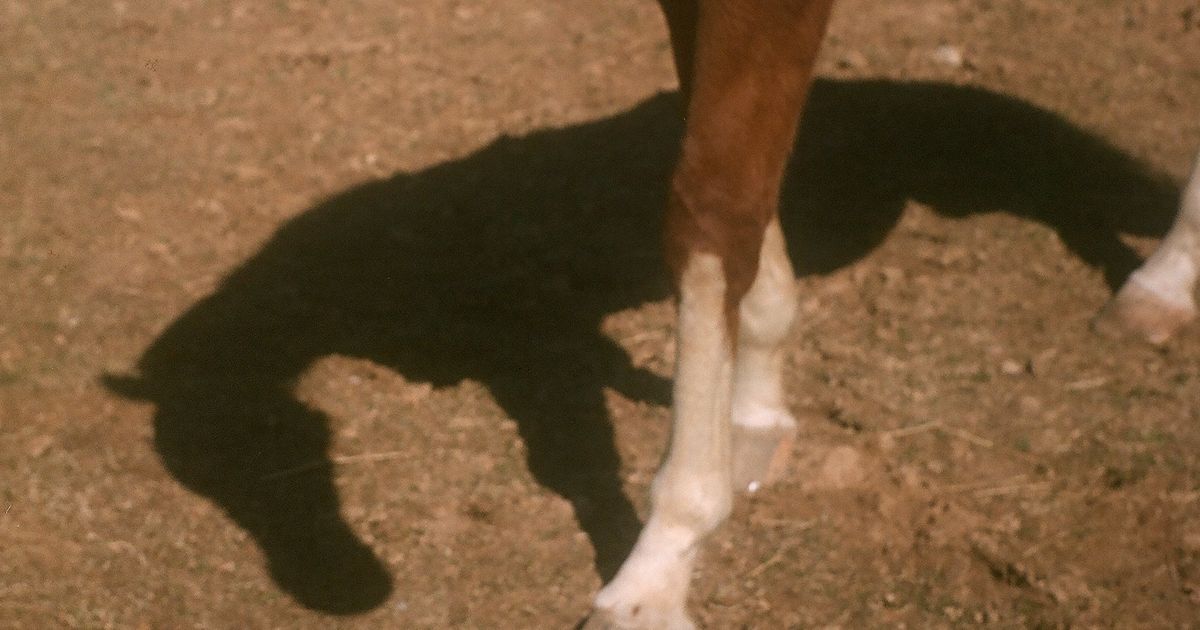
I went to meet Peppy on a sunny day in March, hoping to learn more about a thoroughbred’s life once racing is no longer an option. Peppy approached me curiously but languidly. At 5 years old, he’s somewhere between an adolescent and young adult in horse years. Peppy is chestnut, the horse equivalent of a redhead, with what we in the horse world call “chrome” – or plenty of white markings.
Peppy breathed gently into my hair. But he quickly lost interest in me when Chelsey O’Brien joined me in the pasture. O’Brien, a horse trainer and seasoned equestrian, welcomed Peppy to her farm to offer him a second career. She is supported financially by Pastured Place, a nonprofit specializing in thoroughbred aftercare that owns Peppy and pays for his monthly upkeep as well as entry fees for horse shows. Peppy’s affection for O’Brien is undeniable.
Though he never competed, Peppy was in active race training. He had five recorded workouts and was nearing his first start when he fractured his sesamoid in August 2023. The sesamoids are small but vital bones that allow a horse’s hoof and fetlock (similar to a human’s ankle) to move properly. This type of injury can be catastrophic, but Peppy was given the time needed to heal, with no expense spared by his owners, and made a full recovery with clearance to move on to another career.
The possibilities are many, from working cattle on a ranch out West to running rodeo games with kids in 4-H to becoming a schoolmaster who serves as a mount for students. O’Brien plans to exhibit Peppy’s potential in October at the Thoroughbred Makeover, a competition designed by the Retired Racehorse Project to showcase the trainability and versatility of offtrack thoroughbreds. After the makeover, Peppy will be available for adoption.
O’Brien and Pastured Place give their charges time to figure out how to be horses again. Peppy, for instance, was originally named for his high (or high-strung) energy level, which could’ve made him a hard sell to adopters. But after coming to Pastured Place’s partner farm, Meadow Spring, he was given time to get through his jitters and relax with other horses. At O’Brien’s farm, he is being allowed to further unwind; he takes daily hay-pile naps, falling asleep while being groomed. His calm personality is so endearing that I briefly considered whether I could afford him myself (not unless my math is willfully bad).
O’Brien and Pastured Place take the horses for what they are, not for what they were. And O’Brien does more than that: She asks them what they want to be. She lets them try disciplines, and not just the classic options of jumping or dressage. She asks them (by trying and gauging attitude and aptitude) if they want their rider in Western or English tack, within a fenced arena or out in an open field. Horses can compete in one or two of 10 disciplines at the Thoroughbred Makeover, including barrel racing, competitive trail, dressage, eventing, field hunter, freestyle, polo, ranch work, show hunter and show jumper. So Peppy has a lot of options.
I watched O’Brien breeze Peppy around during a training ride at her farm. He was calm and confident under her hand, clearly still an athlete. I’ll be watching to see what Peppy chooses and where it takes him. At this stage in his schooling, he’s leaning toward the hunter disciplines, with a secondary discipline yet to be determined. His talents are manifold.
But I’ll also be adopting O’Brien’s philosophy, which I think can be applied to humans as well as horses. We should all be doing the same: accepting one another for who we are in the present. Asking one another about our goals and dreams. Helping one another achieve those goals and dreams.
Everyone, after all, deserves a second chance.