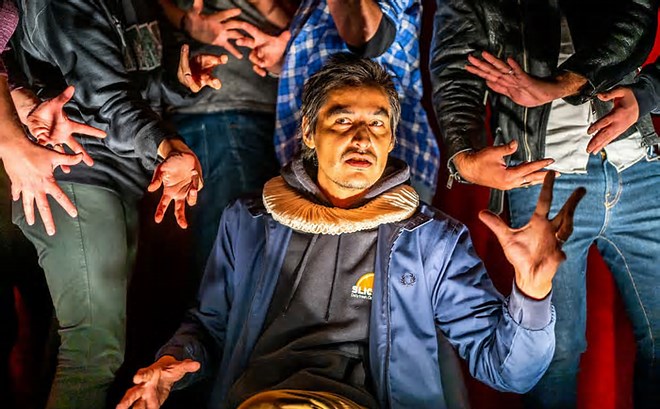
Writer: Cliff Cardinal
Please note: This review contains spoilers that may significantly affect the experience of the performance.
Canadian actor and playwright Cliff Cardinal begins his As You Like It: A Radical Retelling with what seems like a land acknowledgement. At first, it feels appropriate: Shakespeare’s original ends with the return of land and authority, the exiled Duke regaining both power and place. But Cardinal’s show is not a retelling of Shakespeare at all. Instead, it is a monologue that blends TED talk, stand-up, and provocation, using the title as a decoy for something more confrontational.
Performing with exaggerated gestures, Cardinal turns his attention to systemic injustice. He rails against inherited privilege, the wealth built on stolen land, and the hypocrisies of presumed allyship. He draws in references to Britain’s history of colonial violence, the shameful history of Canada’s residential schools, financial inequality, and the climate crisis. The effect is deliberately unsettling: a performance designed to make audiences feel complicit, guilty, and uncomfortable.
Yet bringing this work to Edinburgh without careful grounding raises questions. If Cardinal truly wishes to “be friends” with everyone, as he claims, it is reasonable to expect that he would acknowledge the histories and cultures of the land where he performs. By generalising all white people under a single label, he erases the identities of other marginalised groups within Scotland, many of whom were themselves colonised by the English state. It is telling that he mentions the Irish as oppressed, while allowing them to be separated from the British, yet does not extend the same distinction to the Scottish. His final line—“Aren’t you sorry you forced me to learn English?”—lands awkwardly when one considers the long suppression of Gaelic in the Highlands and Islands. The number of Gaelic speakers declined from 254,415 in 1891 (6.3 percent of the Scottish population) to 57,600 in 2011 (1.1 percent). The struggle to preserve a language long suppressed deserves recognition, especially in a show like this. By dismissing this history, Cardinal repeats the very act of silencing he condemns, turning his provocation into a careless contradiction, reproducing the same dismissiveness he critiques.
Cardinal’s repeated reference to “stolen land” also raises another concern. In emphasising possession, he risks missing Shakespeare’s point: the Forest of Arden is never anyone’s to own. That is not to justify the act of colonisation or the way Indigenous people were prevented from benefiting from the land they had inhabited for generations. It is, however, to recognise that framing the struggle only in terms of ownership reinforces a human-centred worldview, one that treats the earth as property. This perspective weakens its own relevance to environmental justice. If the planet is to be protected, it must be valued as more than a resource for human claims.
In the end, Cardinal’s determination to drag audiences out of their comfort zones is admirable. He provokes, unsettles, and confronts, ensuring no one leaves untouched. Yet his lack of attention to local histories and his over-reliance on a human-centred worldview leave the work shakier than it should be. The courage to unsettle is there, but the care required to strengthen that provocation is missing.
Runs until 23 August 2025
The Reviews Hub Star Rating
50%
A Self-Contradicting Retelling