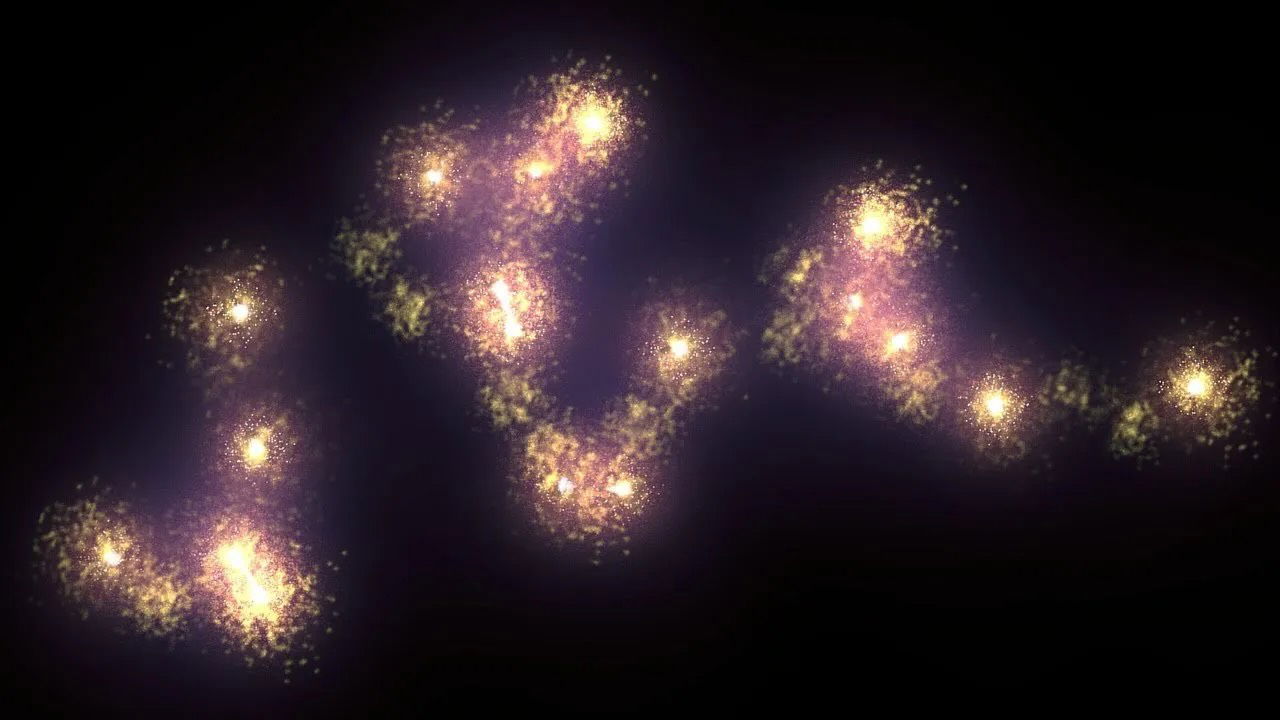
The largest cosmic structure ever observed by astronomers is revealing its biggest cosmic secrets yet, with a little help from powerful gamma-ray bursts.
The most energetic explosions observed in our universe, new research that leverages the power of gamma-ray bursts is helping astronomers chart the immense architecture of the cosmos, offering new ways of testing foundational assumptions about the structure of the universe.
These incredibly powerful blasts of cosmic energy, first detected by U.S. military satellites in the late 1960s, have long intrigued astrophysicists due to their remarkable power, which can outshine the Sun by a factor of close to one quintillion (that number, for reference, is one followed by eighteen zeroes).
The origins of gamma-ray bursts (GRBs) are now believed to be linked to the death of massive stars when they collapse, and collisions between neutron stars or black holes. However, new research suggests these cosmic powerhouses could have another purpose: illuminating the large-scale structure of the universe.
 Artist’s concept of a gamma-ray burst (Credit: NASA/Swift/Cruz deWilde)
This, according to a team of scientists from Hungary and the United States led by Professor Istvan Horvath of the National University of Public Service in Budapest, who have proposed a novel means of using GRBs as cosmological probes.
Based on their findings, outlined in a new study published in Universe, these fleeting, but incredibly brilliant flashes could help astronomers identify massive clusters of galaxies and cosmic walls, structures that are so incomprehensibly massive that they challenge existing models of the universe’s uniformity.
The Great Wall of the Cosmos
The standard Cosmological Principle dictates that the universe should be homogeneous and isotropic on large scales—in other words, the stuff from which the cosmos are composed should be more or less uniform, and look the same in all directions and when seen from all locations.
However, some large-scale cosmic structures challenge these expectations. Observations that have revealed structures like the Sloan Great Wall, the South Pole Wall, and the Hercules–Corona Borealis Great Wall (HerCrbGW)—an enormous galactic feature estimated to stretch across 10 billion light-years—have thrown a cosmic wrench into things, to borrow a famous axiom.
Since GRBs are extremely bright—so luminous that they can be seen across distances greater than 13 billion light years away—Horvath and his colleagues believe they could provide an extremely beneficial tool for identifying such gargantuan formations.
According to the team’s new study, the Hercules-Corona Borealis Great Wall cluster, which is recognized as the largest of the known universal structures, was examined in past research that “used an increasing gamma-ray burst database to show that the cluster was unlikely to have been caused by statistical sampling uncertainties.”
The Largest Cosmic Structure is LArger Than We thought
Continuing that work, Horvath and the team revisited burst clustering in the northern galactic hemisphere with the help of a new method, which revealed something surprising: the Hercules-Corona Borealis Great Wall cluster is even larger than previous estimates had determined.
“The extension of this cluster’s size does not appear to have been due to statistical variations or sampling biases,” the team writes in their study.

To reveal the full extent of this massive structure’s size, Horvath’s team analyzed 542 GRBs with well-documented positions and redshifts, sourced from NASA’s Swift and Fermi observatories and multiple global databases.
Paying close attention to the the Hercules-Corona Borealis Great Wall cluster’s home region, known as the northern galactic hemisphere, the team found that a new cluster of between 110 to 120 GRBs existed, spanning a wide range of redshifts. Based on earlier findings, the new estimates of the cluster’s size show that exceeds past estimates of its boundaries, revealing an even greater radial depth than previously known.
Cosmic Anomalies Persist
Although the team’s new findings are promising, they nonetheless caution that current GRB datasets are limited, and therefore still could be subject to observational biases. Additionally, the fact that GRBs are so fleeting and show irregular distribution throughout the universe means that some cosmic anomalies could exist, although they may have evaded other data sets.
“Large-scale anomalies in the GRB spatial distribution can exist which are not necessarily seen in other cosmic objects,” the authors write in their paper, adding that further observations will be crucial in terms of resolving lingering questions about these massive formations, and ultimately refining models of cosmic structure.
The team’s paper, “Scanning the Universe for Large-Scale Structures Using Gamma-Ray Bursts,” appeared in Universe on April 6, 2025.
Micah Hanks is the Editor-in-Chief and Co-Founder of The Debrief. He can be reached by email at micah@thedebrief.org. Follow his work at micahhanks.com and on X: @MicahHanks.