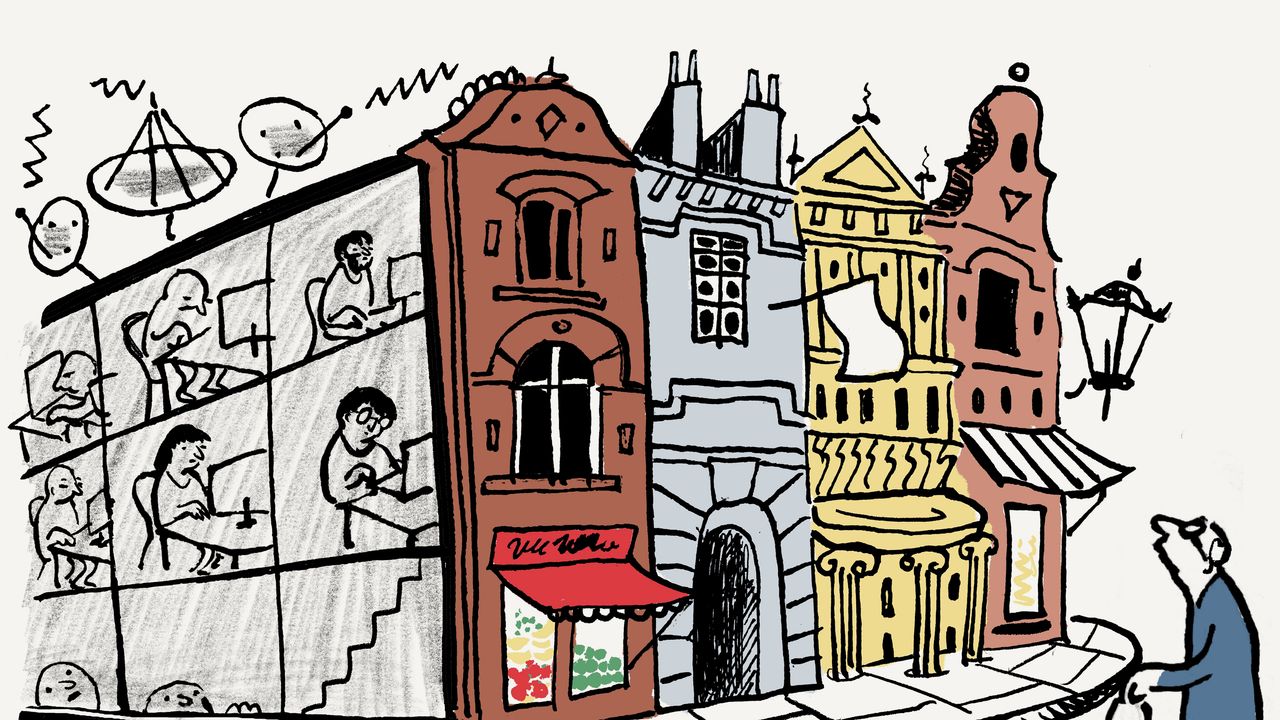
The word “great” is so loaded when used in relation to Britain. It comes with a lot of associations that right-thinking people don’t really want to talk about. Power and subjugation and glory and control. Originally it was just descriptive: one theory says a Greco-Roman geographer, Ptolemy, called the big island “Mega-Britain” and what is now Ireland “Little Britain”. In medieval times, Little Britain was used to refer to what is now Brittany. But then, in 1707, England, Scotland and Wales became the Kingdom of Great Britain (Ireland was added in 1801, but it wasn’t allowed to be Great). And that became the centre of a gigantic empire. Which made us feel great. But all that is now over and lots of people spend a great deal of time arguing about whether it was good or bad. Possibly as a way to avoid thinking about the future.
What we are great at though, is still trying to be Great.
There has been a rather weird movement sweeping across the major cities of Britain over the past 20 years. It is called “façadism”. Any time a property developer wants to demolish an old building, they are forced to keep the original façade. Everything else is scooped out behind and rebuilt as a modern financial/tech/media complex that then becomes part of the contemporary system of power. Meanwhile, the old grand front is tacked onto this modern box. It is presented as preserving heritage, but it isn’t preservation at all. To save only the façade of a building is not to save its reality. Instead, it turns the building into a stage set, a cute toy that both disguises the bleak reality of the modern world and presents a false front of a time when Britain was still great.
It feels like their real aim is to plaster Britain with a cultural façade of Greatness.
Façadism doesn’t just apply to buildings – it is a force that is taking over politics too. You can see it in the figures of the new right emerging out of the shattered ruins of the Tory party. It is led by Robert Jenrick, who has promised to “rebuke the doom” of “our present malaise” to make the UK “greater still”. And somehow the key to do this lies in controlling immigration.
The new right is driven by an idea that somehow one of the keys to restoring Britain’s greatness lies in recreating a strong sense of cultural identity. What is not discussed much is whether they would also set out to restore people’s sense of connection to the levers of power – for example, the financial power system that feels increasingly out of control. It feels like their real aim is to plaster Britain with a cultural façade of Greatness, without wanting to change anything behind it. They do not dream of a “great” society that is better for everyone. Instead, the driving motor is anger and fear. Real power, which sits happily in the box behind the building front, remains unchallenged.
Their opponents are also caught in the dream of being Great. Keir Starmer also seems unable to or uninterested in challenging and unpicking the financial/tech system of debt extraction. Instead, he has turned to playing out a grand role on the international stage – possibly as a distraction from his domestic powerlessness. He has promised to build 12 new nuclear attack submarines, and spend £15bn building new nuclear warheads. But will these really make Britain a great power again? Or are they a façade born of strange dreams of a lost world?