Marrakech – Xlinks has now rebranded as Sila Atlantik after the British government rejected the major transcontinental renewable energy project that would have imported solar and wind power from Morocco to the United Kingdom in late June.
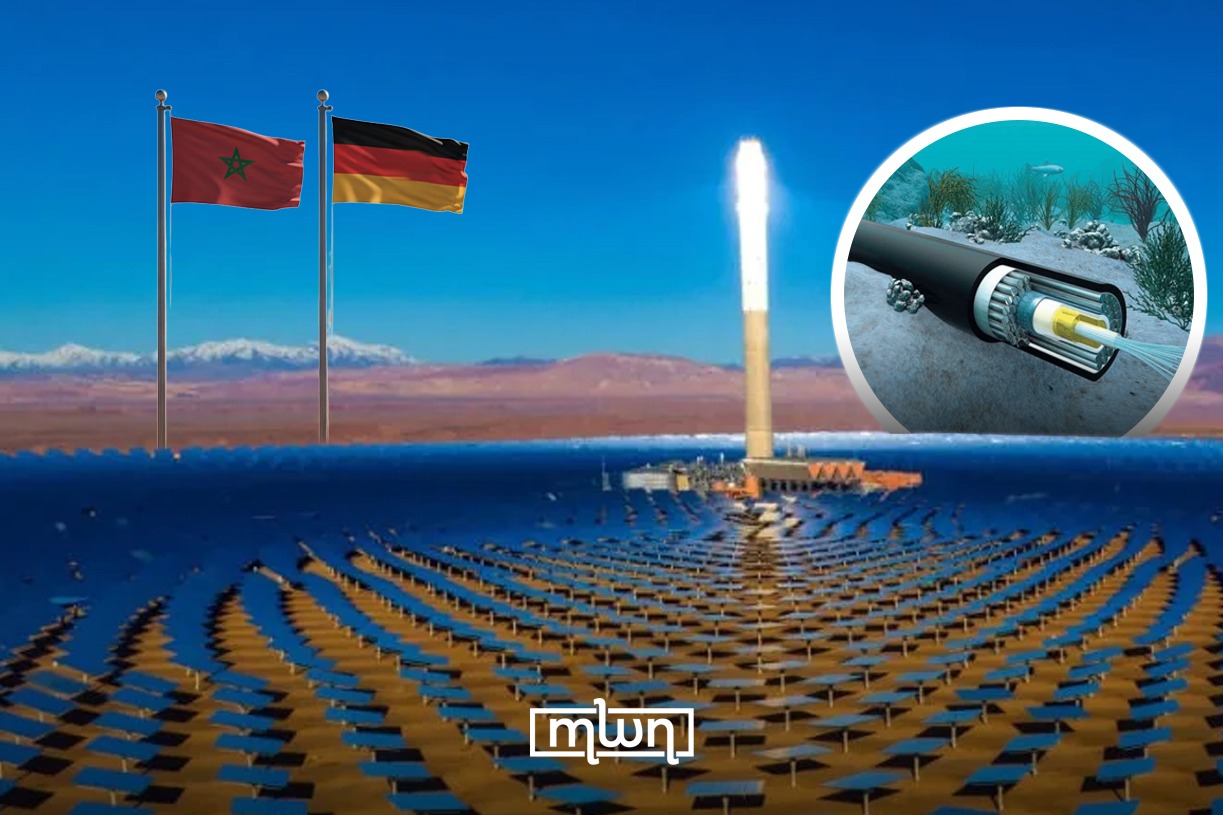
Following its reemergence as Sila Atlantik, the venture charts an ambitious new course to deliver Morocco’s abundant solar and wind resources directly to German consumers through a groundbreaking submarine cable system.
According to multiple German news outlets, this mammoth infrastructure project aims to transport electricity generated from Moroccan renewable installations to Germany via 4,800 kilometers of high-voltage direct current (HVDC) cables.
The undersea power line would traverse the Atlantic coastline, crossing through Portuguese, Spanish, French, Belgian, and Dutch territorial waters before connecting to the German power grid at multiple entry points.
The Sila Atlantik venture promises to deliver precisely 26 terawatt-hours of clean electricity annually, equivalent to approximately five percent of Germany’s current power consumption. The technical specifications include two parallel submarine cables with a combined capacity of 3.6 gigawatts, though reports suggest potential to scale up to 15 gigawatts as demand increases.
Industry veterans from energy giants EnBW and Orsted have taken leadership positions to drive the initiative through X-Links Germany GmbH. The project has reportedly attracted attention from major energy corporations, including Eon, Uniper, and potentially Octopus Energy, lending it additional credibility.
Developers will seek government backing
The financial requirements for Sila Atlantik reach between €30-40 billion – a staggering investment that developers acknowledge will require governmental guarantees, with project leaders indicating they will seek state backing to secure it.
Unlike Desertec, which collapsed in the early 2000s, facing insurmountable financial hurdles and political headwinds, Sila Atlantik capitalizes on dramatically reduced renewable energy production costs and technological breakthroughs in transmission.
Current solar and wind energy production expenses have plummeted compared to two decades ago, transforming the economic calculus. The deployment of state-of-the-art, direct-current undersea cables enables electricity transport with minimal transmission losses while circumventing the community opposition that often plagues overland power line construction.
For German consumers, the project dangles five concrete benefits: reduced electricity costs through increased supply; diminished carbon emissions; lower network infrastructure expenses due to Morocco’s reliable renewable generation patterns; enhanced power delivery to energy-starved southern Germany; and expanded capacity for power-intensive industries, particularly artificial intelligence data centers that threaten to strain Germany’s grid resources.
The Sila Atlantik trademark registration was officially filed with the German Patent and Trademark Office (DPMA) on January 31, receiving formal approval on May 5 – a strategic milestone demonstrating the project’s momentum and long-term vision.
Despite optimism, major challenges remain
Despite these promising developments, significant obstacles loom. The astronomical price tag demands substantial government backing, creating potential taxpayer exposure. Political reliance on Morocco introduces geopolitical vulnerabilities, while coordinating permits across five coastal countries adds layers of complexity.
Manufacturing constraints pose additional hurdles, as the specialized high-performance cables required remain scarce globally – prompting Sila Atlantik to contemplate establishing dedicated production facilities within Morocco.
German energy corporations maintain cautious optimism about the venture. When approached by Handelsblatt, Uniper confirmed initial support while stressing that final investment decisions remain pending during the project’s “intensive startup phase.”
Eon offered similar measured enthusiasm, while the German Federal Ministry of Economics declined substantive comment, noting it was premature to evaluate the enterprise.
According to the most ambitious project timelines, initial electricity transmission could commence by 2034, with the system reaching full capacity by the late 2030s. This extended timeline places any consumer benefits firmly in the next decade.
The current energy landscape in Germany underscores the urgent need for such solutions. In 2024, approximately 4.2 million German households accumulated payment arrears with energy providers, with 6.4% of renters unable to pay electricity and gas bills promptly.
Average electricity costs for typical German households consuming 4,000 kWh have reached 36.51 cents per kilowatt-hour in 2025, compared to 27.54 cents in 2015. Similarly, gas prices have climbed to 11.77 cents per kilowatt-hour for average consumption of 20,000 kWh, nearly doubling from 6.48 cents in 2015.
With Sila Atlantik, Morocco positions itself at the epicenter of Europe’s energy transition, potentially establishing a direct conduit between the Sahara’s vast renewable resources and German industrial powerhouses.
The realization of this transcontinental energy bridge hinges on sustained political will, diplomatic coordination, and technological execution across multiple fronts in the coming decade.
Read also: Report: Morocco’s NOOR Is a Success Story in Africa’s Energy Transition