– Advertisement –
“We’re all very excited and proud to have reached 20,” said Cathy Bolton, Festival Co-Director of the Manchester Literature Festival. When she speaks, there’s a warmth in her voice that carries two decades of graft and no small amount of magic.
For Cathy, who has been there from the beginning, this anniversary marks a moment to look back on a journey that transformed a pioneering poetry festival into one of the UK’s most distinctive and essential cultural events.
What began in 2006 as a modest 30-event programme has evolved into a festival that welcomes global icons, nurtures emerging talent, and proudly represents Manchester’s diversity. “We grew out of the Manchester Poetry Festival,” Cathy recalled.
“But we realised that while poetry is still core to what we do, it has a fairly niche audience. Expanding into fiction and nonfiction meant we could reach more people and bring the city into conversations about music, politics, history, and science.”
That evolution has paid off. Today, the Manchester Literature Festival (MLF) is a recognised stop on the circuit for international names, a champion of homegrown voices, and a pioneer in making literature live in the city.
The early years of Manchester Literature Festival
In 2006, Manchester had a buzzing music scene, a thriving arts community, and an immense literary heritage that ran from Elizabeth Gaskell to Anthony Burgess. What it didn’t yet have was a literature festival with the ambition to rival Edinburgh or Cheltenham. Cathy and her colleagues set out to change that.
“There was always the hope it could grow into one of the big UK festivals,” she said. “But it took a few years to build that reputation, especially with the big publishing houses. We had to show them Manchester could draw the audiences, that this city was worth adding to the tour when a writer came to the UK.”
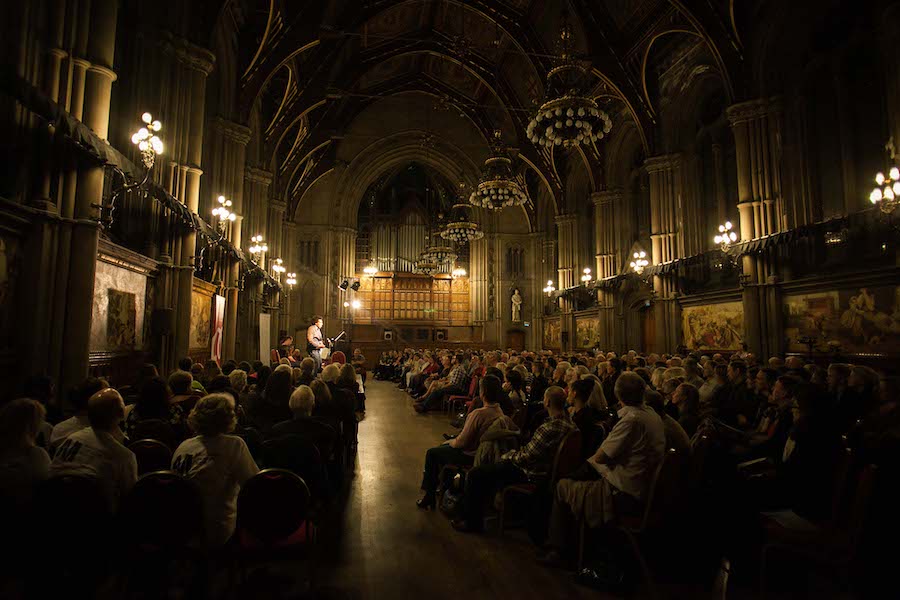 Audience for Lemn Sissay & Manchester Camerata at Mcr Town Hall credit Chris Bull For Manchester Literature Festival
It worked. As Cathy puts it with quiet pride: “We’ve built up trust. Publishers know we’ll get good, engaged audiences. And we make sure our visiting writers are well looked after so they want to come back.”
The venues also helped. Unlike festivals that rely on marquees in muddy fields, MLF spread across Manchester’s cultural landscape: the Royal Northern College of Music, the Whitworth, Manchester Museum, HOME, Contact, the John Rylands Library, and of course, the gorgeous Central Library.
Representing all of Manchester
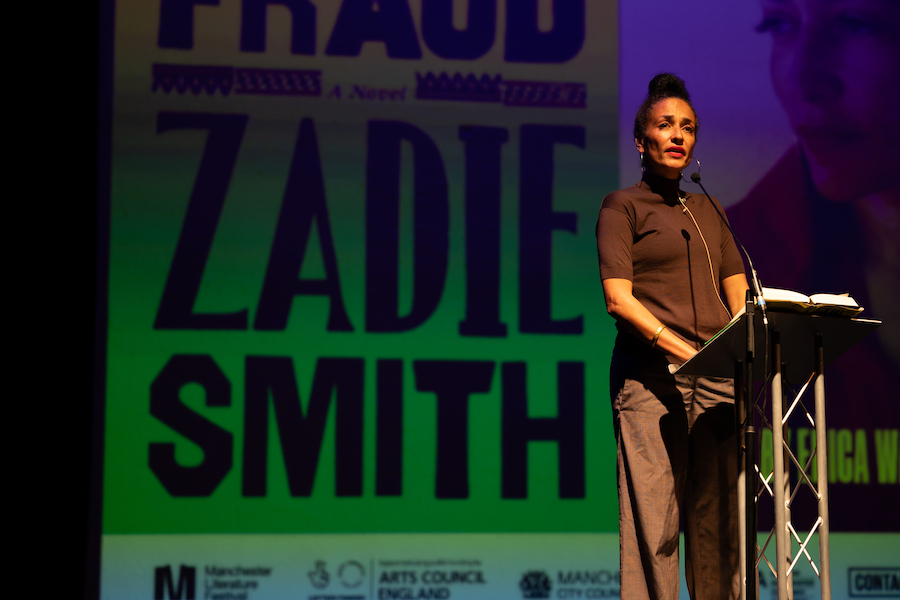 Zadie Smith performs at Manchester Literature Festival. Photo credit: Jon Parker Lee
The expansion wasn’t all about hooking the big names. From the beginning, MLF sought to represent the city’s voice in all its richness.
“We have a commitment that at least 40% of our programme features writers from diverse backgrounds,” Bolton said.
“That includes global majority writers, LGBTQ+ writers, working class writers – we want the festival to reflect Manchester itself.
This commitment has produced unforgettable events: Palestinian writers filling halls in 2006, Young Identity poets celebrating icons like Maya Angelou and James Baldwin, and countless opportunities for new audiences to hear their own stories reflected back at them.
Partnerships have been key. For nearly a decade, MLF has collaborated with Young Identity, the Old Trafford-based spoken word collective, to produce the annual Cabaret of Freedom.
This year, they honour Benjamin Zephaniah, with performances by local poets, musician J. Chambers, and celebrated writers Nick Makoha and Salena Godden. “It’s a brilliant coming together of community and nationally known voices,” Cathy added.
Manchester Literature Festival’s finest moments
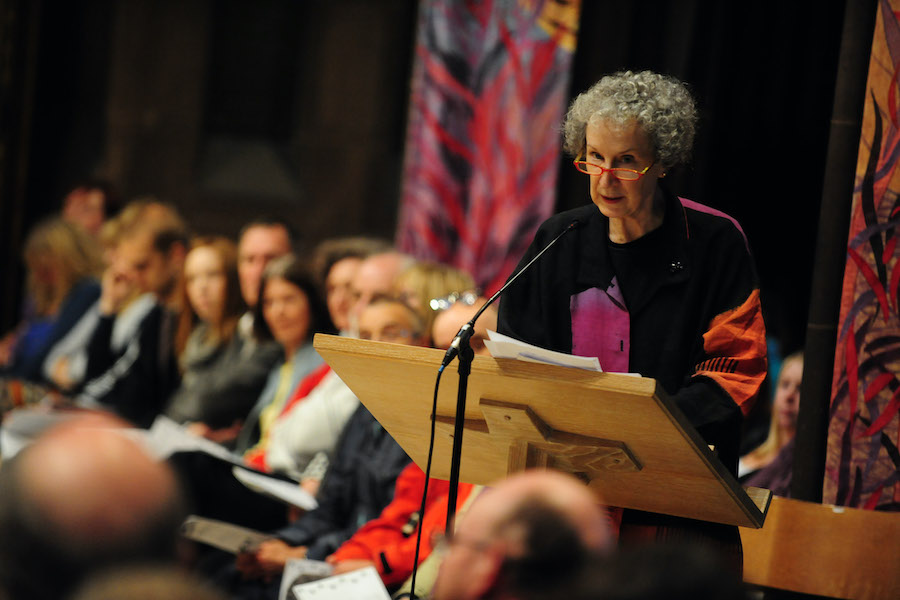 Margaret Atwood reads from her new novel ‘The year of the flood’ at Manchester Literature. Photo credit: Jon Parker Lee
Over 20 years, Cathy has had her share of “is this real?” moments. “The first time I met Margaret Atwood, I thought, oh my God. I can’t believe I’m in the same room as her. And then Seamus Heaney, again, just incredible.”
It’s those encounters, between writer and reader, artist and audience, that fuel the festival’s magic. “Reading and writing are solitary acts,” Cathy reflected. “But the festival is about connection. It’s a space where ideas meet people, and people meet the writers who’ve lived in their heads for years.”
MLF isn’t only about the headline acts. Behind the scenes is a thriving year-round creative learning programme. One flagship project is Little Reads, monthly storytelling and drama sessions in libraries across Greater Manchester, designed to foster an early love of books among pre-school children.
“There’s something beautiful about seeing a child’s confidence with books grow. It’s also about supporting parents and carers, helping them feel confident reading with their kids,” Cathy added.
This year’s festival includes a joyful Family Birthday Bash at Central Library, Library, with three children’s authors, mask making and a real-life wild animal encounter. There’s also a Create Comics workshop led by the UK’s current Comics Laureate Bobby Joseph at Z-arts.
Surviving Covid and flourishing
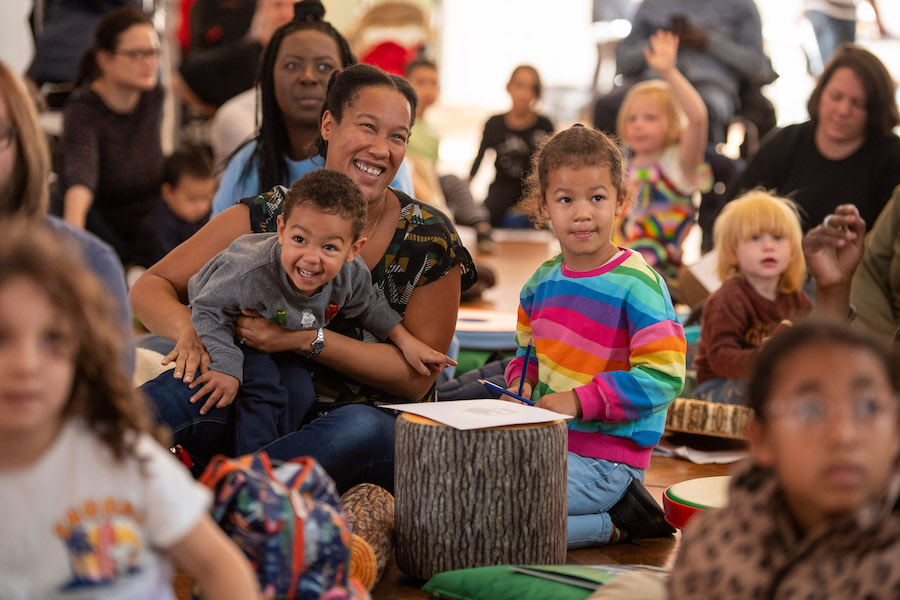 Manchester Literature festival 2023 – photograh by Jon Parker Lee
It hasn’t all been smooth sailing. Like every cultural institution, the festival faced an existential threat during the pandemic. But the team adapted, delivering virtual events, forging international links with other UNESCO Cities of Literature, and keeping the community engaged. “It was tough,” Cathy admitted. “But our audiences were loyal. And in the last year, we feel like we’ve truly come back.”
The loyalty is reciprocal. Audiences tell the festival they come not just to be entertained, but to be challenged. “People say they leave with new ideas or new perspectives. They’ve been lifted, inspired,” Cathy said. “That’s what keeps us going.”
From Page to Stage: 20 Years of Manchester Literature Festival at
Central Library
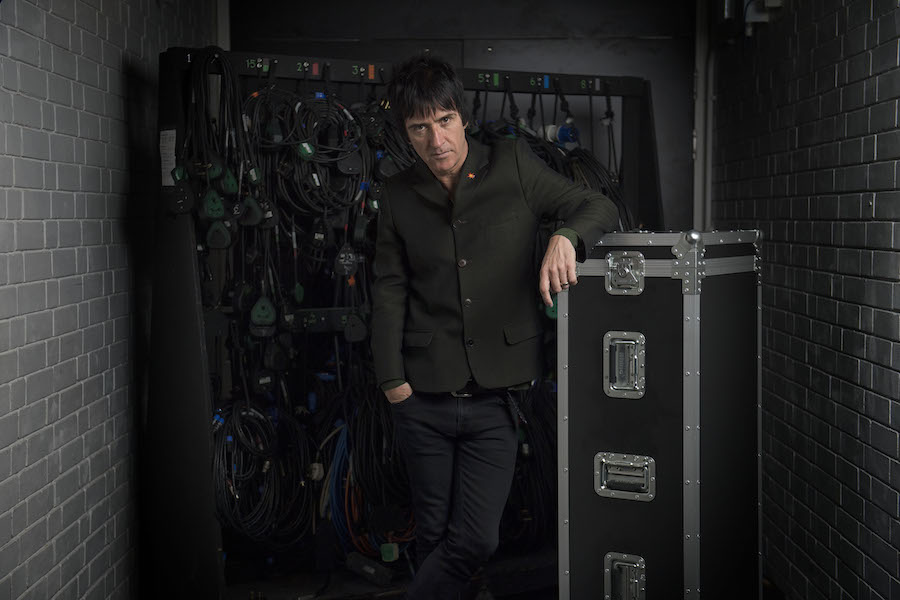 The legendary Jonny Marr. Photo credit: Jon Parker Lee
To mark the anniversary, MLF has opened From Page to Stage: 20 Years of Manchester Literature Festival, a photography exhibition at Central Library’s Wolfson Reading Room (12th September – 16th December 2025).
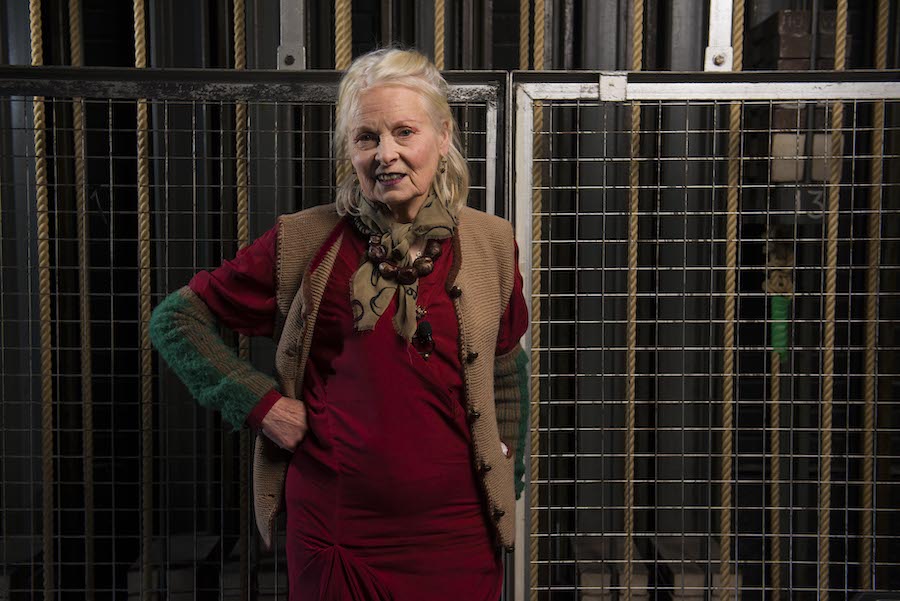
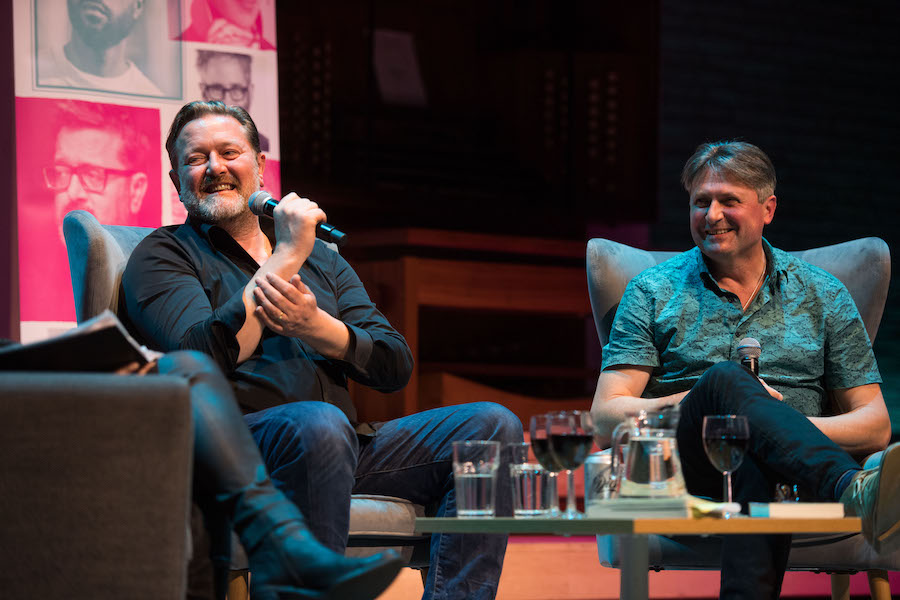
“It was quite cathartic,” Cathy said of curating the exhibition. “We sifted through thousands of photos. It reminded us of all the incredible writers who’ve been part of this journey, Lemn Sissay, Jeanette Winterson, Simon Armitage, Jackie Kay, Guy Garvey, Vivienne Westwood, Johnny Marr, and so many more.
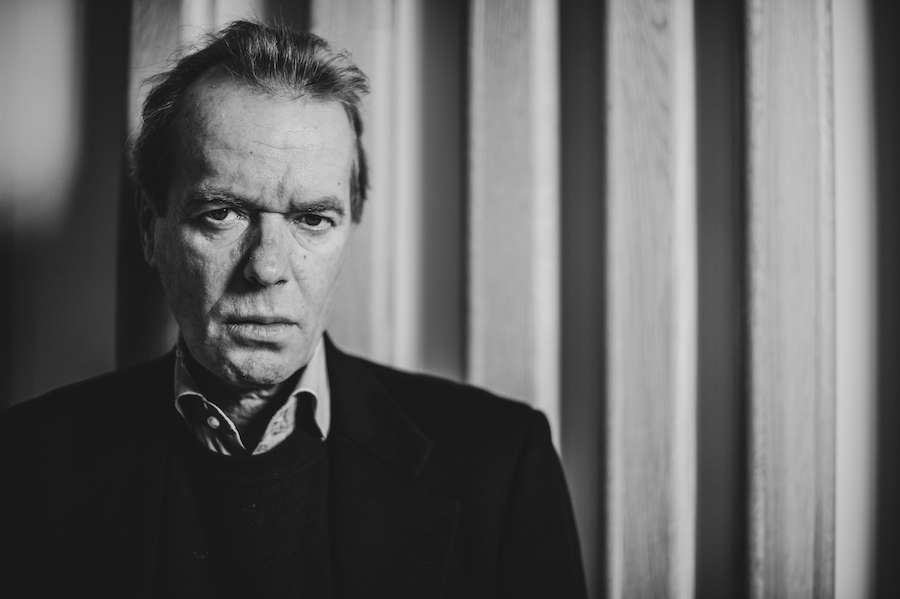 Martin Amis. Photo Credit: Jon Parker Lee
“Seeing those faces, those moments, it brought it all back.”
The exhibition captures the essence of the festival: energy, diversity, creativity, and a deep sense of place. For anyone who has ever attended, it’s a must-see; for those who haven’t, it’s an invitation.
Who’s on at Manchester Literature Festival
This year’s line-up is proof of the festival’s pulling power. From international economists to homegrown icons, the roster is dazzling:
- Yanis Varoufakis: Tuesday, 30th September
- Mary Portas: Saturday, 11th October
- Led By Donkeys: Monday, 13th October
- Samantha Shannon & Saara El-Arifi: Tuesday, 14th October
- A Night with Irvine Welsh: Sunday, 19th October
- Patrick Grant: Sunday, 26th October
- Jeanette Winterson: Tuesday, 11th November
- Zadie Smith: Tuesday, 4th November
- From Page to Stage: 20 Years of Manchester Literature Festival Exhibition — 12 September – 16 December, Central Library
And that’s just the headline programme. In total, over 50 events will take place across the city, from workshops to special commemorations, including a major celebration of Seamus Heaney’s work with leading poets performing previously unpublished poems.
You can see the full lineup by clicking here
“Zadie Smith is always a highlight,” Cathy admitted. “She’s such a brilliant, eloquent speaker. But honestly, I couldn’t pick a favourite this year. It’s such a rich programme.”
Manchester: UNESCO City of Literature
In 2017, Manchester became a UNESCO City of Literature, recognition of its literary past and present. The festival played no small part in that success. “Our former chair, Jerome de Groot, spearheaded the campaign,” Cathy recalls. “But having a high-profile literature festival in the city was key. It showed we could host international conversations.”
Since then, MLF has collaborated with other UNESCO cities on joint commissions, many of them virtual during COVID. It’s another way the festival has placed Manchester firmly on the global literary map.
Why should you go to Manchester Literature Festival?
So why should people come to the festival? Cathy doesn’t hesitate: “Because it’s uplifting. Because you’ll hear voices that move you, challenge you, and make you think differently. And because it’s a chance to connect with writers, ideas, and hopefully each other.” And as for the next 20 years? “We’re still learning, still growing. But if we can keep creating those moments, where someone leaves an event feeling changed, feeling inspired, then
we’ll have done our job.”
Manchester is no stranger to reinvention. From cotton mills to football pitches, from factories to dance floors, the city thrives on its ability to spin glorious stories and tales. The Manchester Literature Festival has become a hotbed of invention where we can all share those stories and listen to others share theirs.
As Cathy summed it up, “It’s about connection. That’s what literature does. That’s what this city offers. And that’s what we’re celebrating.”
Tickets for Manchester Literature Festival
Manchester Literature is on at a range of venues across Manchester from 11th to the 26th of October 2025. You can get tickets by clicking here
– Advertisement –