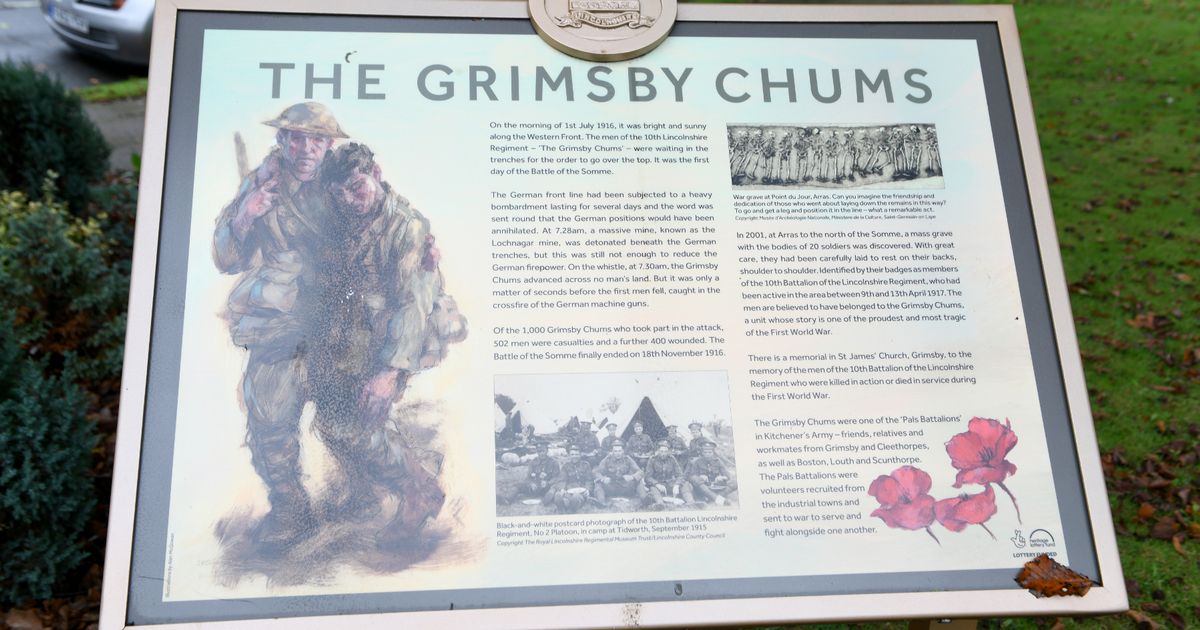
Relatives of four Grimsby Chums who fought and died together in the First World War will attend a special burial at Loos British Cemetery in France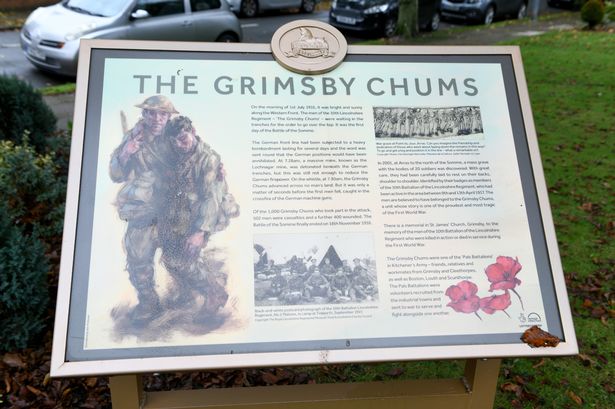 A plaque in memory of the Grimsby Chums(Image: Rick Byrne / Grimsbylive)
Four Grimsby Chums who lived, fought and died together will be buried alongside each other after an investigation spanning more than 100 years. The remains of Privates Arthur Cook, Robert Cullum, John Fraser and William London, all from Grimsby were found during an excavation to make way for a new hospital in Lens in northern France.
The Chums have all been identified thanks to the Joint Casualty and Compassionate Centre Commemorations team, often called The War Detectives. They have invited members of the Grimsby men’s families to the ceremony.
The Ministry of Defence has arranged a burial for the four Chums who fought in the First World War, for October 21 with military honours at Loos British Cemetery in France. All four were killed on May 5, 1917.
They were soldiers in the 5th Lincolnshire Regiment. Joanne Bowkett, the great, great niece of Robert Cullum will be flying from her home in New Zealand for the ceremony, accompanied by her sister and brother and all are originally from Grimsby.
Robert Cullum’s brother, Thomas Cullum was also killed during the First World Ward and is buried in Scartho Road cemetery. Robert Cullum is also remembered on his head stone, although his body was never recovered until this year.
The men were all battlefield casualties who were left where they fell. There were 10 Cullum brothers and at least six of them served, all from the West Marsh area of Grimsby. The history of the Cullum brothers of Grimsby is akin to Steven Spielberg’s Second World War film, “Saving Private Ryan.”
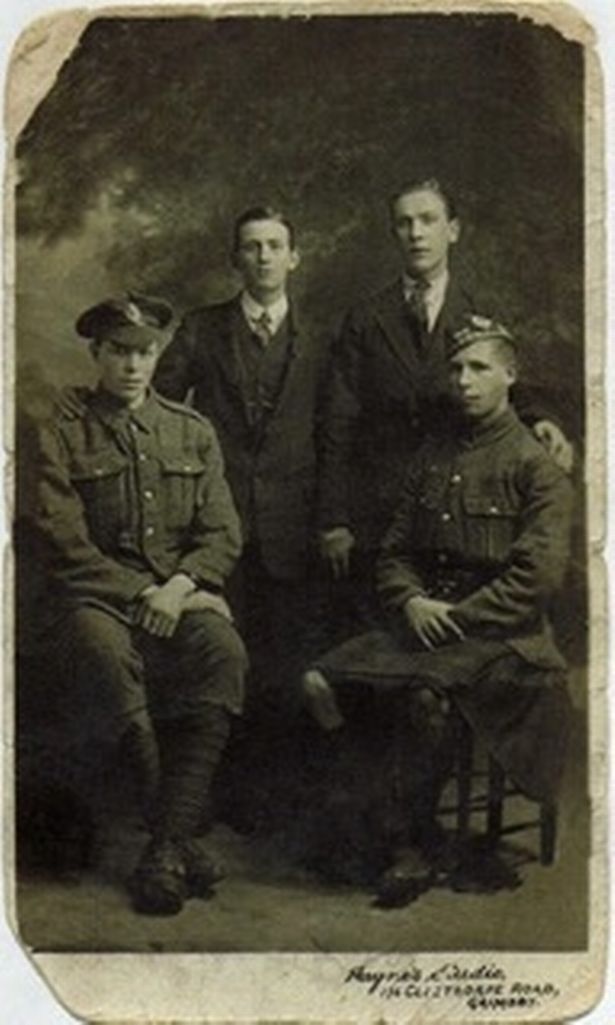 Four of the Cullum brothers(Image: Submitted)
Cyril Cullum of The Scots Guards is on the family photograph, Joanne has kept. William Barrett Cullum., 1888 -1940 was a ship painter, James Cullum 1890 – 1952, served in the navy, George Sydney Cullum, born in 1891 was still alive in 1939 and worked as a bricklayer.
Robert Barrett Cullum, 1892 – 1917, died in France serving with the Lincolnshire Regiment. Brother Thomas Edward Cullum. 1895 – 1916 was killed at The Battle of the Somme. Harry Cullum. 1897 – 1970, also served with the Lincolnshire Regiment and Cyril, born in 1898 was with the Scots Guards.
John Septimus Cullum, was born in 1900 and died in 1958 and Frank Cullum born in 1907 died in 1982. The youngest brother, Herbert, was born in 1908. Through research carried out by Joanne and Andrew Bowkett, they discovered Robert Cullum was born on the December 16, 1892 to father Robert Barrett Cullum and mother, Frances.
Robert Barrett Cullum, senior was a coal trimmer on the docks. In 1891 they lived at 78 Annesley Street on the West Marsh. He attended South Parade school and left at the age of 14. On the 1911 census he was working as a labourer on Grimsby fish docks and living with his parents at the Annesley Street address. They later moved to Alexandra Road.
Robert joined the 10th Lincolnshire regiment, known as The Grimsby Chums and later transferred to the 5th Lincolnshire Regiment and was killed on May 5, 1917 near Loos in France and only discovered this year along with three of his fellow Grimsby chums. John Fraser, William London and Arthur Cook.
Robert’s brother, Thomas Edward Cullum joined the Lincolns then transferred to The Royal Berkshire Regiment and was wounded at the battle of the Somme in 1916. He was shipped home to England where he died from his wounds and is buried in Scartho Road cemetery.
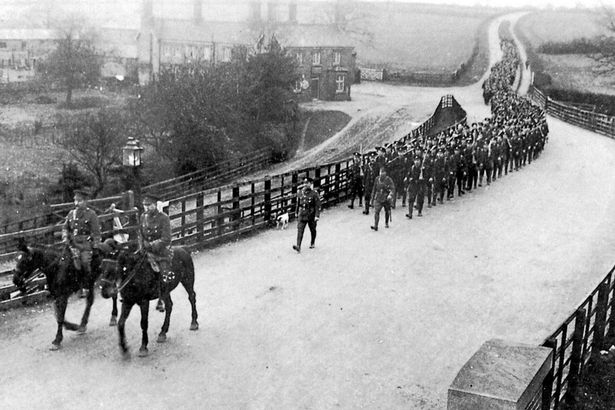 The Grimsby Chums marching before going to war(Image: Grimsby Telegraph)
Brother Harry Cullum also joined the Lincolns. He survived the war. Cyril was Joanne’s great grandad. He joined the Lincolns and was then transferred to the Royal Scots Guards and arrived in France on 27th October, 27, 1915. He was only 16. James Cullum worked as a fisherman sailing from Grimsby then joined the Royal Navy in 1908 and served all the way through the First World War, which he survived.
In April 1917 the division moved to the Lens area and became involved in 10 weeks’ bloody fighting round Hill 70. On April 23, patrols of the battalion had the unaccustomed experience of street fighting, while supporting an attack by 139th Bde on Hill 65.
Until the battalion was relieved on May 6, casualties were suffered from shelling and raiding, and several men were decorated for their actions in the confused fighting. 1/5th Lincolns took further turns in the line, with active patrolling and raiding, and full battalion attacks on June 19, leading to 74 casualties.
Thanks to Joanne and her husband Andrew, who emigrated from Grimsby to New Zealand more than 30 years ago, the remarkable story of The Chums has been unearthed. The couple lived in Legsby Avenue, in Grimsby but now live in Tauranga on the east coast of the North Island, after emigrating in 1994.
Andrew said: “I’m really into history especially both the World Wars and Jo is into ancestry and our family tree. She has always had a fascination with this and has spent hours researching the Cullum brothers along with other family members.
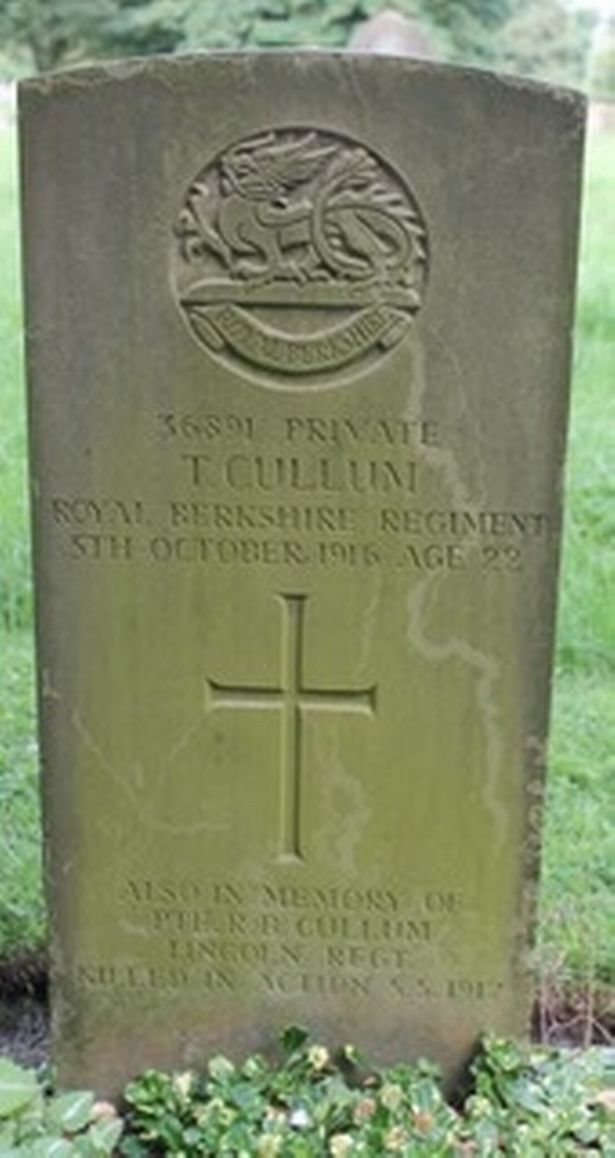 Thomas Cullum’s headstone(Image: Submitted)
“It has been quite an emotional few days for Jo. We also contacted the family member who gave his DNA sample – also a Robert Cullum, Jo’s second cousin, Jo flies out next week and will join up with her sister and brother and will be in Grimsby for a few days before leaving for France. They have been invited to the MoD reception after the service and are looking forward to catching up with their cousin and maybe other family members and relatives of the other three Grimsby men. It’s going to be a very emotional ceremony. Another strange coincidence is that Private John Fraser also appears on our family tree distantly related to me through marriage.
The Ministry of Defence Joint Casualty and Compassionate Centre Commemorations team investigators recorded how in 2020 the city of Lens in France began construction of a new hospital on a field just outside the town, adjacent to the A21 Motorway. The field had been unused for the duration of the 20th century.
As is the way with most construction activity in this part of France, the first task was to call in a company to carry out de-mining activity. That is, to remove any unexploded ordinance which had not yet been cleared from the first world war. At the end of July 2020 the demining team came across four sets of human remains, and called the Commonwealth War Graves Commission who then came on site to recover them and any artefacts found alongside them.
The four soldiers were among 120 casualties recovered from the site in total over a four year period. The Commonwealth Grave Commission wrote a report about the four men and the finds associated with them, which was passed to the War Detectives office in 2023. It wasn’t clear from the position in which the bodies were found whether they had simply fallen, died and been covered over by subsequent explosions, or whether they had been hastily buried by their comrades.
All four men had served with the Lincolnshire Regiment . They all had shoulder titles with them to demonstrate this. The shoulder titles were of a type which indicated they must have served with either the 1/4 th Lincolnshires or the 1/5 th Lincolnshires. Two of the men also had Lincolnshire Regiment cap badges which further reinforced the idea that they were men of this regiment. One of the men had a boot stamped 1917 on the bottom.
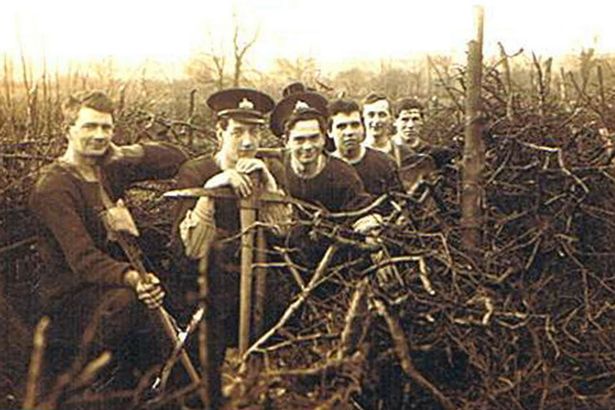 Men of the 10th Battalion the Lincolnshire Regiment, the Grimsby Chums(Image: Grimsby Telegraph)
Investigation of this area of France in terms of First World War activity showed they died in The Battle of Arras, April – May 1917 .The war diaries for the Lincolnshire Regiment showed that they actually only held trenches in the area during the first week of May 1917.
Checking the casualty lists for this period, and comparing that data with the names of those still missing left just four names – Ptes Arthur Cook, Robert Cullum, John Fraser and William London. All four men were from Grimsby, and all four had died on the May 5, 1917. They had been four of a five-man Lewis Gun crew.
The fifth man, Fred Blakely, survived the event which killed his colleagues, albeit badly wounded, and was later awarded the Military Medal for his actions that day. Through DNA testing Private Robert Barratt Cullum was identified on March 12, this year, by matching his paternal line DNA with his great-great-nephew. He is also called Robert Cullum.
A spokesman for the MoD said: “Since the four men lived together, died together and have lain together all this time, they will be buried together on 21 October, in a full military funeral supported by the Royal Anglian Regiment who are the modern day incarnation of the Lincolnshire Regiment.”