Prince Harry contemptuously calls them ‘The Men in Grey Suits’ – faceless courtiers who steer the royal machine away from trouble and tell kings and princes what they can – and can’t – do.
These men, grey-suited or not, stand in the way of Harry and his father Charles’s chance of a reconciliation, he reckons. It’s all their fault, not his.
A figment of Harry’s imagination? Or real individuals, happy to put road-blocks up where they reckon royal princes should not go?
He should ask his father. Precisely fifty years ago, the then Prince Charles ran into a different generation of well-tailored nobodies who were determined he shouldn’t get his way.
Charles was 26, and looking forward to the end of his five-year apprenticeship in the Royal Air Force and Royal Navy. Eyeing the future with trepidation, he asked himself what he was going to do: “My problem in life is that I don’t really know what my role in life is – at the moment I don’t have one. But somehow I must find one,” he mused.
There was no blueprint for being Prince of Wales – no rule-book locked in a dusty Palace cupboard back telling him how to fill his days till it came time for him to step up to the throne. [The wait, though he didn’t know it, would last an astonishing 48 years].
He wasn’t due to leave the Royal Navy until the following year, but at Broadlands, the Hampshire stately home of his ‘honorary grandfather’ Earl Mountbatten, Charles talked late into the night with the old man about what he was to do with his life.
In 1975, Britain under a Labour government was undergoing a crisis, with record levels of unemployment and spiralling inflation. Unemployment rose above three million. Many young people felt they had no stake in society.
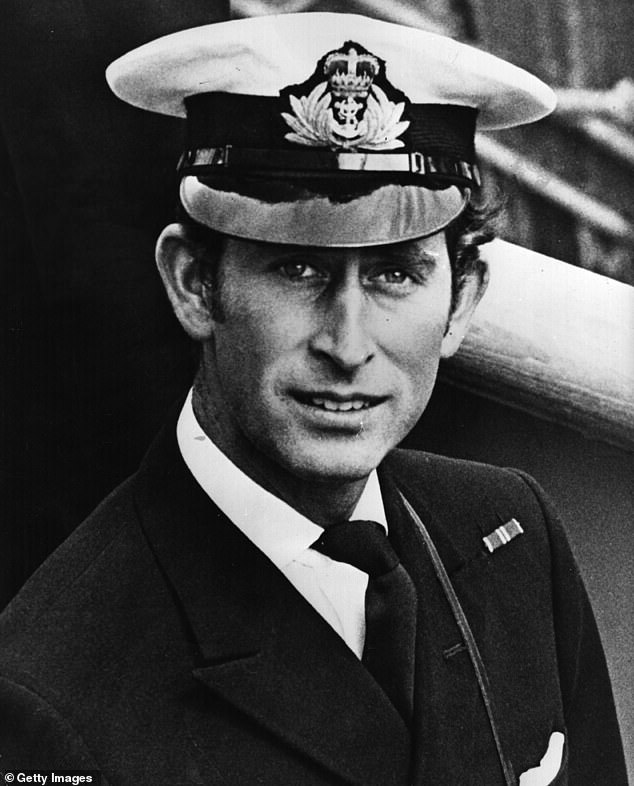
Prince of Wales on board a Royal Navy Frigate, Jupiter in dock at Devonport in Devon after a round the world tour. The Prince was in control of the flight deck and navigated Jupiter into port
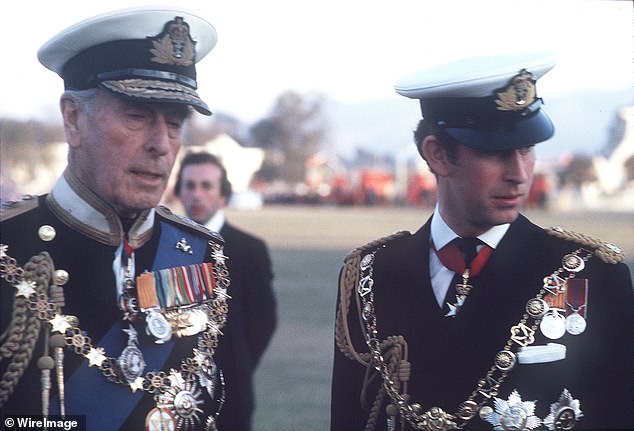
The Prince of Wales and Lord Mountbatten his ‘honourary grandfather’, wearing full naval uniform, visited Nepal in 1975 to attend the coronation of King Birendra
Mountbatten, a man with deep-rooted royal connections, also possessed a social conscience. From his concern about the way the country was being run, and the fact that young people were left out of current political thinking, Charles developed a compelling sense of “something must be done” – to look after the interests of the young and disadvantaged.
That was a phrase his great-uncle, the previous Prince of Wales, had used when visiting the coal miners in depressed South Wales – but in his case, it was all talk. Charles wanted to walk the walk.
The idea which was to change the lives of more than a million young people was born in the Chinese Drawing Room of Buckingham Palace. Its unlikely catalyst was a man called George Pratt, a senior figure in the Probation Service, who’d been called in to talk to Charles about the young men and women who’d found themselves on probation for some offence or other.
What was to be done with them?
As they talked, Charles found himself voicing ideas which were soon to transform themselves into an organisation called the Prince’s Trust.
It would, he said, provide hope where there was none – specifically in the many deprived communities which studded the map of Britain. Jobs, training, adventure, exercise – these would offer a way out for young people who felt trapped in a downward spiral.
He gave Pratt the job of creating a number of pilot schemes, offering £300 (£3.000 in today’s money) to help people get started in business or to receive training. His target was young people between the ages of 15 and 25 ‘who may seem aimless or lacking in purpose, who may feel alienated or rejected.’
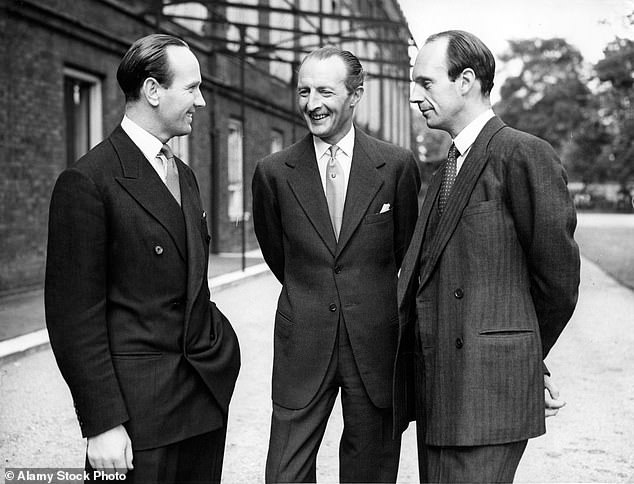
Lieutenant Michael Parker (left) Lieutenant General Sir Frederick Browning and the Hon Martin Charteris who was Princess Elizabeth’s Private Secretary
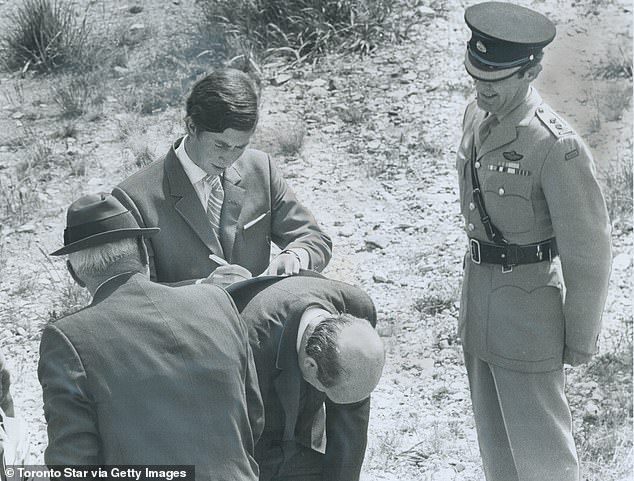
Sir Martin Charteris being used as a desk by Prince warned Charles’s private secretary to ‘go steady on the Trust’
His message was plain – large numbers of young people in 1975 Britain were destined for the scrap-heap almost before reaching adulthood. The Prince’s Trust would provide the means for them to escape.
It was a brilliant idea – because though much-needed, nobody had thought of it before.
And that’s when the Grey Suits stepped in.
“The Queen’s private secretary Sir Martin Charteris intervened,” writes Charles’s biographer Jonathan Dimbleby. There could be a conflict of interest between the brand-new Prince’s Trust and other royal trusts established to do good. ‘Go steady on the Trust,’ he ordered Charles’s private secretary.
“The prevailing attitude among the Queen’s senior advisors was that the heir to the throne was still too young to be taken entirely seriously,” writes Dimbleby. “He should be humoured – but not let off the Palace leash.”
Charles thumbed his nose at those men in suits and set off on his adventures. Experimental schemes were set up in different parts of the country – each case being judged on its merits, with no set rules.
One teenager whose parents were too poor to buy it themselves was given the cash to buy a fishing rod, He rewarded Charles a year later by sending him a box of fishing flies he’d learned to tie himself.
But it was going to take millions to make this grand idea work – where was the money to come from? Charles got the ball rolling by tossing in his severance pay of £7,000 (£49,000 today), plus a bonus £4,000 which came from an interview he gave to American TV.
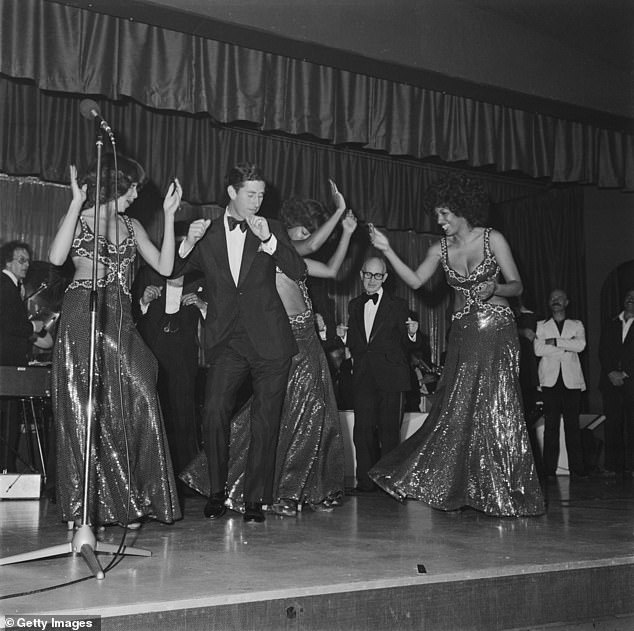
Prince Charles took to the stage with The Three Degrees during a fundraising event for the Prince’s Trust at the King’s Country Club in Eastbourne
The actor Terry Thomas contributed £105, the proceeds from his madcap attempt to cross the English Channel on water-skis.
The Goon Show’s Harry Secombe sent in a cheque for £2,000 which he said came from “selling my mother-in-law to an Arab, plus a charity concert.”
To draw attenton to the youth element of his great venture, Charles suggested holding an annual rock gala and in 1987 Princess Diana attended the Wembley Arena event where a supergroup including George Harrison, Ringo Starr, Eric Clapton, Elton John, Phil Collins, Bryan Adms and Level 42 played. Others on the bill were Alison Moyet, Ben E. King, Curiosity Killed the Cat, and Go West.
The coffers were filling. In fifty years, the Trust – now called the King’s Trust of course – has raised and returned to society a colossal £1.4 billion.
The stars came in to help spread the word about the Trust – including Helen Mirren, Ant and Dec, Idris Elba, Rylan Clark, Kate Garraway, and Fearne Cotton.
And the idea which the Men in Grey Suits tried to bury has, over half a century, turned into the country’s largest single charity for young people, having helped well over one million people find a new life.