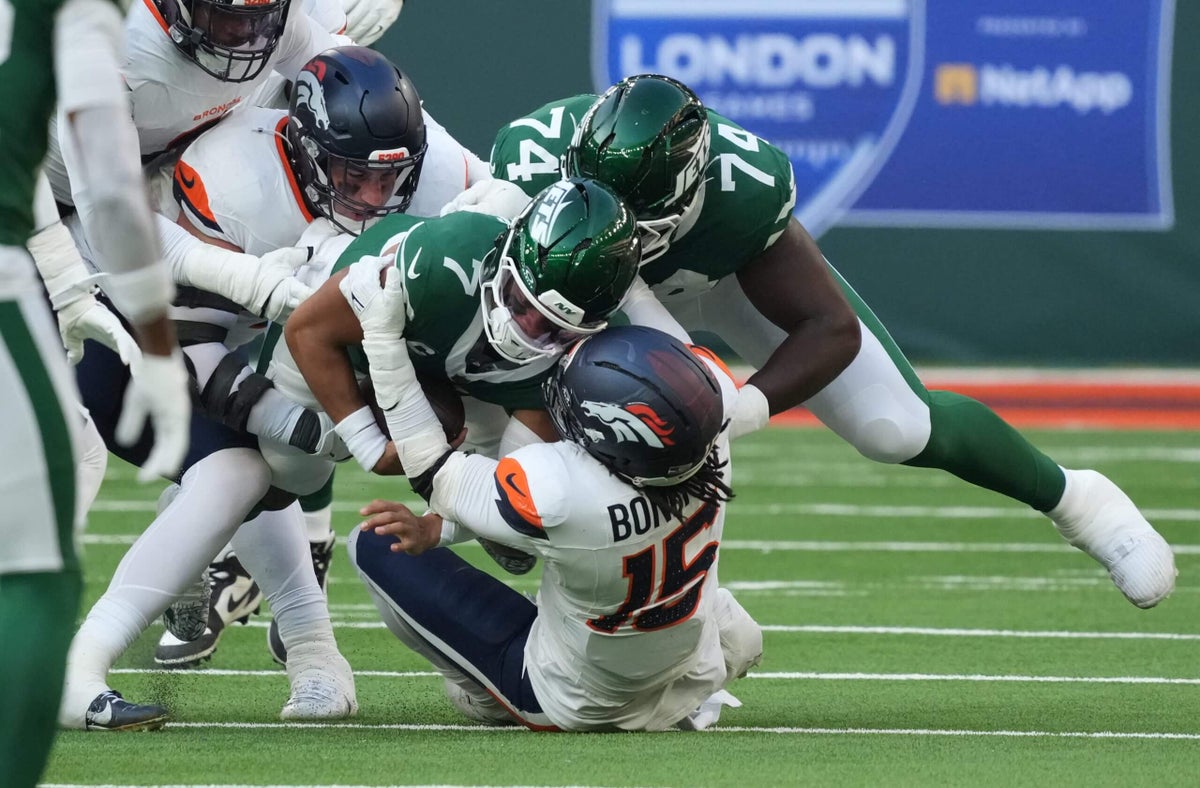
LONDON — Justin Fields looked to the sideline and saw Aaron Glenn staring back at him. The offense was lined up for a play but a snap would never come. As the clock ticked down to zero, Garrett Wilson walked off the field and threw his arms up. He followed Glenn off the field, shaking his head on his way through the tunnel.
The clouds over Tottenham Hotspur Stadium cleared around kickoff, but boos rained at halftime, an understandable reaction for a group of fans who flew thousands of miles to watch their favorite team on foreign soil, only to watch their players scurry into the locker room, confused as to why their coach was simply … giving up. They weren’t the only ones.
Glenn has spoken a lot about all he learned while working on Sean Payton’s coaching staff with the Saints, but there his mentor was on Sunday, at halftime, looking across the field, wondering what his protege was doing.
“We were waiting, either a Hail Mary or something,” Payton said. “And then the clock just ran out, so that was a little surprising. That’s unusual.”
There are numbers that can explain what happened on Sunday, like an NFL team finishing a game with minus-10 passing yards — but that won’t really do the trick. The Jets, in spite of a historic level of passing ineptitude, still had a chance to win. Instead, they will fly back to the United States on Sunday in silence, alone, the last team left at the bottom of the NFL after a 13-11 loss.
“I can’t process it right now,” Sauce Gardner said after the game. “As a player, I’m tired of these quiet locker rooms.”
Wilson winced. He didn’t want to talk. His brain was scattered, worried about the severity of an injury he suffered late in Sunday’s game, reeling from another wasted moment, another baffling loss. But his thoughts crystallized when it came to that moment before halftime — a moment that was the picture of the 2025 Jets. In a word (or two): Dysfunctional surrender.
There was one minute left when the Jets ran a trick play on fourth-and-1, lining up to punt only to directly snap it to running back Breece Hall. It worked. Teams don’t usually go for it on fourth down before halftime unless they are trying to score. Glenn called timeout … and then ran the ball again, a handoff to Hall. With 44 seconds left, Fields was sacked, so Glenn called timeout again. With 37 seconds left, Fields completed a pass to wide receiver Josh Reynolds for six yards, short of the first down. The ball was spotted at 27 seconds.
Tick, tick, it ticked away. They did nothing. With a few seconds left, Wilson walked off the field. The Jets, down 10-6, went into the locker room, many players with a confused look on their faces.
Wilson, a captain, went to his coach.
“I just didn’t know exactly what the plan was,” Wilson said. “And once I figured it out, I was disappointed.”
Glenn’s explanation, paraphrased: The Jets were getting the ball back, he wasn’t sure in the moment if the Jets had gotten a first down because, he said, one ref said yes, the other said no. It turns out they didn’t.
“I’m not about to sit there and try to get a play off, they get the ball back, give them a chance to kick a field goal,” Glenn said.
He referenced last week’s loss, when the Jets attempted to push the ball down the field before halftime, failed, and then the Cowboys scored two plays later, a crucial moment in a blowout loss.
“I don’t want to put our guys in a situation like that again,” Glenn said. “I think the smart thing to do is: We run this clock down, can we come back in the second half and get some points again?”
In one fell swoop, it could be argued that Glenn displayed a lack of trust in both his defense — which was in the midst of its best game of the season — and his offense, with a quarterback Glenn furiously defended moments later in the same press conference.
“I don’t know exactly what the plan was,” Wilson said. “I just thought once we converted the fourth down, I thought we were going to try to (score) then we get to another fourth down and — it’s a tough spot to be in. In the moment, I was like: Man.”
C’mon, man. What kind of question is that?
Glenn’s hand-picked quarterback played in such a way that can be hard to come back from, especially in a locker room that has been here before — and with a quarterback they believe in (Tyrod Taylor) waiting in the wings. When Fields wasn’t missing his targets, or throwing it to them too late, he wasn’t throwing it all. Three seconds are a lifetime in the NFL, especially against a Broncos pass rush that already led the NFL in sacks before Sunday.
Tick, tick, tick, BOOM.
That was Fields’ day. He was sacked nine times, hit 15 more — and on many of those occasions, receivers were open. If Fields’ first read was covered, he panicked, and held onto the ball. After a week of pushing back on the narrative that he holds onto the ball too long, that’s exactly what he did.
“I got to get the ball out,” Fields said afterward.
Left guard John Simpson put the responsibility on the shoulders of the offensive line, though that wouldn’t be an entirely fair way to assess the pressure. The receivers were, at times, streaking open, so it wouldn’t be fair to put it on them either.
“It’s a tough spot as a receiver,” Wilson said. “Obviously, you want to keep in mind all the things they are dealing with back there. The O-Line had to deal with a tough front today. It’s not always as simple as: I’m open, I get the rock. I would just say knowing the plan we had in totality and staying and waiting and being ready for your moment if it does come.”
The moment never came, not on offense.
But when Jets defensive end Jermaine Johnson sacked Bo Nix with 3:19 left, the Jets, somehow, still had a shot.
Trailing by two, the final drive started with a bad snap; Breece Hall scooped it up and turned it into a seven-yard gain. Two plays later, Fields was sacked. Three plays after that, on fourth-and-8 from the 44, Fields took a 12-yard sack, and so the misery was finally over.
By the time it was over, Fields had completed 9 of 17 passes for 45 yards. He averaged 5.5 air yards per attempt — which, for context, would rank 33rd of 34 qualifying quarterbacks this season. He was afraid to throw it, and so the Jets were afraid to call passes. The running game wasn’t really working either. The Jets offense went the entire game without an explosive play, according to NextGen Stats, the first time any offense has done that sort of thing since 2021.
So, will Fields be the Jets quarterback next week?
Glenn responded with consternation, befuddlement at the suggestion that he’d consider benching Fields — even though he played the way he did, even though the Jets are 0-6, and even though Fields was behind the wheel for their offensive ineptitude.
“There’s guys that have bad games,” Glenn said. “That doesn’t mean you just bench them. C’mon, you know better than that.”
He added later: “I don’t want to sit there and pin this all on Justin.”
Glenn released returner Xavier Gipson for much less after Week 1, after Gipson fumbled away a kickoff in a crucial moment. But Glenn is riding with Fields anyway — even as the Jets wasted their first positive defensive performance of the season, a familiar tale for this franchise.
The Jets were 6-4 in 2022 when Robert Saleh benched Zach Wilson for Mike White. He had to — the defense was dominating and yet they were losing because of incompetent quarterback play. The locker room was turning, so Saleh made the switch.
These Jets are not 6-4. They’re 0-6. The defense was the biggest reason for the first five losses, but not on Sunday. Jarvis Brownlee forced a fumble on the first possession, the defense’s first takeaway of the season. They held Nix to 49 passing yards in the second half, and Broncos running backs only averaged 2.6 yards per carry for the game. The Jets were only penalized two times. The defense only allowed one touchdown, on a coverage miscommunication that left Broncos tight end Nate Adkins wide open in the end zone. That first-quarter mishap wasn’t repeated.
The Jets offense started possessions from the Broncos’ 37 and 24, as well as the Jets’ 43, 42 and 43. The Jets gained 60 yards combined on those five possessions — 37 coming on one drive — and scored nine points.
“I feel like we got what we wanted to get done,” Johnson said. “We said we have to be the reason we win or we’re in it. I feel like we got that done. But we’re always thumb pointers, that’s the main thing.
“It’s always going to be frustrating when the engine is not firing collectively. It doesn’t matter what the component is.”
Before the season, Glenn explained that the last four minutes of each half are on the head coach. Those are the high-pressure moments, the situations when he is supposed to step up and make the right decisions to put the Jets in position to score, or to win.
Those scenarios have not played out well so far, though that’s not the way Glenn sees it: “I think the decisions have been the correct decisions. Sometimes we just didn’t execute it.”
There was nothing to execute at the end of the first half, as it turns out. Glenn chose to retreat to the locker room instead. To Wilson, and to many watching, that’s how everything feels right now — a retreat.