The opening of a colossal new museum containing treasures of the pharaohs has reignited a campaign for Britain to return one of ancient history’s most important artefacts.
Academics say the £910 million Grand Egyptian Museum (GEM) in Cairo strengthens the case for the Rosetta Stone to be given back to Egypt.
The stone, carved between 323BC and 30BC, was the key to understanding hieroglyphics.
It has been almost constantly on show at the British Museum since 1802.
The GEM officially opened yesterday and will house more than 100,000 items in an area the size of 70 football pitches.
Other iconic relics regarded as stolen loot by some Egyptologists include the 3,300-year-old bust of Queen Nefertiti, held by Berlin‘s Neues Museum, and the Dendera Zodiac, a stone relief map of the ancient sky, at The Louvre.
Dr Monica Hanna, Dean of the Arab Academy of Science and Technology, said they were ‘taken under a colonialist pretext’ and should be repatriated because ‘the GEM gives this message’.

Academics say the £910 million Grand Egyptian Museum in Cairo strengthens the case for the Rosetta Stone (pictured) to be given back to Egypt
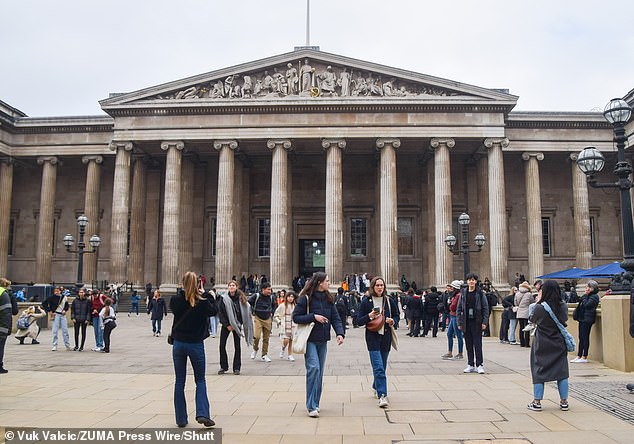
The stone, carved between 323BC and 30BC, has been almost constantly on show at the British Museum since 1802
Speaking on BBC Radio 4’s Today programme she added: ‘On the occasion of the inauguration, Egypt should start asking officially for the restitution and repatriation of the different objects that were looted in the 20th and 19th century.’
Her call has been supported by Dr Zahi Hawass, Egypt’s former minister of antiquities.
The Rosetta Stone was discovered in 1799 at Fort Julien, near the port of Rosetta, on the west bank of the Nile.
When the British defeated the French in 1801 they took it to London as war booty.
Share or comment on this article:
Pressure intensifies on Britain to return the Rosetta Stone after new museum opens in Egypt