
Everyone poops, but it’s still something a lot of us have an awfully hard time talking about. (Unless you’re my 6-year-old and 3-year-old, who cannot talk about poop enough, it turns out.)
Ekaterina Demidova / Getty Images
But it’s unfortunate that poop talk tends to make adults squeamish, because our stool can offer some powerful clues about what’s going on inside our guts — and even more broadly within our bodies. And doctors really do wish people would lean into it.
“When I ask patients to describe their stool, even when they’re at the GI doctor, you can almost immediately sense their discomfort,” Christopher Henry, a gastroenterologist at Thomas Jefferson University in Philadelphia, told HuffPost.
Related: Colon Cancer Is On The Rise, But Doctors Say This One Habit Can Significantly Reduce Risk
Enter the Bristol Stool Chart (sometimes called the Bristol Stool Form Scale or the Meyers Scale), a diagnostic tool that health professionals can use with their patients to help determine what’s normal (and what’s not) in terms of size, texture and color of poop.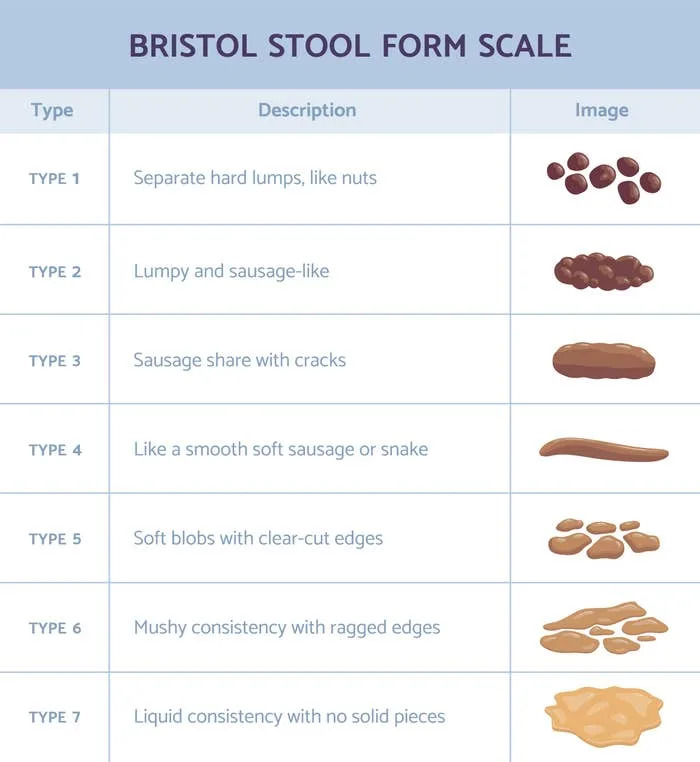
Sabelskaya / Getty Images
In general, ideal poop is Type 3 or Type 4. Type 1 or Type 2, on the other hand, can indicate a person is struggling with constipation. And Types 5, 6 or 7 can suggest diarrhea — though not always.
“Sometimes I’ll have patients with very severe constipation, and they’ll have periodic diarrhea,” Henry said.
That particular example shows why the stool chart really shouldn’t be used by laypeople to self-diagnose. Instead, people should see it as a jumping-off point for health-related conversations — and it certainly can help make those discussions less awkward. Many people find it easier to point to a line on a chart than to have to search for the words to describe their stool to a provider, Henry said.
Doctors, on the other hand, can use the chart to help diagnose conditions like various types of irritable bowel syndrome, or IBS.
Ingwervanille / Getty Images
Related: 17 Cancer Patients Are Sharing The Concerning Symptoms That Made Them Go To The Doctor ASAP
If your poop pretty consistently falls outside of the normal types on the chart, that’s definitely worth flagging to your primary care physician, who might refer you to a specialist. Significant changes in poop frequency or form also are worth noting. And don’t ignore other gastrointestinal symptoms. That includes heartburn that doesn’t get resolved with antacids, blood in your stool, severe pain or unintentional weight loss.
Even if your poop-related issues turn out to be relatively mild, a doctor might be able to help you with some simple changes that can help you achieve the ideal poop (and feel better overall) — like getting sufficient fiber and water.
But experts caution against getting too caught up on whether your poop is exactly the right texture and color based on the chart ― especially because there are many slightly different iterations of it floating around the web. Also, people’s stool color can vary based on what they eat.
Westend61 / Getty Images
But what the Bristol Stool Chart can do pretty well is provide clarity.
Henry recalled an experience when he was working with multiple patients complaining of diarrhea, but when he asked them to point to what their stool looked like on the chart, they pointed to Type 1 — which actually indicates constipation. They believed that diarrhea referred more to frequency, rather than to a particular stool form.
In cases like that, the chart helps to create a shared language, to make sure patients and their providers are on the same page.
“I think of it kind of like a Rosetta stone. To make sure we’re using the same words to mean the same things,” Henry said. “It’s a platform for patients and doctors to have better conversations.”
Because talking about poop may not be most grown-ups’ favorite thing to do, but it’s an important part of overall well-being.This article originally appeared on HuffPost.
Also in Goodful: People Asked Male Gynecologists To Honestly Answer Questions About Their Job, And It’s Way More Wholesome Than I Thought It Would Be
Also in Goodful: My Mom’s Disappearance Was A Mystery. Then I Saw An Old Photo — And What I Discovered Next Left Me Shaken.