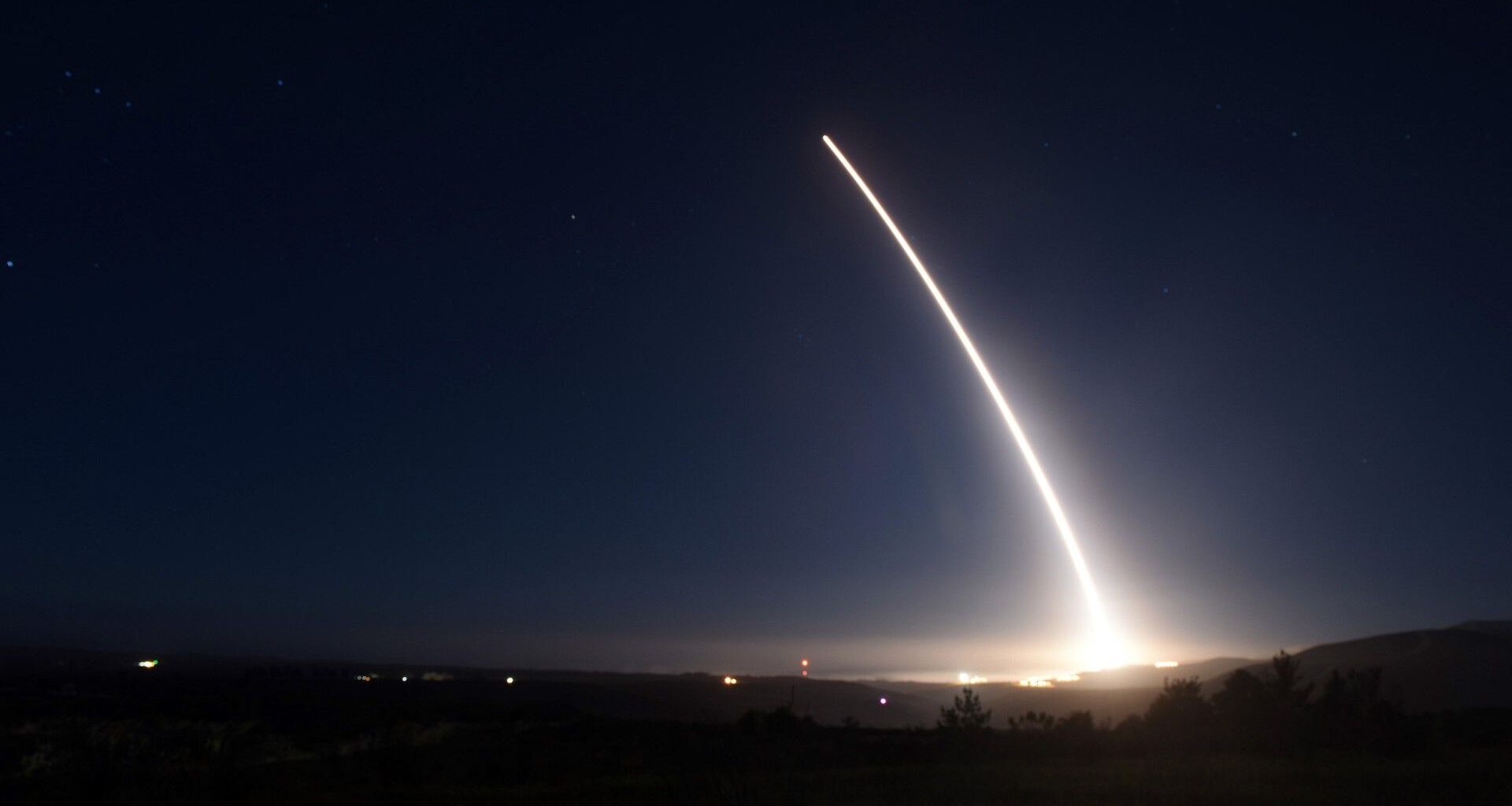
Minuteman III missile test.
Photo. Senior Airman Kyla Gifford/U.S. Air Force photo
At the end of October, U.S. President Donald Trump announced the need for the United States to immediately resume nuclear weapons testing. What might that look like in practice? What would the White House hope to achieve with such an action?
The latest SIPRI (Stockholm International Peace Research Institute) report clearly shows that most states possessing nuclear weapons are continuously developing their capabilities in this area. China maintains the fastest pace of growth in its nuclear warhead stockpile; according to SIPRI data, it increases its stockpile by roughly 100 warheads per year. The three countries mentioned today hold almost 90 percent of the world’s nuclear weapons stockpiles (the report states that 9,614 warheads were in military stockpiles potentially available for use, and about 2,100 of them were kept at high operational readiness — ed.). Knowing the existing arsenals, the question of the ability to test them remains separate.
Obstacles to overcome?
Could Donald Trump’s announcement about resuming nuclear tests be easy to carry out? We know well that there is a long way from a political declaration posted on one of the social platforms to implementation. After more than 30 years of pause, would such tests even be possible? According to a PISM expert, Artur Kacprzyk, the answer is yes. Returning to such tests after more than 30 years would be feasible, but complicated and time-consuming (it could take from several months up to three years).
„It would depend, among other things, on whether the U.S. wanted to conduct a nuclear test solely as a political demonstration, or whether it intended to use the information gathered to improve its arsenal. If the latter were the case, additional preparations of infrastructure and personnel for conducting diagnostic research would be necessary,” said Artur Kacprzyk, who pointed out that potential tests could also be delayed for formal reasons (safety or environmental regulations).
Interestingly — as he stressed — international law would not necessarily be the problem here. „Although the U.S. signed the Comprehensive Nuclear-Test-Ban Treaty (CTBT) in 1996, it did not ratify it. It is therefore not bound by its provisions and could legally carry out an underground nuclear test,” the PISM expert reminded.
Another issue not to be forgotten is the location of potential nuclear tests. Certain obstacles could appear here. Admittedly, there is a facility in Nevada intended for this type of testing, but its heyday is behind it. It is also not hard to assume that resuming specific activities would meet some social resistance.
„If the United States decided to carry out an explosion in the atmosphere, underwater, or in outer space, it would first have to withdraw from the 1963 Partial Test Ban Treaty (PTBT). Such tests would also carry a greater risk of undesirable effects, such as contamination beyond the test site. But an underground explosion in Nevada would also be politically controversial both globally and within the United States. Over the years the U.S. government paid compensation to some citizens who may have suffered as a result of tests,” Artur Kacprzyk summed up this thread.
A separate matter is the reaction of other nuclear powers to possible American tests. It is highly likely that both Russia and China would use the situation to massively criticize Washington. More importantly, they would view U.S. actions as a pretext to officially resume their own nuclear tests (it is worth noting that in recent days the CIA acknowledged having information indicating that Moscow and Beijing are secretly conducting nuclear tests. It is also worth noting that in 2023 Russia renounced the treaty banning tests, and China is expanding ranges for conducting them — ed.).
According to the PISM expert, a „green light” for nuclear tests would be particularly advantageous for America’s adversaries. „From a technical-military dimension, both of the U.S.’s rivals would have more to gain from nuclear tests than the Americans. That is, they could more readily use them to improve their arsenals. This applies especially to China — there are 45 confirmed cases of Chinese nuclear tests, compared with 1,030 American and 715 Soviet and Russian tests. That means the U.S. and Russia have collected far more data from their tests, useful for maintaining warheads and developing new ones. At the same time, the Americans have far more advanced laboratory capabilities to carry out such work,” said Artur Kacprzyk.
What did Trump want to achieve?
Finally, there is the question of the words Donald Trump published at the end of October. The U.S. president wrote on the Truth Social platform that, because of other countries« testing programs, he has instructed the Department of War to begin testing our nuclear weapons on an equal footing; he added that the said process shall begin immediately.
How should these words be interpreted? According to the PISM analyst, it is not certain that Trump actually meant a return to trial nuclear explosions. As Artur Kacprzyk noted, the American president wrote about the need for the U.S. to conduct „nuclear tests” on a par with Russia and China.
„It is possible that he meant more frequent test firings of delivery missiles for nuclear warheads, but without warheads on board. This is all the more likely because Trump’s post appeared right after Putin boasted of testing new intercontinental delivery systems and nuclear-powered systems: the Burevestnik cruise missile and the Poseidon underwater drone,” our interlocutor pointed out, adding that Trump’s words should certainly be treated as an attempt to exert pressure on both Moscow and Beijing.
”(…) Both of the U.S.’s rivals are expanding their nuclear arsenals, and China is doing so particularly rapidly. Trump has long been open about wanting to negotiate new limits on nuclear arsenals with both countries,” he concluded.