Former French president Nicolas Sarkozy is released from prison – story Angelique Chrisafis
in Paris
The former French president Nicolas Sarkozy has been released from prison after a judge ruled he could serve the rest of his sentence at home.
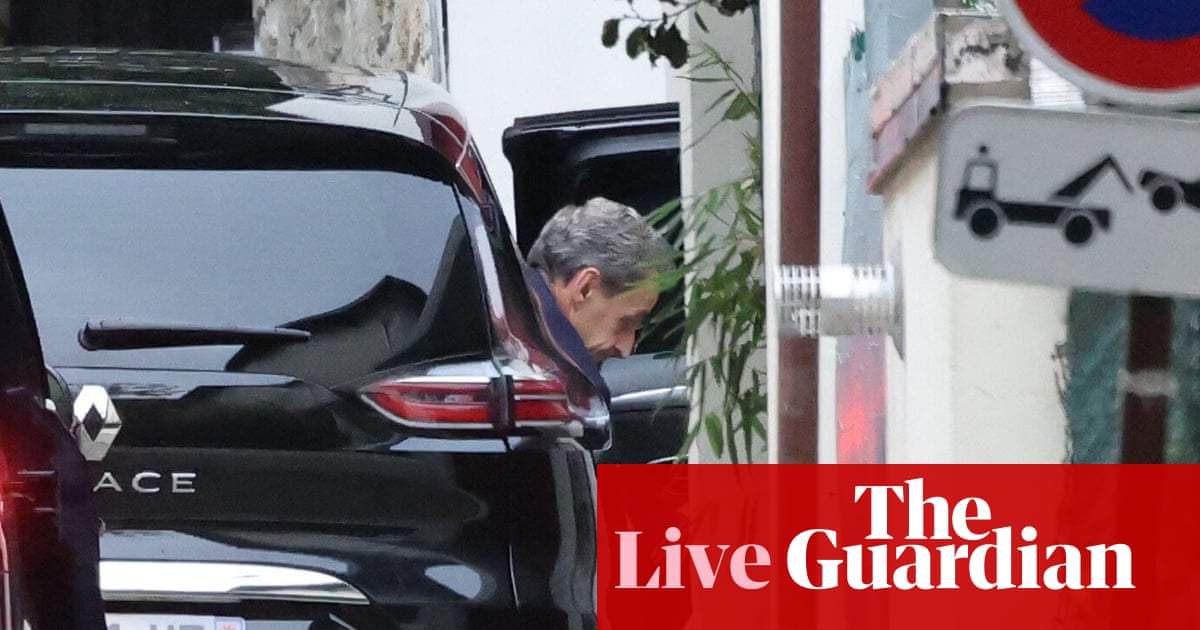
 Former French president Nicolas Sarkozy arriving at his residence in Paris, France. Photograph: Jumeau Alexis/ABACA/Shutterstock
Sarkozy was driven by car from La Santé prison in Paris accompanied by his wife, the singer Carla Bruni-Sarkozy, and arrived at his home in the west of the city without making a public comment.
Earlier, he had told a Paris appeals court by video link that his three weeks in jail had been “gruelling” and a “nightmare”.
Sarkozy went to prison on 21 October, after a Paris court gave him a five-year sentence for criminal conspiracy over a scheme to obtain election campaign funds for his 2007 presidential race from the regime of the late Libyan dictator Muammar Gaddafi.
He denies wrongdoing and has appealed against that verdict, with a fresh trial on appeal scheduled for next spring. Judges ruled last month that, because of the “exceptional gravity” of his conviction, he must go to prison while the appeals process took its course.
A Paris appeal court on Monday granted Sarkozy’s request for release to serve his sentence at home with strict judicial controls. Under the terms of his release, Sarkozy will be forbidden from talking to any officials from the justice ministry, including the justice minister, Gérald Darmanin.
Darmanin, who once considered Sarkozy as his mentor before rejoining Emmanuel Macron’s centrist party in 2017, visited the former president in prison last month. Some French magistrates criticised the move as undermining the independence of judges.
Sarkozy will also be forbidden from talking to others involved in the case, and he will be banned from leaving France.
At the hearing on Monday morning, Sarkozy, dressed in a navy blue suit, appeared on camera from prison, seated at a table with his lawyers beside him. He told the court: “I want to pay tribute to all the prison staff, who are exceptionally humane, and who have made this nightmare bearable – because it is a nightmare.”
He said: “I never had any idea or intention to ask Mr Gaddafi for any kind of financing … I will never confess to something I didn’t do … I never imagined that at 70 years of age, I’d be in prison. It’s an ordeal that has been imposed on me. I confess it’s hard, it’s very hard. It leaves a mark on any prisoner because it’s gruelling.”
Key events
Show key events only
Please turn on JavaScript to use this feature
Closing summary Jakub Krupa
… and on that note, it’s a wrap!
-
Former French president Nicolas Sarkozy has been released from jail and will await his appeal trial early next year at home under strict conditions (13:40, 14:47), which include prohibitions on talking to other accused or any officials from the country’s justice ministry.
-
The former president will also be banned from leaving France, pending appeal.
-
Sarkozy, accompanied by his wife, Carla Bruni, left the La Santé prison early afternoon and returned to his residence in west Paris (15:03, 15:17, 15:24).
-
His lawyers said today’s decision was just the first step in a broader process of challenging the original sentence, adding “the next step is the appeal trial” (13:49).
-
Earlier, Sarkozy had told a Paris appeals court by video link that his three weeks in jail had been “very hard” and “gruelling” (10:31).
Elsewhere,
-
79 people were hospitalised, mostly with light injuries, after two trains collided near Bratislava in Slovakia last night in a second high-profile crash in the last month (12:37).
-
A man has gone on trial in the eastern German city of Magdeburg on charges of murdering six people and attempting to murder hundreds more by deliberately ploughing his SUV into a packed Christmas market last December (16:40).
-
A Russian opposition activist arrested in Poland has admitted he worked as an undercover agent for Russia’s FSB security service and informed on other opposition figures, court documents claim (12:02).
-
Ursula von der Leyen has offered an olive branch to the European parliament to head off a revolt over her plans for a radical shake-up of the EU budget (11:45).
-
Carmakers in Europe have received their first deliveries of chips from the Chinese owned Nexperia plant following a lift on the ban on exports last week (12:54).
And that’s all from me, Jakub Krupa, for today.
If you have any tips, comments or suggestions, email me at jakub.krupa@theguardian.com.
I am also on Bluesky at @jakubkrupa.bsky.social and on X at @jakubkrupa.
According to France Info, there are currently no plans for a public statement from Sarkozy this evening.
Former French president Nicolas Sarkozy arrives by car at his house after leaving La Sante prison following a court decision to release him, in Paris, France. Photograph: Mohammed Badra/EPASharePalestinian man dismissed from Gaza says he’s left penniless after losing access to bank account with severance pay Lisa O’Carroll
A Palestinian man who was evacuated from Gaza to Egypt during the way and then dismissed by the EU after nearly 20 years service has said he has been left penniless unable to access a severance payment made by Brussels.
Mohammad Baraka, who is suing the EU over alleged breach of Belgian law and discrimination, was told he would be paid €54,025.45 euro as a “comprehensive financial and welfare severance package following the end of his contract” in June.
However, the payment was made in a single tranche, raising red flags of a potential corrupt payment, under controls put in place by the Palestinian Monetary Authority in cooperation with the Israeli ministry of finance under the Oslo Agreements on joint coordination between the Palestinian Authority and Israel.
Under the rules no more than $10,000 can be transferred in a single transaction.
Baraka says he has just $3 in his bank account, no access to the money and has had no contact from the EU over his welfare.
He has now legal right to live in Egypt or to receive hospital care for his seriously ill wife, or the right to send his children to school.
“Since I arrived in Egypt, they promised me dozens of times, ‘Don’t worry, we are with you, we will support and help you,’” he said.
He said:
“My bank account in Gaza is active and functions without problems.
However, the bank is used to receiving my regular monthly salary.
Suddenly, in July, they transferred a lump sum of €54,000 to my Gaza bank account without informing me in advance.
The bank immediately froze the amount, and it remains blocked without explanation.
I have no money, no work permit, and no one to support me here in Egypt.
My family in Gaza lives in tents without homes or food, and they cannot even help themselves.
Even the amount of 54,000 euros, which is my right, I have not received to be able to live with a little human dignity.”
Asked about the situation on Monday, the EU said it could not comment on the payment.
Updated at 11.01 EST
Netherlands presses on with plan to ban imports from illegal Israeli settlements Emma Graham-Harrison
in Jerusalem
The Netherlands is still working on legislation to bar imports from illegal settlements in occupied Palestine, even though it has paused a push for broader sanctions on Israel after last month’s ceasefire deal in Gaza, the foreign minister has said during a visit to the region.
Dutch foreign minister David van Weel Photograph: Hollandse Hoogte/Shutterstock
The partial ban was a response to settlement expansion and spiralling Israeli violence against Palestinians that threatened the viability of the two-state solution, David van Weel said after visiting an area in the West Bank that had been targeted by settlers.
“Now we deem it is not a time to increase sanctions on Israel because we want to see the peace plan implemented and we want to also encourage Israel to play a positive part in this,” he told the Guardian in an interview.
“At the same time, we’re not blind to any movements on the West Bank that might move the two-state solution further (away).”
Five EU countries have announced plans to impose sanctions on trade with Israeli settlements in the occupied West Bank, where soldiers and settlers have killed more than 200 Palestinians this year, including 40 children.
Spain and Slovenia have banned exports from settlements; Ireland and Belgium are working on legislation and implementation. Belgium and Spain have cut consular services to settlement residents.
Van Weel said drawing up the legislation had been slow and difficult since trade policy was mostly controlled by the EU.
“It’s not easy to make a carve-out,” he said. “We cannot just stop [all imports from illegal settlements] immediately because there is currently no legal basis for that. We are trying to make new policy now, then it has to go through parliament.”
ShareMan goes on trial in Germany over deadly Christmas market car attack Kate Connolly
in Berlin
A man has gone on trial in the eastern German city of Magdeburg on charges of murdering six people and attempting to murder hundreds more by deliberately ploughing his SUV into a packed Christmas market last December.
Defendant Taleb al-Abdulmohsen (L) arrives for the first day of his trial for murder in the 2024 Magdeburg Christmas market attack. Photograph: Jens Schlueter/EPA
Taleb al-Abdulmohsen, 51, a psychiatrist from Saudi Arabia, appeared in court on Monday wearing handcuffs and with his feet shackled, accompanied by armed police. He will be held in a bullet-proof glass case throughout the trial.
In a lengthy indictment read out over several hours, the chief public prosecutor, Matthias Böttcher, said the defendant had acted “with the intention of killing an indeterminately large number of people”, when, on 20 December 2024, he “deliberately drove his 2-tonne, 340-horsepower car into a large number of pedestrians”.
In what Böttcher described as a carefully planned attack that took place between 7.02pm and 7.04pm, the majority of deaths occurred within a few seconds.
A nine-year-old boy and five women, aged between 45 and 75, were killed. A further 338 people were injured, 31 of them in a way prosecutors describe as life-changing.
Abdulmohsen was described as a critic of Islam and a supporter of far-right views and radical conspiracy theories who appeared to have been motivated by “personal resentment” and a sense of “perceived injustice” after a legal dispute.
ShareJakub Krupa
As there’s no sign of Sarkozy coming planning to come out to talk to reporters, let’s take a quick look at other stories across Europe instead.
ShareFormer French president Nicolas Sarkozy is released from prison – storyAngelique Chrisafis
in Paris
The former French president Nicolas Sarkozy has been released from prison after a judge ruled he could serve the rest of his sentence at home.
Former French president Nicolas Sarkozy arriving at his residence in Paris, France. Photograph: Jumeau Alexis/ABACA/Shutterstock
Sarkozy was driven by car from La Santé prison in Paris accompanied by his wife, the singer Carla Bruni-Sarkozy, and arrived at his home in the west of the city without making a public comment.
Earlier, he had told a Paris appeals court by video link that his three weeks in jail had been “gruelling” and a “nightmare”.
Sarkozy went to prison on 21 October, after a Paris court gave him a five-year sentence for criminal conspiracy over a scheme to obtain election campaign funds for his 2007 presidential race from the regime of the late Libyan dictator Muammar Gaddafi.
He denies wrongdoing and has appealed against that verdict, with a fresh trial on appeal scheduled for next spring. Judges ruled last month that, because of the “exceptional gravity” of his conviction, he must go to prison while the appeals process took its course.
A Paris appeal court on Monday granted Sarkozy’s request for release to serve his sentence at home with strict judicial controls. Under the terms of his release, Sarkozy will be forbidden from talking to any officials from the justice ministry, including the justice minister, Gérald Darmanin.
Darmanin, who once considered Sarkozy as his mentor before rejoining Emmanuel Macron’s centrist party in 2017, visited the former president in prison last month. Some French magistrates criticised the move as undermining the independence of judges.
Sarkozy will also be forbidden from talking to others involved in the case, and he will be banned from leaving France.
At the hearing on Monday morning, Sarkozy, dressed in a navy blue suit, appeared on camera from prison, seated at a table with his lawyers beside him. He told the court: “I want to pay tribute to all the prison staff, who are exceptionally humane, and who have made this nightmare bearable – because it is a nightmare.”
He said: “I never had any idea or intention to ask Mr Gaddafi for any kind of financing … I will never confess to something I didn’t do … I never imagined that at 70 years of age, I’d be in prison. It’s an ordeal that has been imposed on me. I confess it’s hard, it’s very hard. It leaves a mark on any prisoner because it’s gruelling.”
ShareJakub Krupa
Let’s now cross to our Paris correspondent, Angelique Chrisafis, for her take on what happened today in Paris.
Two of Sarkozy’s sons – Jean and Pierre – were spotted near the former president’s residence in Paris.
Jean Sarkozy at Nicolas Sarkozy’s residence in Paris, France. Photograph: Jumeau Alexis/ABACA/ShutterstockJean Sarkozy and Pierre Sarkozy, sons of former French President Nicolas Sarkozy, are seen in Paris. Photograph: Jeanne Accorsini/SIPA/ShutterstockShare
And here’s the man himself, arriving back at his apartment in west Paris.
Former French president Nicolas Sarkozy seen arriving at his flat in west Paris after leaving La Sante Prison earlier today. Photograph: Jumeau Alexis/ABACA/ShutterstockShare
Updated at 09.25 EST
And Sarkozy has just arrived at his apartment, with his and police cars going past a group of reporters and other people gathered outside, with heavy police presence at the scene.
A screengrab from France Info’s coverage of Sarkozy’s return home after he was released from jail in Paris, France. Photograph: France Info/YouTubeShare
Updated at 09.18 EST
Sarkozy – joined by his wife, Carla Bruni, as reported by Le Figaro – is now understood to be en route to his apartment in west Paris.
We should get a first glimpse of the former president when he gets there.
ShareCar believed to be carrying Sarkozy leaves La Santé Prison
A car believed to be carrying Sarkozy has been reported leaving La Santé Prison.
Vehicles believed to be carrying former French President Nicolas Sarkozy leave the Sante prison in Paris, France. Photograph: Benoît Tessier/ReutersShareSarkozy’s appeal trial expected in March
The formal appeal trial (13:49) is expected to begin in March, with the dates expected to be confirmed later this week, BFM TV noted.
ShareSarkozy expected to be released this afternoonJakub Krupa
We are expecting Sarkozy to be released from the La Santé Prison this afternoon, according to French reporters outside the prison.
I will make sure to bring you the latest when it happens, including pictures and potential quotes from the former president.
Updated at 08.54 EST
‘Long live freedom!’ Sarkozy’s son says
Nicolas Sarkozy’s son, Louis Sarkozy, has welcomed the court’s decision by posting a picture from his childhood with his dad, accompanied by a brief comment: “Long live freedom!”
SharePrison release just first step as defence eyes appeal process next, Sarkozy’s lawyer says
Sarkozy’s lawyer Christophe Ingrain offered a very brief response to the verdict, saying that today’s decision was just the first step, and that “the next step is the appeal trial.”
“And our job now, for Nicolas Sarkozy and for us, is to prepare for that appeal hearing,” he said.