Professional women’s road racing has come an incredible
distance in the past decade. Once relegated to one-day events or oddities, stage
races are now firmly part of the calendar. For instance, the Tour de France
Femmes avec Zwift launched in 2022 marked a watershed moment for women’s
cycling, as finally the women restored their own addition of cycling’s most famous
race.
More teams, more media, more exposure. Minimum wages
for women’s top-tier teams were introduced in recent years, elevating a degree of professionalism previously absent.
That progress is real: 2025 data from the rider union The
Cyclists’ Alliance (TCA) reports that 54% of surveyed women’s WorldTour and
ProTeam riders can live solely off their cycling income. At the same time,
viewership and commercial interest in women’s races are booming; today’s
broadcast audience in some markets rivals, or in hours surpasses, what the
sport had five years ago.
Yet the narrative of “closed gap” remains incomplete. Many
riders and journalists emphasize that although the shape of the sport for women
looks increasingly professional, the scale (budget, salary, media value, etc.)
remains much smaller than for men.
What does “pay-equality” actually mean in cycling?
When we ask “are men and women paid the same in cycling?” we must consider multiple dimensions: salaries (team contracts), prize money
(for races), benefits, and career security. In professional road racing, the
governing body Union Cycliste Internationale (UCI) sets minimum salary levels
for the top women’s teams (Women’s WorldTour).
For example, in 2025, the minimum salary for self-employed
riders in the Women’s WorldTour reached €62,320, and for employed riders at
least €38,000. Meanwhile, the tier below (Continental level) remains almost
unregulated in many places, with many riders earning far less.By contrast, the men’s WorldTour and ProTeam levels enjoy
much higher average salaries, much larger team budgets and far greater
prize-money pools (though publicly detailed comparisons are less consistent).
In race prize money alone: the 2025 Tour de France Femmes prize pool was €259,430
while the men’s equivalent (2025 Tour de France) exceeded €2.3 million.
According to TCA, 84% of women on Continental teams earn
under €20,000 annually; 42 % have a second job while racing. Thus “pay parity”
remains far from the lived reality for the majority of riders in the women’s
peloton.
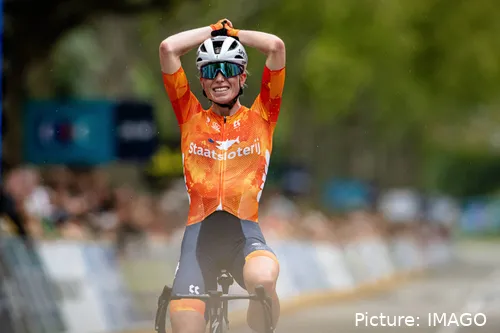
Demi Vollering is reported to be the highest-payed rider in the women’s peloton, with a salary of almost €1 million per season with FDJ – Suez. @Imago
Pay gap overview
Minimum salaries and structure
–Women’s WorldTour minimum salary (2025): €62,320
(self-employed) / €38,000 (employed) for top tier.
–At the Continental level, “over 75 % of WorldTour/Pro riders now hold
multi-year contracts; … but 84 % of Continental riders earn under €20,000
annually.”
Prize money disparities
–2025 Tour de
France Femmes general-classification winner takes €50,000.
–2025 men’s Tour de France winner takes approximately €500,000 and the total
prize pot for men about ten times that of the women’s equivalent.
Viewership and media growth
–The 2025 Tour de France Femmes drew a TV audience of 25.7
million in France alone across its nine stages.
–It achieved a 31.6 % audience share per stage in France.
–In Australia, the 2025 event logged 11.7 million third-party platform views,
a 99% year-on-year increase.
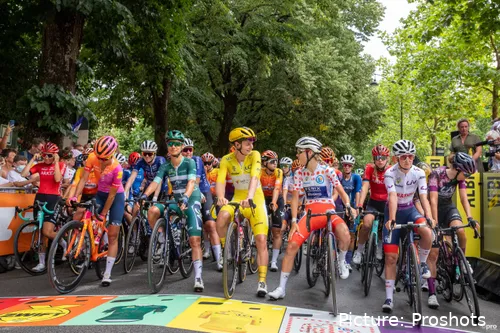
The Tour de France Femmes, upon its return, has become one of cycling’s biggest events quickly. @ProShots
Why the gap persists
Investment and budgets
Professional men’s cycling teams often operate with
multi-million-euro budgets, backed by long-term sponsors, television rights,
and deep commercial deals. By contrast, many women’s teams, even at top tier, remain
undercapitalized. A 2019 report noted that the average women’s team budget was
around US$200,000 versus US$16 million for men’s WorldTour teams.
Prize pool and revenue-sharing
Prize money is a visible indicator of value, but it’s also a
function of revenue generated from sponsorship, TV rights, race length and
media coverage. The race director of the Tour de France Femmes, Marion Rousse,
says: “It’s difficult to compare a race with 21 days and one with nine days”
when judging prize money. Thus some of the disparity is argued to stem from the
structural difference in event length itself.
Media coverage and exposure
Media exposure drives sponsorship which drives budget which
drives salary. The explosion in viewership of women’s races is promising (see
above), yet in most countries media coverage remains significantly less than
men’s racing. Less exposure means smaller commercial deals, fewer team
sponsors, lower budgets and thus lower pay potential.
Career pathways and lower tiers
A professional sport has to support talent at all levels.
While top women’s riders may now earn respectable salaries, the pipeline often
breaks down in lower tiers. The 2025 TCA survey shows that riders outside the
top two tiers are overwhelmingly financially insecure. If young women cannot
rely on cycling as a full-time profession, the talent pool and depth of the
sport suffer, which in turn limits commercial growth.
Momentum
Men’s cycling has had more than a century of sustained
commercial build-up, while women’s professional road racing is relatively new
in its modern form. That’s not to say women’s racing is ‘new,’ at that is
entirely false. But, the current wave of viewership, investment, and equality
improvements, is relatively new. Therefore, the economic infrastructure,
sponsorship hierarchies and media tradition are further behind.
How much difference does this make for women riders?
For riders earning under €20,000 annually (as many do),
cycling remains a part-time job or simply unsustainable long-term. The TCA
found that newer professionals (1-2 years experience) increasingly consider
quitting due to financial concerns. Without stable income, teams with budget
constraints may prioritise short contracts, limiting continuity and development
for athletes.
Lower budgets often mean fewer support staff, less
investment in training camps, less equipment margin and fewer racing
opportunities. That can limit performance progression and widen the gap between
top-tier women and their male or male-budgeted rivals.
When prize-money, sponsorship deals and media exposure
remain lower, athletes may struggle to build long-term earnings via
endorsements, brand deals or media opportunities. That impacts post-racing
careers, and the ability to retire with financial confidence.
Key voices and quotes from the peloton
“Definitely it was very special, but I think eventually we
will get where we should be. The goal of every rider is to one day have a
daughter that competes in sports and laughs at the times when there were
differences between men and women,” said Katarzyna Niewiadoma, after her 2024
Tour de France Femmes win.
“The easiest thing would be to completely scrap the whole
cycling model and start again,” Grace Brown (TCA president) summarising the
2025 survey findings.
“It’s not just about opening new doors for riders and fans;
it’s also about uplifting all the women involved in and around cycling,” Kate
Veronneau (Zwift head of Women’s Strategy) on investment in women’s cycling.
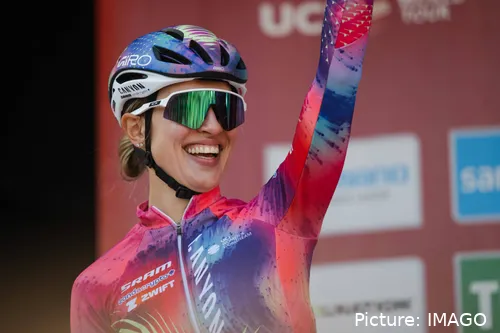
2024 Tour de France Femmes winner Katarzyna Niewiadoma is one of the many vocal voices who point out the disparity in pay between the two pelotons. @Imago
Opportunity for parity
The recent surge in viewership and media attention on
women’s cycling provides perhaps the most promising route to narrowing pay
gaps. To reiterate, the 2025 Tour de France Femmes attracted 25.7 million
viewers in France and achieved record audience shares.
What that signals: sponsors and broadcasters are
increasingly recognizing women’s cycling as a product (remember, sport is a
product to broadcasters) with audience pull. With growth in “attention” comes
growth in commercial value, better team budgets, higher salaries, larger
prize-pools. In this respect, women’s cycling is no longer just catching up, it’s
a growth opportunity for broadcasters and sponsors, as well as those competing.
If the commercial model scales then the pay disparities
become more about historical lag than structural inevitabilities. The challenge
is sustaining investment long enough for it to mature.
So: are men and women paid the same in cycling?
Short answer: No, not yet.
At the top level, women’s professional cycling has made
meaningful gains, minimum salaries, better contract structures, larger
audiences. But major gaps remain in prize money, team budgets, income for
lower-tier women, and media exposure.
Women’s cycling is still structurally smaller in scale than
men’s: fewer long stage races, less historical revenue accumulation, fewer deep
sponsorship deals. Many women riders, especially those in lower tiers or
Continental teams, remain financially insecure, some earning under €20,000 per
year, or working second jobs. However, momentum is growing: broadcast audiences are spiking, sponsorship is
rising, and commercial value is clearer than ever. In practical terms: while
the “top women” in cycling may earn mid/upper five-figure to low six-figure
salaries plus endorsements, many male professionals at similar levels still
earn substantially more, both in direct salary and via indirect revenue.
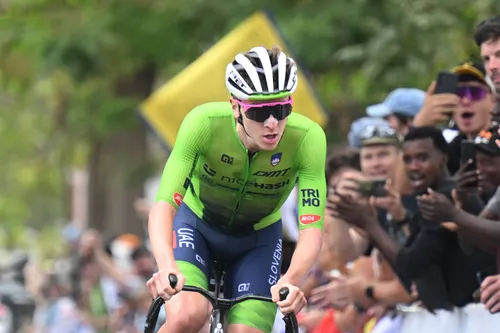
Is the €8 million salary Tadej Pogacar earns a possible goal for any female rider in the coming decades? @Sirotti
Final thoughts
Men and women in professional cycling are not yet paid the
same, and, actually, the gap in some areas is still large. But the story is not
one of stagnation, it’s one of transition. Women’s professional road cycling
has matured as a business from fragmented beginnings into a product with global
audiences, commercial investment and elite athletic performance. Still, large
segments of the female peloton remain insecure, under-paid, and under-exposed.
Remember, no one is denying that cycling had supremely
talented women’s riders during the 20th century, when the men’s
sport became globally popular. It just never had the business drive or
commercial elements of the men’s, but that is starting to change.
In the end, the value of women’s cycling isn’t just measured
in euros and contract, it’s measured in fairness and sustainability. As one
rider put it: for equal effort and equal suffering, there should be equal
reward. The next few years will show whether the sport embraces that principle,
or lets it slip again.