Seven months from now, thousands of miles from Wembley, England will start their 2026 World Cup finals challenge.
Their qualification campaign so far has been perfect — six games, six wins — and their two remaining group matches are now effectively dead rubbers. England host Serbia on Thursday before playing Albania away on Sunday. When the final whistle goes in Tirana, England will not play another competitive game until the big kick-off. Just two home friendlies in March and then likely two more pre-tournament in Florida in early June.
So while this week’s games do not look like they have a lot riding on them, every minute of the 180 counts. Head coach Thomas Tuchel and his staff are desperate to learn as much as they still can about their players between now and next summer.
There have been two themes in this run of three autumn international windows. The first was to “show the identity of Team England to the world”, as assistant coach Anthony Barry put it last week. The second is competition, to let every single player — whether in the squad or not — know that they are fighting for places and that if they perform well, they will be rewarded. Hence Tuchel’s decision in October to stick with the same group — injuries permitting — who played for him in September.
Tuchel did not want to look too far forward in his Wednesday press conference when asked about his plans for the World Cup.
“I hold myself back from knowing, or pretending to know so much,” he said. “I don’t feel the pressure, I don’t feel the World Cup urge. I just feel the excitement and pressure for tomorrow.”
But even though the focus is on competition, the outline of the team that will start that World Cup opener in the United States, Canada or Mexico is becoming clear. And while of course anything can happen in the next seven months — not least injuries — there are some players who are not exactly sweating on their squad places.
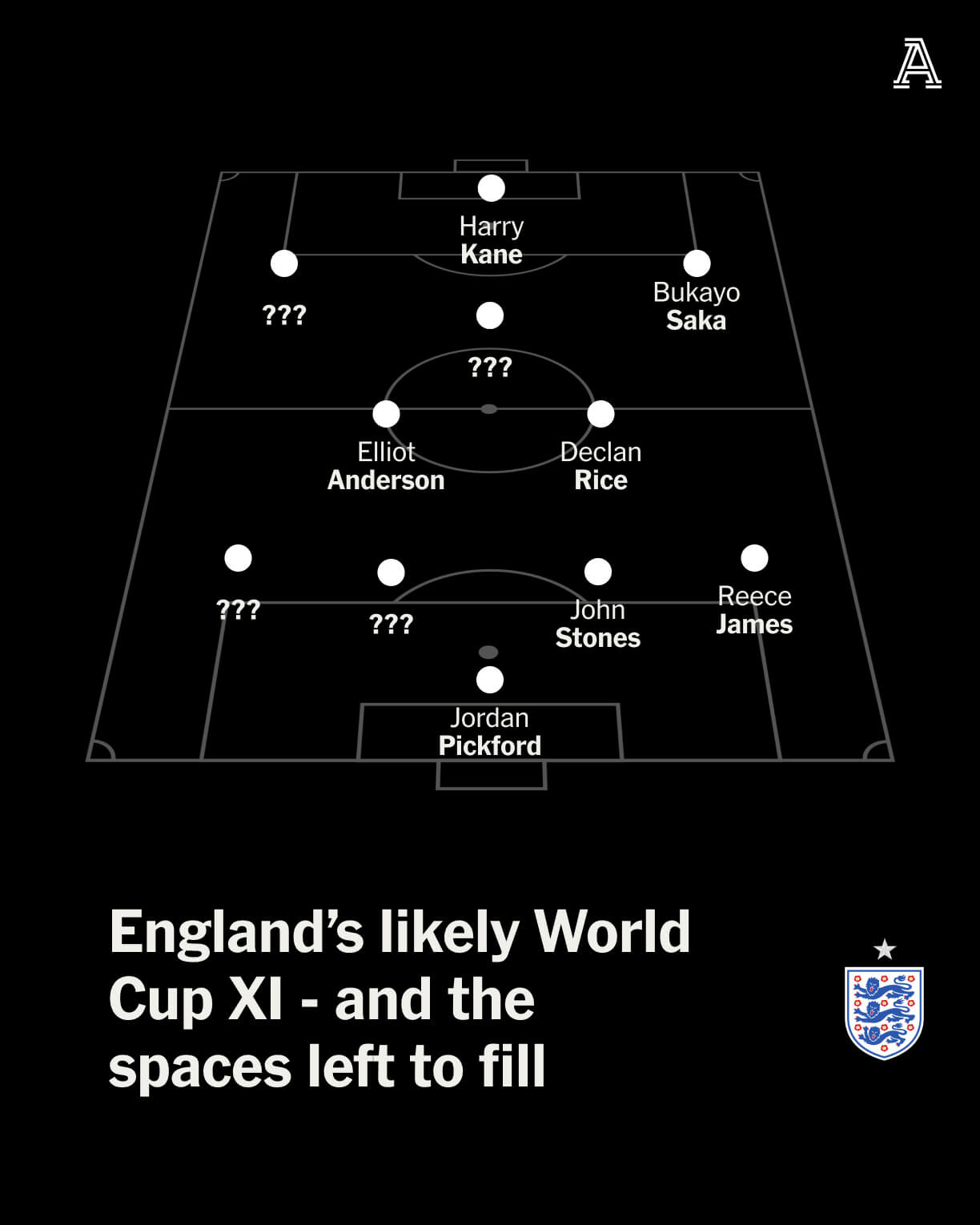
Jordan Pickford will be in goal for his third World Cup. He has started seven of Tuchel’s eight games so far. Dean Henderson is very good but nobody is disputing who England’s No 1 is.
Reece James now feels like the first-choice right-back. There is plenty of competition in that position, but he started both games in September and performed well, before missing the October matches with injury. John Stones will certainly start alongside him in central defence if fit.
In the middle of the pitch, Declan Rice is now one of this team’s most important players, and will very obviously start. Elliot Anderson has been the discovery of the autumn, only making his senior England debut in September but already looking like a seasoned international. He does everything a modern No 6 is expected to do and it would take something dramatic for him not to be alongside Rice next June. (Tuchel insisted on Wednesday that he would offer no guarantees, certainly in public, for a World Cup spot for the 23-year-old.)
Out on the right, Bukayo Saka started both games last month and it would be a surprise for him to lose his place, assuming he stays fit. Nothing needs to be said about striker and captain Harry Kane’s place in the side.
All of the above leaves four spots up for grabs.
Centre-back
Tuchel loves Stones, one of his most experienced and accomplished players. But the question of who partners him is less clear.
At this point, it feels like a coin-flip between Ezri Konsa and Marc Guehi. In September, it was Guehi and Dan Burn against Andorra, then Konsa and Guehi in Serbia. The following month, it was Stones and Guehi in the Wales friendly at Wembley, then Stones and Konsa away to Latvia.
There is not much between the two players.
Konsa is older (28 to 25) but it’s Guehi who is slightly more experienced; he is ahead 26 caps to 16 and also started six of the seven games at last year’s European Championship (he was suspended against Switzerland in the quarter-finals, and Konsa replaced him). Both are having good seasons at club level, Guehi with Crystal Palace, Konsa with Aston Villa.

Will Marc Guehi start at the World Cup? (Julian Finney/Getty Images)
If there is a footballing difference, Guehi offers more in possession, which may align with how Tuchel wants to play, especially if England want to keep the ball in the anticipated heat of a North American summer. But Guehi picked up a foot injury playing for Palace last week. He is out of the Serbia game and being assessed to see if he can travel to Albania. Trevoh Chalobah has been called into the squad as cover.
Konsa will get another chance to play this week. Or maybe Burn, Chalobah or Jarell Quansah will get the opportunity to prove themselves.
Left-back
This is the most open spot of all. Myles Lewis-Skelly has been the choice here for five of Tuchel’s eight games, but is not even in this month’s squad. The teenager has started only four times for Arsenal this season — two in the Champions League, two in the Carabao Cup. In the Premier League, he has lost his place to Riccardo Calafiori. That leaves a space.
Djed Spence started here against Wales, before switching to right-back in Riga five days later. He is the man in possession, and has looked comfortable whenever Tuchel has called on him this season. Spence has had a remarkable 2025, going from forgotten man at Tottenham to one of their best and most popular players. He is a natural one-v-one defender and carries the ball forward elegantly. But he is not left-sided, and like Lewis-Skelly, is not assured of a starting place with his club — Spurs are a better team with Destiny Udogie at left-back. So even he may not get the required minutes in the months ahead.
Tino Livramento only has three England senior appearances but started the 5-0 win in Belgrade two months ago. He missed the October camp with a knee injury and is absent for this one, too. He may well end up starting at the World Cup but will need to come back and shine in the March double-header.
Livramento’s absence means the competition this month is from Nico O’Reilly, who has done very well at left-back recently for Manchester City. He is 20 years old and still uncapped, but this month could be the perfect time to take a first look at him at international level. And if he plays in these matches and does well, who knows?
Left-winger
England have two good direct options here: Marcus Rashford and Anthony Gordon.
Rashford has been one of Tuchel’s passion projects. He brought the Manchester United forward back into the setup in March while he was on loan at Aston Villa, resurrecting an England career that looked like it might be finished. He knew Rashford offered him a significant upside, not just for what he can do with the ball at his feet but for what he can unlock from Kane, too.
But in England’s past three games, it was not Rashford starting wide on the left, but Gordon.
Tuchel spoke in detail about the now Barcelona loanee in Riga, including how such a good player ought to deliver more goals and assists. It felt like a warning that Rahford needed to do more to make the most of his talents. “You have to reach your personal best on a regular basis,” Tuchel told reporters. “That is what is demanded on this kind of level, and that is the challenge for him.”
When Gordon then performed so well against Latvia, and scored the opening goal, it felt like he had the clear edge.

Anthony Gordon scored in Latvia last month (Carl Recine/Getty Images)
Gordon, however, has picked up an injury playing for Newcastle United and pulled out of this squad. That means Rashford is in pole position to be in the team against Serbia, in what would be his first England start since the 2-0 win against Andorra on September 6.
If he plays and can perform well — and do what Tuchel told him to — he could regain the upper hand.
No 10
The most interesting selection dilemma of all.
This was the one that Tuchel’s predecessor Gareth Southgate could not solve: how to get the most out of Jude Bellingham, Phil Foden and Cole Palmer. Southgate ended up playing Foden and Bellingham together at Euro 2024, without getting consistent performances from either of them.
So far, Tuchel does not obviously have a solution, either. Neither Bellingham nor Foden was in the September or October camps. Eberechi Eze started against Andorra at Villa Park, before Morgan Rogers came in for the next three games. Rogers was very good, especially in Belgrade, and so, by Tuchel’s own logic, he should be the man in possession of the shirt.
How and when Tuchel uses Bellingham will be one of the fascinating stories of this camp, whether he comes straight in for Rogers or has to wait. And Tuchel has also said that he will not make the decision easier for himself by just shifting Foden out onto the wing. He told reporters on Friday that it “does not make sense” to call Foden up, then tell him there is “no space” for him through the middle so he is going to be playing on the wing instead. So Foden’s England role is the “9, 10 position, in the middle of the pitch”. Maybe we will see him in that new position this week.

Where can Phil Foden be used for England? (Carl Recine/Getty Images)
On that basis, it is difficult to see Foden, Bellingham and Kane all starting together. If Foden plays as a 10 rather than a false nine, he will be joining a busy competition, along with Rogers and Eze. And that is before we even get to Palmer, who has only made one appearance for Tuchel to date, but would surely be in the conversation if he can get fit.
How you rank Foden, Bellingham, Rogers, Eze and Palmer is very much a matter of personal choice. But what is clear is that performances — on the pitch and in training — during this camp and again at the next one in March will be crucial. And deciding who gets that role, in front of Rice and Anderson, playing off Kane, could be the most important call of Tuchel’s tenure.