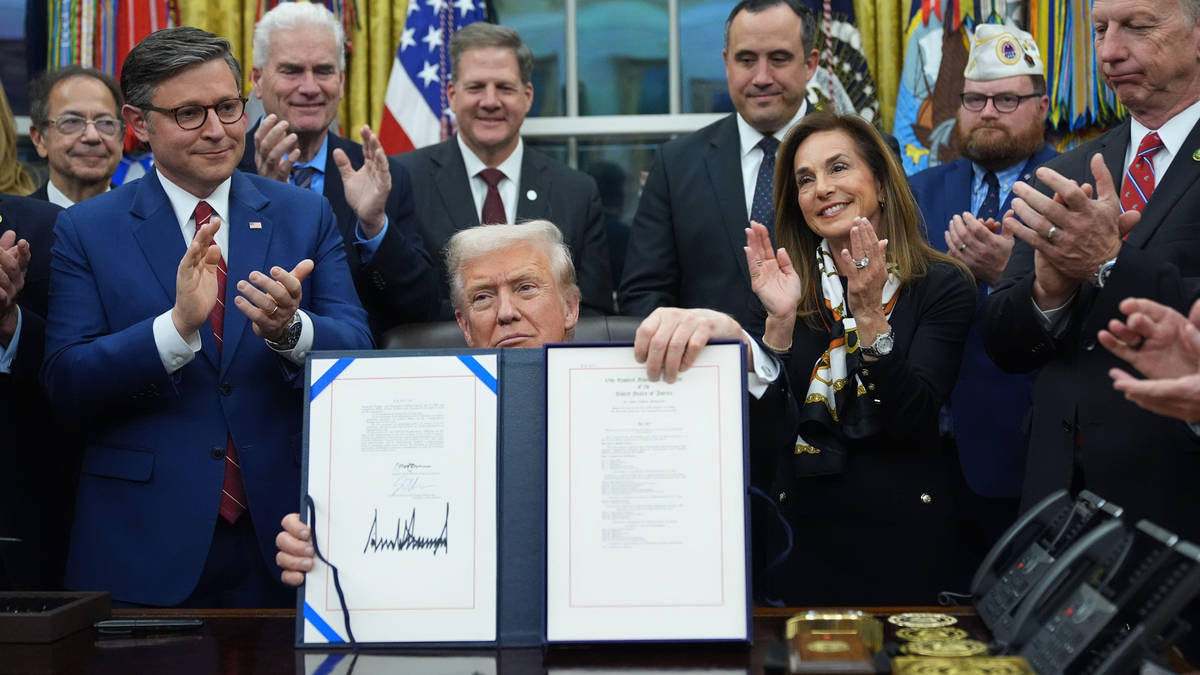
The House voted 222-209 in favour of reopening the federal government on Wednesday evening after a record-breaking standoff
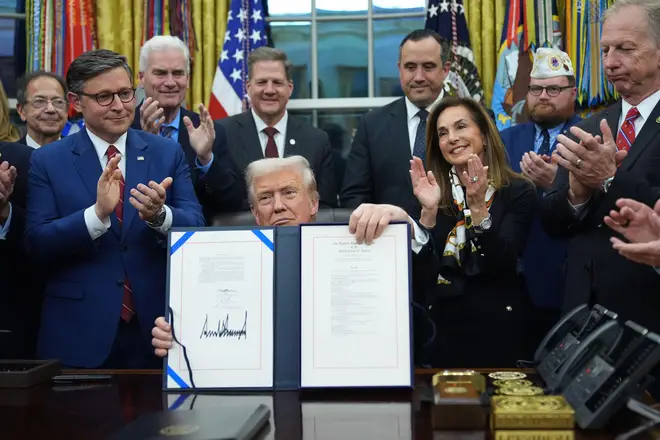
President Donald Trump displays the signed funding bill to reopen the government, in the Oval Office of the White House on Wednesday.
Picture:
Alamy
Donald Trump has signed a bill to re-open the US government after historic 42-day shutdown – but refused to answer questions following the release of incriminating Epstein emails.
The US President signed the bill after the House voted 222-209 in favour of reopening the federal government on Wednesday evening – a move that breaks the record-breaking 42-day standoff.
The shutdown had led to thousands of federal workers not being paid, restrictions on flights caused by air traffic controllers being furloughed, and millions losing food benefits under the SNAP programme.
Seated at his desk in the Oval Office surrounded by Democrats, Trump signed the bill to re-open the government in front of waiting media.
But Trump appeared in no mood to answer questions on the newly-released Jeffrey Epstein emails – released just hours before the signing.
It comes after the Senate approved a new budget deal after Republicans managed to persuade eight Democrats to break from their party and vote with them.
The bill is now on its way to the White House, with President Trump’s signature now needed to formally reopen the government.
Read more: Trump has ‘obligation’ to sue BBC for $1 billion – insisting corporation has ‘defrauded the public’
Read more: Andrew and Virginia Giuffre photo ‘is real’, leaked Epstein emails claim
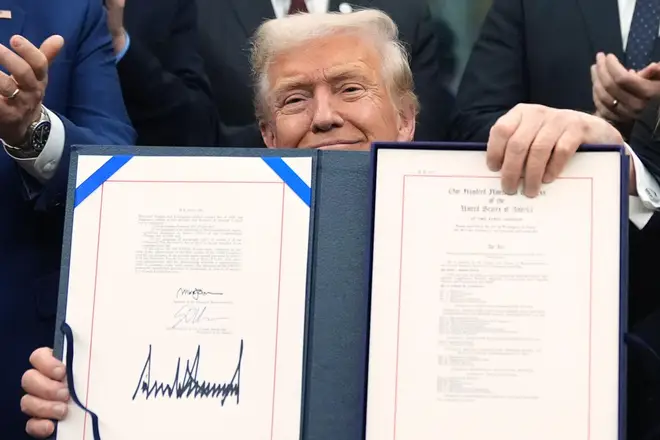
President Donald Trump displays the signed the funding bill to reopen the government, in the Oval Office of the White House, Wednesday.
Picture:
Alamy
Three emails were initially released on Wednesday by Democrats on the US oversight committee – with Republican lawmakers in response then choosing to release a further 20,000 pages of documents.
Among the papers were emails that appeared to incriminate the US President, with correspondence suggesting the US President spent time in the company of Epstein’s “girls” – a reference to Epstein’s sexual trafficking victims.
The emails reveal that the US President not only “knew about the girls” but “spent hours” with one of his victims.
It’s a subject the US President refused to touch on overnight as he re-opened the US government – but one he will likely have to speak on following the swearing in of Arizona’s Adelita Grijalva.
The newly-elected US lawmaker’s appointment had concerned Democrats, with Grijalva’s arrival narrowing the razor-thin Republican majority.
She also became the 218th and final signature on a petition that would automatically trigger a House floor vote demanding the justice department release further files on Jeffrey Epstein.
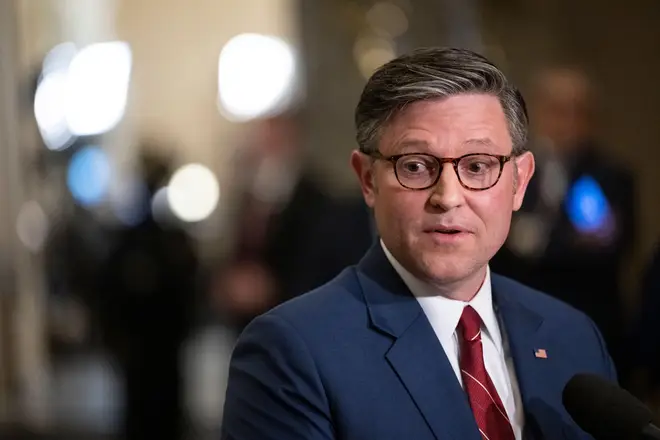
Speaker of the US House of Representatives Mike Johnson (Republican of Louisiana) holds a press conference following the US House 213 to 209 vote on a motion to advance the bill to reopen the government.
Picture:
Alamy
Senate Democrats had earlier refused to support any deal without a renewal of healthcare subsidies under the Affordable Care Act.
But eight of their number decided to vote with their opponents on the promise that the subsidies would be voted upon in the future.
The shutdown has been attributed to horrendous results for Republicans in elections on November 4.
The party, which controls the White House, the House of Representatives, and the Senate, was seemingly blamed for the ongoing logjam in the polls.
Trump’s party lost key races in Virginia, New Jersey, New York and a ballot measure fight in California.