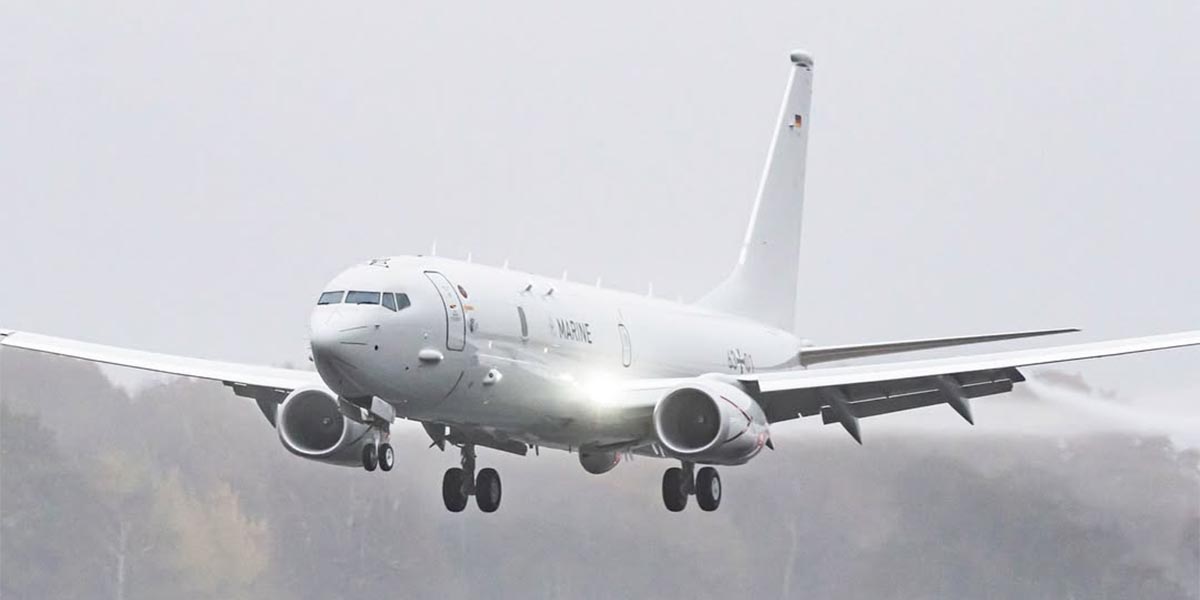
The German Navy received its first P-8A Poseidon maritime patrol aircraft
In recent days we have learned some new developments regarding maritime patrol aircraft (MPA) and maritime surveillance aircraft (MSA) from NATO countries.
Spanish Air Force will receive 16 C295W MPA/MSA: this is how these aircraft are for maritime missions
The interior of the P-3 Orion ‘Cisne 31’, a Spanish plane that tracked Soviet submarines
MPAs have two main roles: anti-submarine warfare (ASW) and anti-surface warfare (ASuW), and can also carry out search and rescue missions. MSAs, in turn, are aircraft designed for border and coastal control, combating illegal fishing, and search and rescue.

Last week, the German Navy received its first Boeing P-8A Poseidon MPA. Germany acquired eight of these aircraft to equip the Marineflieger (Naval Air Arm), which will be assigned to Marinefliegergeschwader 3 (Naval Aviation Wing 3) based in Nordholz, on the German Atlantic coast.

The P-8A will replace the German Navy’s P-3C CUP+ Orion aircraft. Of the eight that were once operational, only two remain in service. The remaining six were sold in 2023 to the Portuguese Air Force, where they were assigned to Squadron 601 “Lobos”.

The P-8A improves upon some of the P-3C’s capabilities, but not others. The Orions used by Germany had a top speed of 761 km/h, a ferry range (without weapons) of 8,950 km, and a combat range (with weapons) of 2,491 km. It has 10 hardpoints with a capacity of up to 9,100 kg, capable of carrying anti-ship missiles, bombs, sea mines, torpedoes, and depth charges.

The P-8A has a maximum speed of 907 km/h, a ferry range of 8,300 km, and a combat range of 2,225 km. It also has 11 hardpoints for weapons (5 in the internal bay, 4 under the wings, and 2 under the fuselage) for carrying anti-ship missiles, cruise missiles, air-to-surface missiles, torpedoes, naval mines, and depth charges. It can carry up to 9 tons of armament.

The P-3 Orion was an exceptional aircraft, and today the P-8A is the only model on the market that comes close. In this respect, Germany has made a good choice in seeking a replacement for its P-3Cs.

On the other hand, two years ago Spain announced the purchase of 16 C-295W aircraft for maritime missions: 6 MPA and 10 MSA, although it was finally confirmed that there will be 8 MPA and 8 MSA. The C-295W MPAs will fill the gap left by the Air Force’s seven P-3 Orions: the last of these was decommissioned on December 16, 2022. Thus, Spain has been without maritime patrol aircraft for almost three years. In turn, the eight MSAs will replace the eight CN-235 VIGMAs currently operated by the Air Force.

On Tuesday, November 11, Airbus Defence announced the first flight of the first of the Spanish C-295W MSA aircraft. These aircraft will improve upon the performance of their predecessors. The CN-235 VIGMA has a maximum speed of 450 km/h, a ferry range of 5,000 km, and a payload range of 2,870 km. The C-295W has a maximum speed of 482 km/h, a ferry range of 5,750 km, and a maximum payload range of 3,704 km. In the case of the C-295W MSA, Airbus states that its maximum range is 4,352 km. It is a good aircraft with high sales.

On the contrary, the C-295W MPA has considerably lower performance than the P-3 Orion. Two years ago, I already warned that with this acquisition the Air Force loses performance and capabilities. Its maximum speed of 482 km/h is well below the P-3’s 761 km/h. Its ferry range of 5,750 km is 3,200 km less than the ferry range of the P-3. Its full load capacity of 3,705 kg does exceed the P-3’s 2,491 kg, but at the cost of sacrificing combat capability, since the C-295W MPA only has 6 weapon hardpoints (all external) to carry torpedoes, air-to-surface missiles, bombs, depth charges and ECM gondolas, with a maximum capacity of 3,200 kg, well below the P-3’s 9,100 kg.
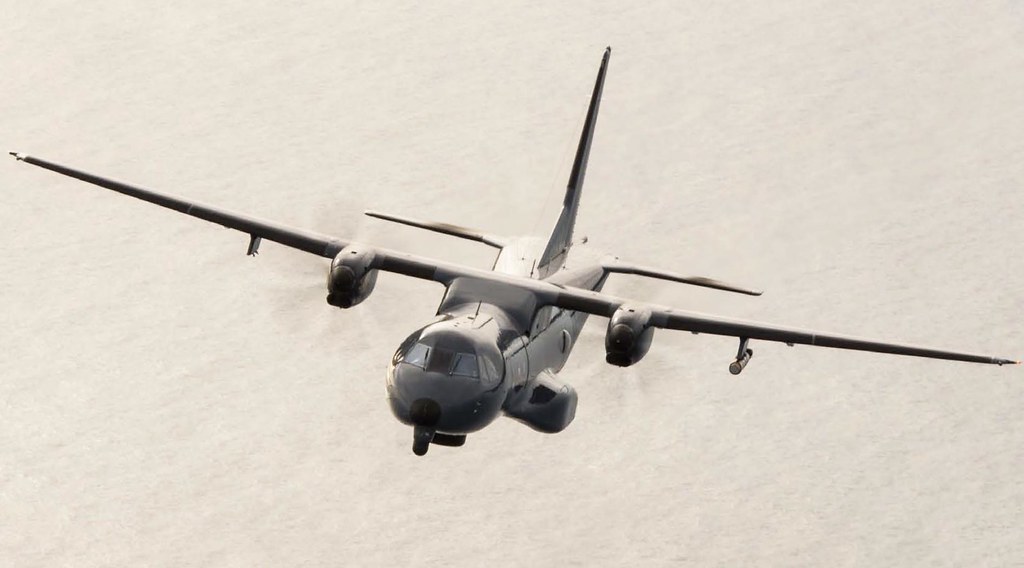
I’ll conclude with two facts: Germany will cover 2,389 km of coastline with 8 P-8As, and Spain will cover 7,905 km of coastline with 8 C-295W MPA aircraft, which have a much shorter range than the P-8A. Obviously, Spain chose the C-295W MPA because it is manufactured in Seville and because it is much cheaper than the P-8A, both in terms of unit cost and operating costs. However, it is difficult to understand how Spain will be able to meet its maritime patrol needs with only 8 aircraft, given their limited range compared to a P-3 or a P-8A.
—
Photos: Deutsche Marine / Boeing / Airbus Defence.