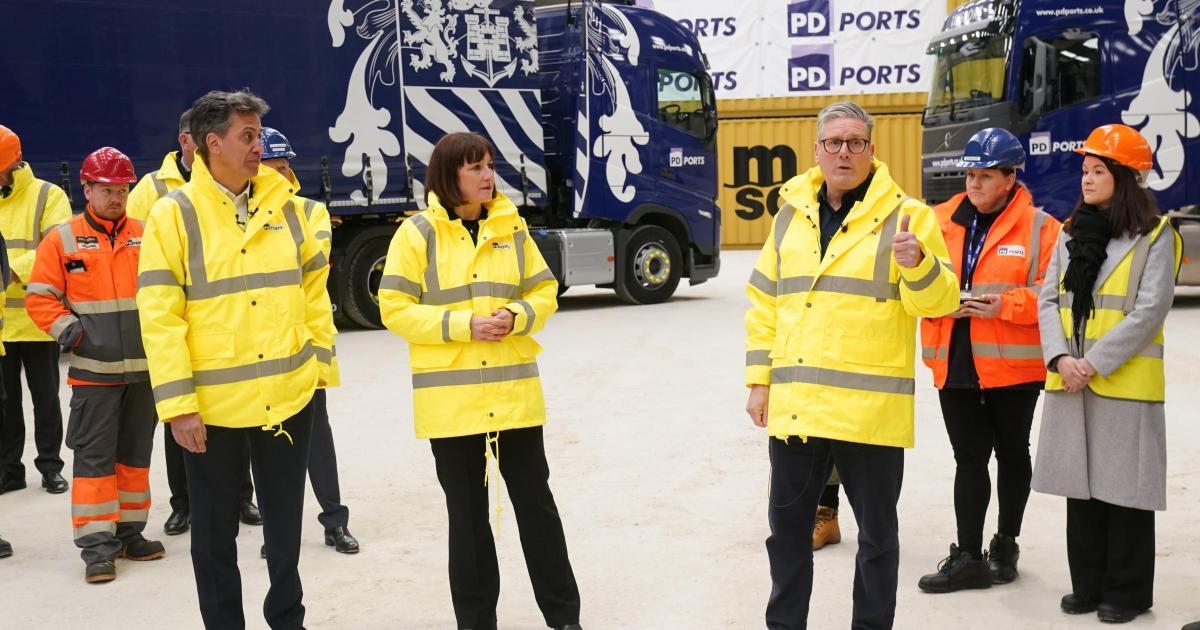
More crucially, Labour’s woes stem from Starmer’s ideological socialism, diverging from Tony Blair and Gordon Brown’s pragmatic blend. Starmer, the millionaire “son of a toolmaker,” stumbled at the outset with revelations of accepting £16,000 in clothing donations from Labour peer Lord Alli for himself and his wife – a pathetic revelation.
This was followed by silly pledges like “smash the gangs” on illegal immigrants, and the ridiculed “one in, one out” migrant deal with France, which saw deportees swiftly return.
Compounding this, the Chancellor, Rachel Reeves, faced scrutiny for CV inaccuracies, like a mis-stated HBOS tenure, and struggles with growth strategies, epitomising failed tax-and-spend socialism.
Ed Miliband’s policies have exacerbated energy insecurity, leaving the UK with Europe’s highest industrial electricity prices – 90% above the EU median – and far exceeding US rates.
In essence, it’s not Brexit but raw, ideological socialism, historically flawed, that seals Labour’s fate.
Ian Lakin, Milltimber, Aberdeen.
Read more:
Where will all this finally end?
We see more infighting in the Labour Party concerning the Prime Minister and a possible coup to bring him down. Then there are calls for his Chief of Staff, Morgan McSweeney, to resign over his alleged involvement. Wes Streeting, the Health Secretary, has been accused of starting this move to oust the PM.
It’s about time that the Labour Party, who were voted in by a massive majority, started to deal with the state of the economy, with growth at 0.1% , asylum seekers arriving on our shores in their droves, hospital waiting lists, prisons bursting at the seams, and prisoners being released in error.
It’s little wonder that the people of Scotland have nothing to turn to but the SNP who themselves have contributed to the state we find our own country in. I ask myself, where will this all end?
Neil Stewart, Balfron.
An ideological doom-loop
“Wee, sleeket, cowran, tim’rous, beastie/ O, what a panic’s in thy breastie”!
Labour, after ripping up their manifesto commitments, are now apparently plotting against their leader, Keir Starmer, panicking over his dismal poll ratings. Is this unfair to the globe-trotting, freebie-loving Prime Minister, who has changed his “this is what I stand for” repeatedly since being elected Labour leader in 2020?
The name in the frame is the right-wing, pro-privatising English Health Secretary, Wes Streeting, but if there is a contest, expect a candidate (or two) from the left to join in, and the party could find itself in an ideological doom-loop.
Any contest would expose Labour in Scotland, whose leadership (apart from Richard Leonard) is always Blairite + 10, but postures as “left wing”. This is before party trepidation over the Reeves Budget, so get the popcorn out and watch the fun!
GR Weir, Ochiltree.
Buses as a public service
Your article (“Transport body hikes chief’s pay by 35k”, November 13) revealing that Strathclyde Partnership for Transport (SPT) has “hoarded” £160 million of unspent cash contributed by its funding local authorities has not gone down well with the private bus companies. This should come as no surprise.
The case for franchising of bus services has been made by far too few Scottish politicians since deregulation in 1985 and it has been left to SPT, following the model pursued in Manchester, to make the unarguable case for re-centring buses as a public service.
It is in that context which we should view any critical comments from private bus companies that have spent the last 40 years prioritising profits over passengers.
Incidentally, the 35 per cent salary increase for SPT’s chief executive, Valerie Davidson, should also be placed in the proper context: the increase was over a six-year period, and is in line with the 33.6 per cent increase in UK median gross earnings over the same period.
Tom Harris, UK Transport Minister, 2006-2008; Chief Public Relations & Marketing Officer, SPT, 1998-2001.
Suggestions for BBC Scotland’s way ahead
Although a frequent critic of the BBC, especially in Scotland, I believe that sustaining a public broadcasting channel for news and current affairs programmes seems desirable, provided that genuine professional balance supports the claim of impartiality.
While “institutional bias” may be an exaggeration, the influence of the right-wing media has become increasingly evident while the organisation seemingly still attempts to act in accordance with laudable aims around diversity and multi-culturalism.
This contradiction appears to be deepening because, in following stricter guidelines set by remote/distant board members, many journalists and political commentators appear to increasingly present slanted stories and employ pejorative expressions which lack professional rigour and objectivity.
If this is not the case then editors must be partially re-framing stories, as evidenced in exposed reports relating to Donald Trump and Alex Salmond, with many journalists not prepared to speak out in defence of the basic principles of their profession.
As a supporter of the right to self-determination my view is that the lack of political balance in Reporting Scotland news programmes is particularly concerning. Good news relative to England and the rest of the UK is invariably shunned, while bad news is persistently highlighted with references made to England whenever events or services there appear to imply that Holyrood is not performing as well as Westminster.
Of course, more astute viewers realise the reverse when no such reference is made (as in most cases and demonstrated with this week’s unemployment figures). But professionalism also requires transparency and one should not have to be a political analyst to gain a true understanding of the relative performances of our respective governments.
Openly stating the voting intentions represented by Question Time and Debate Night audiences would be a good start.
And it would probably help if the BBC hired more journalists who were still closely in touch with local communities around Scotland.
Stan Grodynski, Longniddry, East Lothian.
War Game is still a must-see film
Never mind ‘Daviegate’; of all the BBC’s sins over the decades, the worst must surely be sitting for 20 years on Peter Watkins’ 1965 film The War Game, which it deemed “too horrifying for the medium of broadcasting”.
The pseudo-documentary simulated civil preparations for, and the effects of, a nuclear attack (at the end, the real-world press is described as saying nothing about the dangers of nuclear weaponry; plus ça change …).
Given that our Prime Minister has told us to prepare for war a few years hence, no doubt on Russia, that film should be mandatory viewing for all the jingoists who advocate the UK continuing to arm Ukraine with missiles hitting Russia.
Do not provoke any state with a nuclear arsenal capable of devastating this small island with only a few dozen warheads.
George Morton, Rosyth.
The BBC and the President
Whilst not wishing to prolong the matter of the BBC’s “error of judgement” in relation to the editing of Donald Trump’s speech, I would like to go a step further on the comments made by Alan Fitzpatrick (letters, November 11).
The editing resulted in a deliberate misrepresentation of part of Trump’s speech. An innocent misrepresentation can be forgiven but a deliberate misrepresentation is a criminal offence which, arguably, could be classed as fraud.
Would the Crown Prosecution Service have the guts to prosecute whoever was responsible for the misrepresentation or whoever sanctioned it?
Alan G T Walker, Carradale.