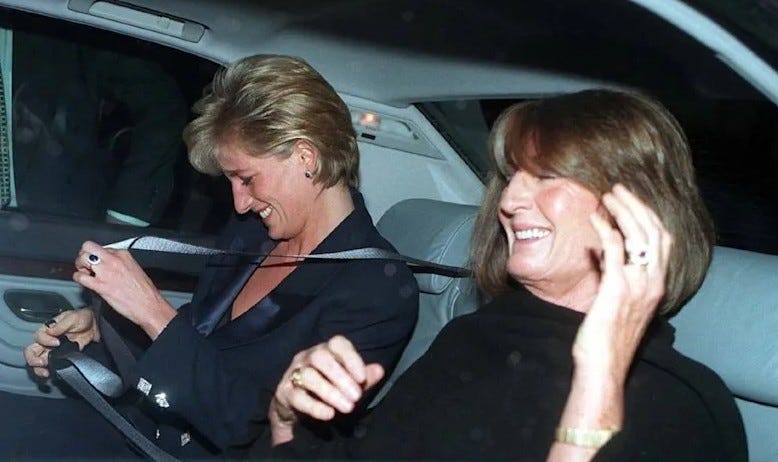
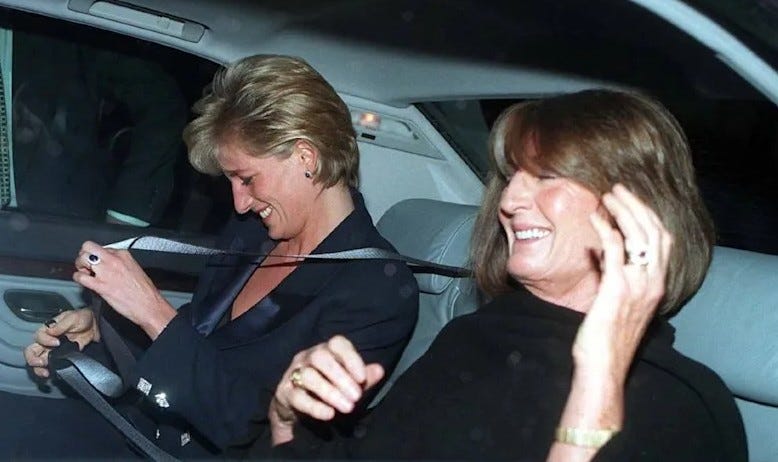
 Princess Diana laughing with Lady Annabel Goldsmith after dining at Wiltons in London, 1996
I first came to know Lady Annabel Goldsmith four months after the death of her husband of nearly twenty years, the billionaire financier and political activist Sir James Goldsmith, and ten weeks after the death of Diana, Princess of Wales, who had been her “surrogate daughter.” While doing research for Diana in Search of Herself: Portrait of a Troubled Princess in late 1997 and early 1998, Annabel and I had two in-depth conversations. We met at Mark’s Club, the Mayfair men’s club owned by her former husband, Mark Birley, and at her elegant home near Richmond Park in London, Ormeley Lodge.
“I was careful to keep off the subject of Diana”
We spoke at length about her friendship with Diana, which had begun early in 1989 after a party at Ormeley Lodge when Diana and Camilla Parker Bowles had a memorable encounter over Camilla’s affair with Prince Charles. Annabel was close to Camilla’s younger sister, Annabel Elliot, and knew Camilla fairly well, which created initial awkwardness with Diana. “When we first knew each other, we talked about Camilla,” Lady Annabel recalled. “I used to have to say, ‘I can’t because of Annabel [Elliot].’ After a bit she gave it up. I had to be careful.” Camilla, in turn “has been very wary of me ever since I was a friend of Diana’s. I was careful to keep off the subject of Diana with Annabel Elliot and Camilla.”
“The worst thing you can do to your children”
Lady Annabel said she was “most definitely” a mother figure to Diana. She traced the origins of Diana’s need for maternal consolation and guidance to her dysfunctional childhood after the acrimonious divorce of her parents, Frances and Johnnie, the 8th Earl Spencer, when Diana was six. Frances left her husband for another man, Peter Shand Kydd, and testimony from Frances’s mother, Ruth Fermoy, influenced the court’s decision to give Johnnie custody of the children. “Diana told me that every time she saw her mother, Frances would weep hysterically and say dreadful things about their father, which is the worst thing you can do to your children,” Annabel told me.
Later on, as an adult, Diana “adored her mother,” and “she got on very well with her, and from time to time was pleased to see her,” said Annabel. “They had the same sense of humor.” But Frances “had a terrible problem with drink. You couldn’t call her after 5:30. What it came down to, the reason Diana had to talk to me, was she couldn’t confide in her mother. When she tried to do that in the evening, her mother was on the bottle. She also thought her mother would go over the top and attack Prince Charles.” Diana tried to stop her mother drinking, “but how do you really do that?” said Annabel.