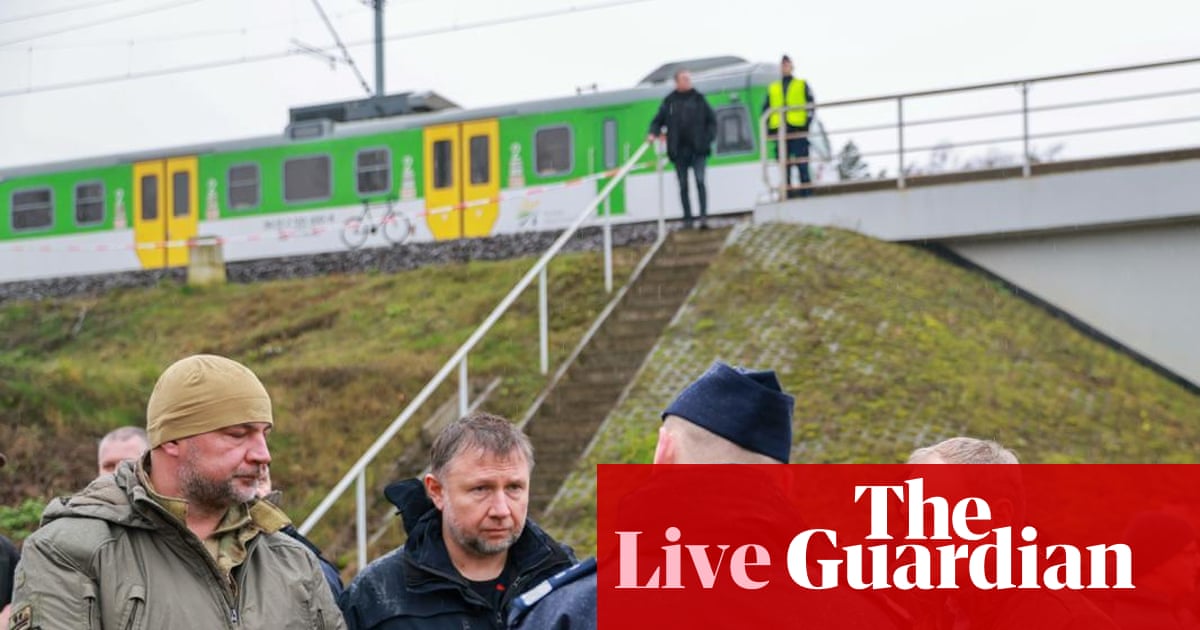
‘Everything indicates’ Russian intelligence commissioned rail sabotage incidents in Poland, government spokesperson says
In a further confirmation of the inquiry lines in Poland, the Polish security services minister’s spokesperson Jacek Dobrzyński has just confirmed that “everything indicates” that Russian intelligence services were behind the rail sabotage incidents in Poland over the weekend.
“The fact is that everything indicates that this … we can already confidently call it a terrorist attack, was initiated by special services from the East,” he later added.
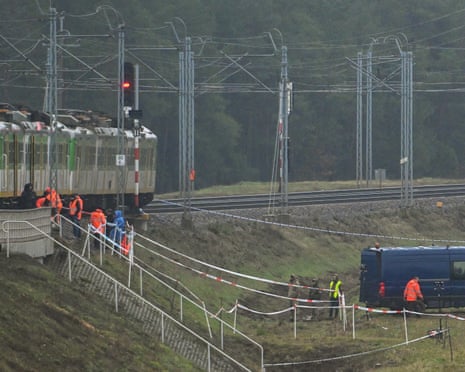 Special forces and police investigate at the scene of a destroyed section of railway tracks on the Deblin-Warsaw route near the Mika railway station, central Poland. Photograph: Wojtek Jargiło/EPA
But he insisted that the investigation into the two incidents needed to be kept confidential at this stage to ensure it can be effective.
“I cannot say what stage the officers are [at] or [what they are] currently working on and what threads they are connecting or what threads they are analysing. The Russian services would very much want to have this information: where our officers are or in which direction they are heading,” he said.
Key events
Show key events only
Please turn on JavaScript to use this feature
Polish PM to address parliament on rail sabotage incidents Jakub Krupa
Heads up: Poland’s prime minister Donald Tusk will address the Polish parliament around 1pm local time (midday UK) to give lawmakers an update on the latest on the rail sabotage incidents over the weekend.
I will bring you all the key lines here.
ShareIreland’s longstanding finance minister Donohoe steps down to join World Bank Lisa O’Carroll
Ireland’s longstanding finance minister Paschal Donohoe is to step down to join the World Bank.
Eurogroup President Paschal Donohoe attends an EU Economic and Financial Affairs Council (ECOFIN) meeting in Brussels, Belgium. Photograph: Olivier Matthys/EPA
Donohoe, who has been in finance or public expenditure departments for the past 10 years, will also step down from his job as head of the Eurogroup, the alliance of member states who use the euro currency.
The Irish cabinet was given the surprise news on Tuesday and was told that the appointment of Donohoe as the managing director of World Bank, the second most important job in the institution, had been approved on Monday night.
Donohoe has been a stalwart of Irish politics during Brexit years, Covid and beyond and his steady hand made him seem as a potential frontrunner for taoiseach.
But he lost out on a key opportunity last March 2024 when the leadership of his Fine Gael came up with Simon Harris quickly amassing enough support within the party to take over following the resignation of the former taoiseach Leo Varadkar.
He has been tipped for international jobs, including the head of the International Monetary Fund, ever since. However, he has always professed loyalty to his position in the Irish cabinet or missed out to other candidates.
His resignation could trigger a cabinet reshuffle but it will also prompt what is likely a hard byelection in Dublin central, a constituency shared in the multi seat system by Sinn Féin leader Mary Lou McDonald and in which Gary Hutch who had links with the Hutch criminal gang also ran in November general election.
Donohoe’s departure is a significant blow to the Fine Gael and Fianna Fáil partnership and to the EU as one of the longest serving ministers attending EU summits.
He played a significant role in protecting Ireland’s economic strategy in relation to foreign investment and corporate tax when under serious international attacks from the likes of France and a court case, which Ireland ultimately won, over the Apple’s corporate tax.
Updated at 06.04 EST
Zelenskyy visits Spain before flying to Turkey to ‘reinvigorate’ peace talks
Ahead of his talks in Spain today, the Ukrainian president, Volodymyr Zelenskyy, said he was hoping that after talks with the Spanish prime minister, Pedro Sánchez, “another strong country will increase its support” for Ukraine, “helping us protect lives and bring the end of the war closer.”
He also confirmed that he would go to Turkey on Wednesday and try to “reinvigorate negotiations” over a potential peace deal ending the war as “we have developed solutions that we will propose to our partners.”
“Doing everything possible to bring the end of the war closer is Ukraine’s top priority. We are also working to restore POW exchanges and bring our prisoners of war home,” he said.
But Kremlin spokesperson Dmitry Peskov said that no Russian representatives would be involved in talks in Turkey, even as he insisted that Moscow was ready to negotiate.
But Reuters reported that US special envoy Steve Witkoff is expected to come to Turkey and join the talks, according to a Turkish source.
Share‘Everything indicates’ Russian intelligence commissioned rail sabotage incidents in Poland, government spokesperson says
In a further confirmation of the inquiry lines in Poland, the Polish security services minister’s spokesperson Jacek Dobrzyński has just confirmed that “everything indicates” that Russian intelligence services were behind the rail sabotage incidents in Poland over the weekend.
“The fact is that everything indicates that this … we can already confidently call it a terrorist attack, was initiated by special services from the East,” he later added.
Special forces and police investigate at the scene of a destroyed section of railway tracks on the Deblin-Warsaw route near the Mika railway station, central Poland. Photograph: Wojtek Jargiło/EPA
But he insisted that the investigation into the two incidents needed to be kept confidential at this stage to ensure it can be effective.
“I cannot say what stage the officers are [at] or [what they are] currently working on and what threads they are connecting or what threads they are analysing. The Russian services would very much want to have this information: where our officers are or in which direction they are heading,” he said.
ShareCzechs join protests against incoming Babiš government as they mark anniversary of Velvet Revolution
Similarly, Czechs also took to the streets to use the anniversary of the 1989 events to protest against controversial populist billionaire Andrej Babiš, who is expected to lead the next government after last month’s parliamentary elections.
Large crowds flooded Prague’s historic Old Town Square at a rally called “Czechia is not for sale”, carrying banners criticising Babiš and chanting “Throw away Babiš”, an AFP journalist observed.
People light their phones as they take part in a demonstration during commemorations to mark the 36th anniversary of the 1989 Velvet Revolution, at the Old Town square in Prague, Czech Republic. Photograph: Michal Čížek/AFP/Getty Images
The billionaire’s appointment as the next prime minister continues to be delayed amid his unresolved conflicts of interest, which the country’s president, Petr Pavel, insists need to be addressed before he can take the top job.
Joining the official commemorations earlier in the day, Babiš was reportedly booed by some in the corwd.
Leader of the ANO (YES) movement and coalition candidate for prime minister Andrej Babiš leaves after lighting a candle at the memorial to students who were attacked by riot police in 1989 on Narodni Street, marking the 36th anniversary of the Velvet Revolution in Prague, Czech Republic. Photograph: Martin Divíšek/EPA
Later in the evening, some 100,000 people took part in an official commemorative concert at the Wenceslas Square in central Prague.
ShareTens of thousands of Slovaks protest against Fico as they mark Velvet Revolution anniversary
Last night, tens of thousands of Slovaks protested against the country’s populist and pro-Russian prime minister Robert Fico, marking the 36th anniversary of the Velvet Revolution which had ended the communist rule in the country in 1989, but which his government has recently removed from the list of national holidays.
A demonstrator holds a picture depicting Prime Minister Robert Fico being scared of chalk during a protest against the government of Slovakia’s nationalist prime minister Robert Fico in Bratislava, Slovakia. Photograph: Joe Klamar/AFP/Getty Images
Despite torrential rain, protesters gathered across the country, including the capital, Bratislava, and the eastern city of Košice.
Fico remains a deeply divisive figure in Slovakia, which regular protests against his government and policies. Critics say he risks undermining the country’s pro-western course since 1989, jeopardising its relations with the EU and Nato, as he insisted on keeping close relations with Russia – visiting Vladimir Putin in Moscow three times since the full-scale invasion of Ukraine in 2022 – and opposed further EU sanctions on Russia or aid for Ukraine.
Crowd of around 20,000 people gather to voice their opposition to Slovakia’s current government, led by nationalist prime minister Robert Fico in Kosice, Slovakia. Photograph: Anadolu/Getty Images
Most recently, Fico angered many by telling students in the city of Poprad that they should go to fight for Ukraine if they don’t agree with his pro-Russian views, AP noted.
The next parliamentary election in the country should be held by 2027.
A woman holds a banner during an anti-government protest marking the 36th anniversary of the 1989 Velvet Revolution in Bratislava, Slovakia. The banner reads: “I am standing here like my parents in 1989”. Photograph: Radovan Stoklasa/ReutersShareMorning opening: ‘All traces lead to Russia,’ Poland saysJakub Krupa
Poland’s deputy prime minister and defence minister, Władysław Kosiniak-Kamysz, said that looking at the rail sabotage incidents over the weekend in the broader context of hybrid threats facing European countries “all traces lead east, to Russia.”
Special forces and police investigate at the scene of a destroyed section of railway tracks on the Deblin-Warsaw route near the Mika railway station, central Poland. Photograph: Wojtek Jargiło/EPA
Speaking on Radio Zet this morning, he also confirmed media reports that investigators were looking at a device was found near the blast site which they believe may have been intended to capture “the explosion or observe the site” of the blast.
Kosiniak-Kamysz said that Poland and Europe faced “a state between war and peace, where we have attacks, acts of sabotage, disinformation on a gigantic scale on the internet, the destruction, or attempts at destruction, of critical infrastructure across the whole of Europe.”
On Monday night, public prosecutors in Poland said an investigation had opened “regarding acts of sabotage of a terrorist nature […] committed on behalf of a foreign intelligence service against the Republic of Poland.”
This morning the Polish government will convene its national security committee to discuss the next steps in its response to the rail incidents.
I will keep an eye on what comes out of it.
Elsewhere, the French president, Emmanuel Macron, meets the German prime minister, Friedrich Merz for talks in Paris, where they will be later joined by the UK prime minister, Keir Starmer.
Meanwhile, Ukraine’s president Volodymyr Zelenskyy is in Spain for talks with the country’s prime minister, Pedro Sánchez, before going to Turkey on Wednesday in a bid to reinvigorate peace talks to end the Russian invasion of Ukraine.
Separately, senior representatives of the EU candidate countries meet in Brussels at the EU Enlargement Forum, and Danes go to the polls in local elections, as the centre-left could lose control of Copenhagen for the first time in the city’s electoral history.
There is lots for us to cover. I will bring you all the latest updates here.
It’s Tuesday, 18 November 2025, it’s Jakub Krupa here, and this is Europe Live.
Good morning.
Updated at 04.16 EST