Speaking during a ChargeUp Europe webinar, Meta Kessler, Director of Corporate Strategy at IONITY GmbH, outlined the sector’s main trends.
On the one hand, Kessler notes that IONITY’s network is seeing rapidly accelerating demand for public high-power charging (HPC), meaning above 150 kilowatts (kW).
“According to our data, in Germany by 2030 we expect 60% of charging to remain private. But of the remaining 40% that happens in public, more than 65% will be high-power,” she explains.
The same pattern is apparent in other large European markets with higher battery electric-vehicle (BEV) penetration.
“That’s why, for us, the key direction is public HPC, not only along motorways but increasingly within cities,” she adds.
However, Kessler acknowledges that the number of BEVs per charging point is still insufficient to guarantee the economic sustainability of charge point operators (CPOs).
One of the key metrics IONITY tracks across the 24 markets where it operates is the ratio of electric cars to HPC devices.
“Currently, in Germany there are 60 BEVs per high-power charging point. That figure is too low,” Kessler says.
She continues: “To maintain a healthy and sustainable business model for CPOs, we need to be around 100 — or even slightly higher in future.”
This indicates that the industry has built infrastructure ahead of fleet growth.
“In 2024 we saw a sharp drop in that figure, which is now starting to recover as more electric vehicles reach the market in 2025. But it will still take a few years to get back to the 100 level,” she comments.
This shows that more BEVs are needed to sustain the market’s current momentum with adequate infrastructure and to protect the capital already invested.
IONITY highlights that range anxiety is no longer an issue
One of the metrics IONITY monitors relates to which countries customers come from and where they charge.
“IONITY remains a network primarily located on motorways or long-distance routes, and what we see, especially in the summer months, is a large proportion of drivers charging at our stations who come from other countries where they do not reside,” says Kessler.
For example, many drivers from the Nordic countries or the Netherlands charge in Germany, Austria or Italy.
This factor shows that travelling long distances in an electric vehicle is both possible and reliable.
“When we speak with those drivers, they explain that range anxiety simply does not exist,” the IONITY representative adds. In this regard, she acknowledges that “it is a good time to buy a BEV because this is no longer a problem.”
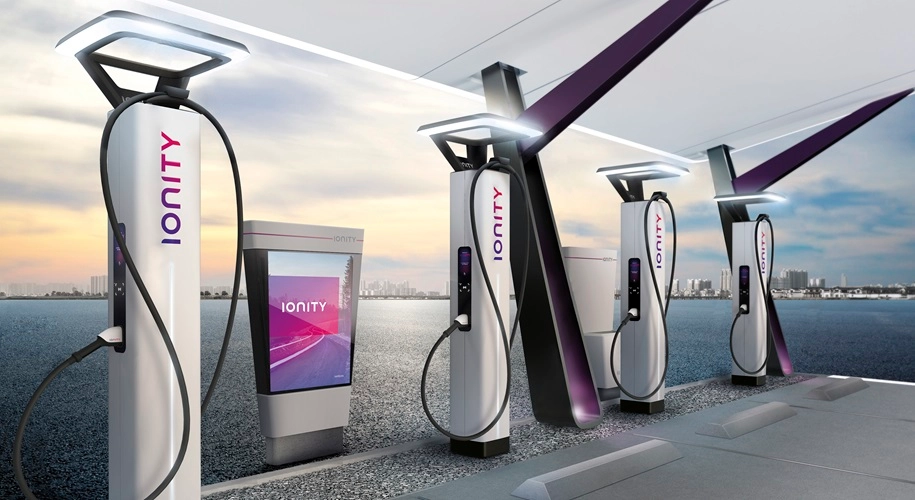 IONITY charging points
READ MORE
-
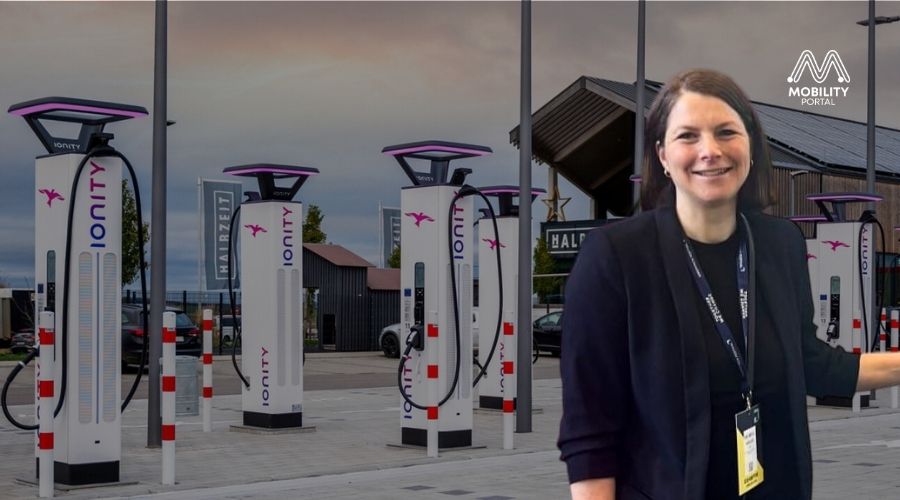
High-power charging (HPC) infrastructure is expanding, but IONITY acknowledges that more EVs are needed to keep the business model sustainable: in Germany there are 60 per station, compared with the 100 required.
-
Con cargadores de hasta 150 kW y un diseño adaptado al entorno portuario, Marina Port Premià estrenará el mayor parque de recarga del Maresme. Mobility Portal España asistirá a la inauguración in situ.
-
La confederación alerta de que la Ley de Movilidad Sostenible obliga a instalar cargadores en zonas sin demanda real, genera cargas desproporcionadas para pymes y convive con graves retrasos en el acceso a la red eléctrica.