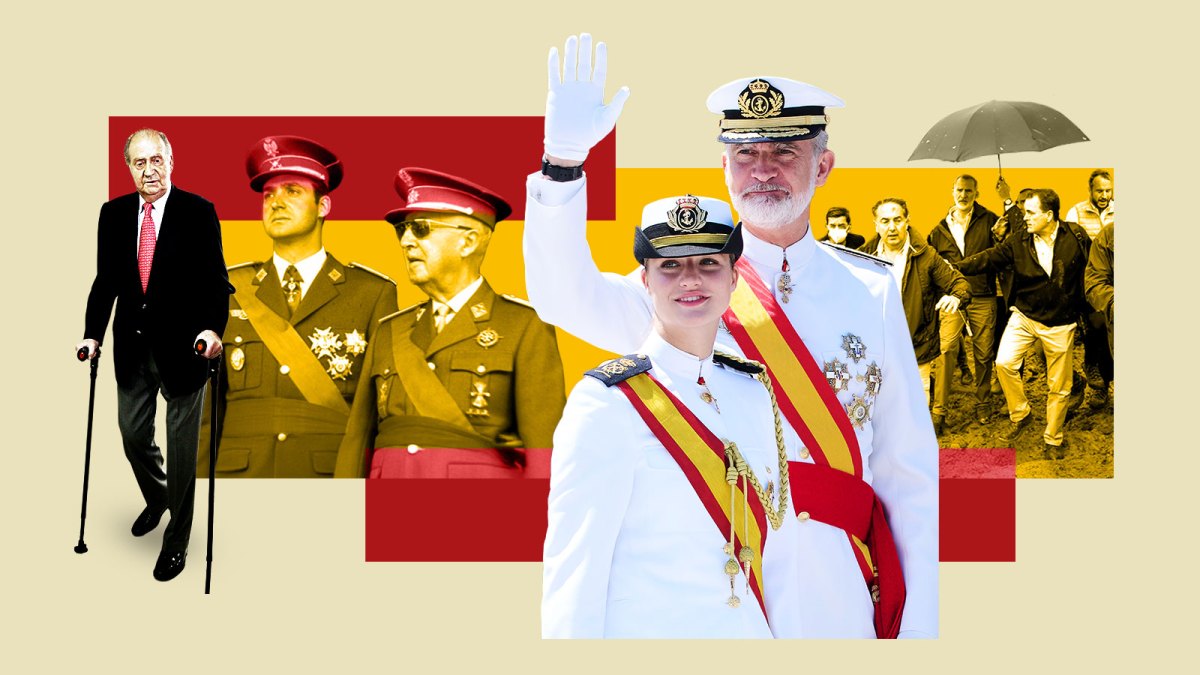
As an angry mob threw stones, mud and insults at him, King Felipe’s composure won new supporters for Spain’s monarch. The crowd attacked him and other visiting dignitaries in Paiporta three days after the town was devastated by floods, in which 237 people died in the eastern Valencia region a year ago.
The king, who at over 6ft 5in presents an easy target, did not flinch. He stood his ground, then advanced, with Queen Letizia joining him, to reason with the attackers. By contrast, Pedro Sánchez, the Socialist prime minister, fled the scene, earning the moniker the “Greyhound of Paiporta” from his critics.
Felipe’s reaction consolidated his reputation among his subjects. It also won plaudits from the monarchy’s staunchest opponents in a country where republicanism and antipathy towards the Bourbon dynasty remain potent. “People like me would prefer a republic,” said Vicent Císcar, Paiporta’s Socialist mayor. “But that day his personal conduct was exemplary … and since then he has come back here seven times and everyone sees his affection … and has respect for our head of state.”

Felipe was heckled by residents who threw mud and stones during his visit to Paiporta, Valencia, in November last year after deadly flooding
MANAURE QUINTERO/AFP/GETTY IMAGES
However, the Paiporta incident also exposed the fragility of the monarchy. As Spain commemorates 50 years since the death of the dictator Francisco Franco, the popularity of the institution rests precariously on the king’s shoulders.
The monarchy is increasingly disdained by left-wing parties and the populist right-wing Vox party. It also stands to lose from those parties’ opposition to the 1978 constitution, the compact that sealed Spain’s transition to democracy and reverted the country to a constitutional monarchy 44 years after Alfonso was sent into exile when the Second Spanish Republic was proclaimed.
The institution also faces danger from within. Notably absent from official ceremonies on Friday to mark the anniversary will be Juan Carlos, Felipe’s father. The former monarch played a key role in the democratic restoration but his 39-year reign ended in scandals that have tarnished the monarchy and led to his exile in Abu Dhabi.
• Spain honours its architects of democracy — but unity is slipping away
His recently published memoir, in which he praises Franco, chides his son for distancing himself from him and criticises Letizia for undermining their family unity, has cast a shadow over the anniversary and bolstered anti-monarchist sentiment.

Juan Carlos and Franco in Madrid in 1972
GIANNI FERRARI/COVER/GETTY IMAGES
Yet the monarchy has proved integral to the success story of Spain’s transition to democracy and its transformation into a prosperous modern country.
In his law firm’s offices in Barcelona, a historic seat of opposition to rule from Madrid and the monarchy, the institution’s “stabilising” role was highlighted by Miquel Roca, 85, one of the last two surviving “fathers of the constitution” who drew up the compact.
Two days after Franco’s death on November 20, 1975, Juan Carlos was proclaimed king in line with the dictator’s succession law, and inherited his absolute power. Relinquishing that power three years later, the king paved the way for the transition to democracy, negotiating the monarchy’s future. “The king played a very important role because he knew that the future of the monarchy in Spain depended on a political pact to build a parliamentary monarchy,” said Roca, a former conservative Catalan nationalist politician.
• General Franco: a mediocrity in everything except cruelty
The lawyer noted that “the vast majority of us who drafted the constitution were staunch republicans” but they reached a compromise in which they accepted the monarchy in exchange for the Franquista right’s concessions on decentralising some power to the regions.
Looking back over 50 years, Roca suggested the monarchy’s worth has increased in a country where trust in other institutions is in decline and its rancorous politics is alienating voters. “Today it is easier to accept the crown as a stable institutional factor than it has been for a long time,” he said. “Why? Because if the government has lost its standing or parliament is not valued, there remains a representative figure who attracts more trust, or better said, more respect.” He added: “Democracy without institutions is very difficult.”
Surveys by the pollster GAD3 between 2000 and 2024 suggest stable support for Spain’s parliamentary monarchy, with 58 per cent of respondents last year in favour of it and 36 per cent backing a republic. Javier Cercas, the renowned novelist, pointed out that in opinion polls the monarchy was not high on people’s list of concerns. “The king and queen don’t create problems,” he said.
• 50 years after Franco, Spain’s economy is booming — but will it last?
Unusually for a left-wing voter, Cercas praised the king for a controversial speech in 2017 when the monarch accused Catalan separatist leaders involved in an illegal, failed independence campaign of shattering democratic principles and of dividing Catalan society. Felipe, he added, “is better educated than any of our politicians … there’s an incredible difference … he went to better universities, knows about history and economics … I have never met a Spanish politician with such culture.”

Felipe and Queen Letizia earlier this month in Madrid
CARLOS ALVAREZ/GETTY IMAGES
Felipe’s popularity, however, does not remotely match that once enjoyed by his father. Due to his role in the democratic transition, particularly his facing down of an attempted coup d’état in 1981, and the high profile that the former monarch gave Spain on the world stage, many republicans declared themselves “juancarlistas”.
Then Juan Carlos fell from grace. The decline began when it emerged in 2012 that he had been on an elephant-hunting trip in Botswana with his former mistress, Corinna Larsen, while Spain languished in economic crisis. The media caught wind of it after he had to be flown home to Madrid for an emergency hip replacement.
The elephant-hunting scandal came as Iñaki Urdangarin, Juan Carlos’s son-in-law, and Infanta Cristina, Felipe’s sister, were facing corruption charges. While Cristina was acquitted, Urdangarin ended up in prison for embezzlement, among other charges. The scandals led to Juan Carlos’s abdication in favour of Felipe in 2014.
More troubles followed. Juan Carlos left Spain in 2020 amid investigations into alleged financial irregularities, which have now been shelved. However, questions remain over large sums of money in offshore accounts, such as a €65 million donation from Saudi Arabia that ended up in Larsen’s control and over which the two former lovers have bickered.
After paying millions of euros in tax payments, Juan Carlos has returned to Spain on short trips with increasing regularity and in 2023 took part in his first royal family gathering since 2020. Reports suggest he will join the royal family for a private commemoration of the monarchy’s restoration this week. But Sánchez has said that Juan Carlos owes Spain an explanation.
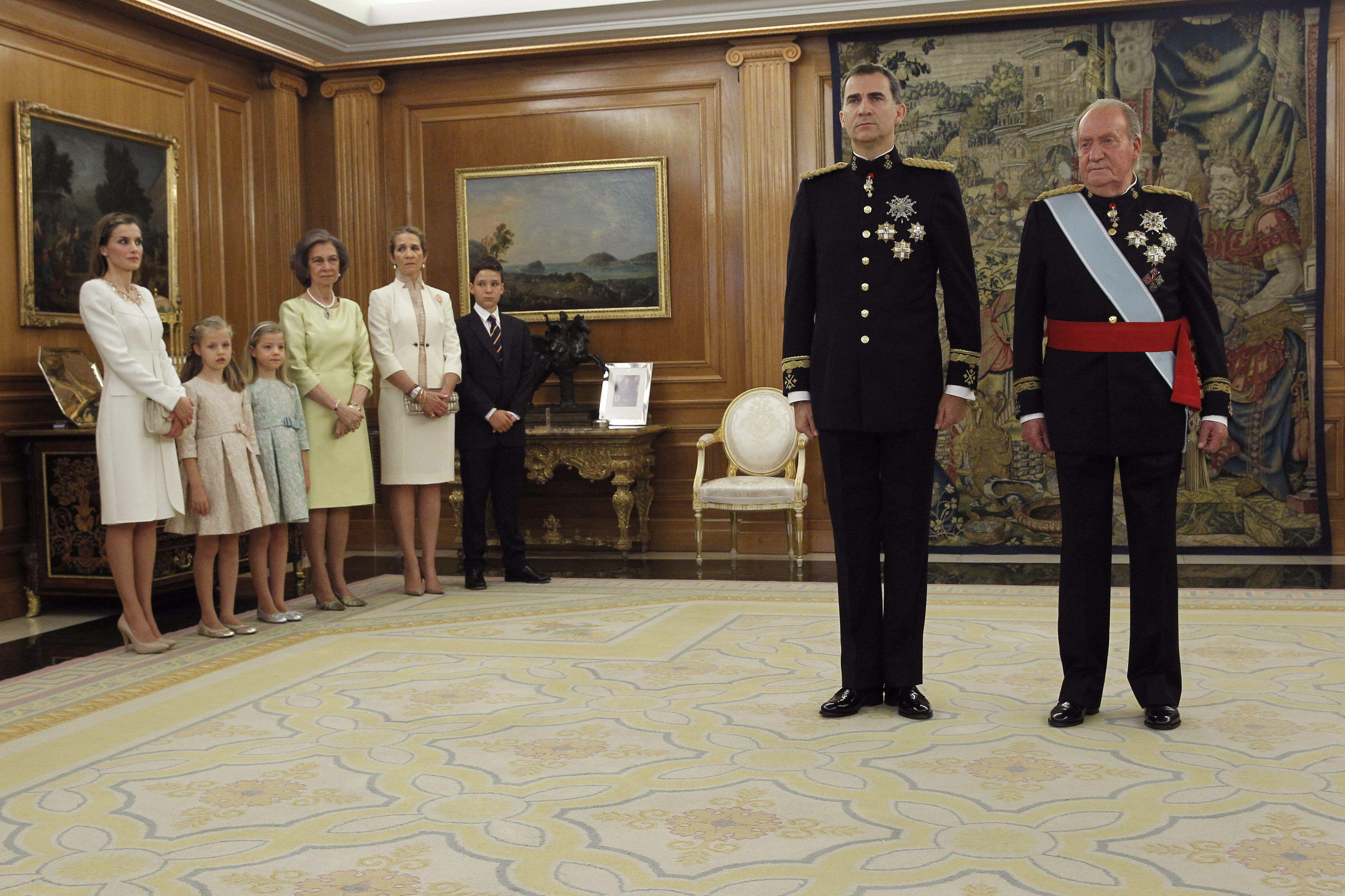
The king and his father at Felipe’s coronation ceremony on June 19, 2014
ALAMY
In the southern port city of Malaga, Francisco de la Torre, 82, the conservative mayor for the past 25 years, noted “the mistakes Juan Carlos made” and paid tribute to his historic role. But he reserved adulation for Felipe. “I believe that King Felipe VI is doing an extraordinary job for the prestige and strength of the Spanish monarchy,” he said. “There is no monarch in Europe today or head of state with the preparation, approachability and sense of responsibility and ethics of King Felipe VI, and Queen Letizia accompanies him in that regard.”
The question of money has also long been a bone of contention with regard to Spain’s monarchy. Franco sent Juan Carlos to live in the Zarzuela Palace, on the outskirts of Madrid. After the dictator’s death, the king chose it as the royal family’s residence over the vast Royal Palace in the capital’s centre, in part to project a more modest image. That quest for modesty did not last.
Today the grounds of the palace are overrun with deer. A staff member jokes that since Juan Carlos’s departure into exile nobody is hunting them. The former monarch longs to return but his financial peccadillos, as he sees them, have forced Felipe to bar him from living in his old home.
At the start of his reign, Felipe became Europe’s youngest king and pledged a “renewed monarchy” and greater transparency. He reduced the members of the royal family to six: his parents, himself, his wife and their two daughters. His sisters, brothers-in-law, nieces and nephews were left out. In 2015 he removed the title of Duchess of Palma from Cristina.
Months before Juan Carlos went into exile, Felipe disinherited himself from his father and cut his €200,000 annual stipend in an apparent attempt to distance the crown from tax evasion and bribery allegations made against him.
He also for the first time published the royal household’s accounts. The total amount that he received last year from the state for the maintenance of the institution and his family was €8,431,150, a paltry sum compared with their British counterparts. The king’s salary was €277,361.76 in 2024, while Queen Letizia received €152,539.92.

Letizia and Felipe with Princess Leonor and Infanta Sofía in 2023
RAUL TERREL/EUROPA PRESS/GETTY IMAGES
The royal household labours under a difficult relationship with the prime minister, according to Spanish media. Ramón Pérez-Maura, an aristocrat and the opinion editor of the conservative online newspaper El Debate, went further, saying that Sánchez had “wounded the crown”. He said: “For years we had election after election with nobody questioning the crown but for the first time Spain has a government with a hostile attitude towards the monarchy.”
He cited the prime minister breaking protocol at events with the king and its relegation of the monarchy’s role, with a decline in the number of state visits. Among those tensions, Sánchez’s critics have accused him of instrumentalising the king by sending him on a recent trade mission to China when Spain’s embrace of Beijing is out of step with other EU nations.
However, Felipe has maintained his stature, even winning back ground. For years after 2017 he seldom set foot in Catalonia but now once again, with separatism at a low ebb, he is a frequent visitor to that corner of his kingdom.
Charles Powell, the director of the Elcano Royal Institute think tank, said: “Some had doubted Felipe would succeed but, more than a decade on, he has stabilised the institution and regained its popularity.”
Its future, he added, is secure in the figure of Leonor, the young crown princess, who is in the final stage of three years of military training.
Fifty years after the monarchy’s restoration, Roca noted approvingly that on Friday, as part of the anniversary commemorations, the king and queen will leave the royal palace and pay their respects to parliament, “the symbol of popular sovereignty”.