Those who, like myself, experienced life behind the Iron Curtain understand instinctively that centrally planned economies beholden to an ideology do not bring benefit to the majority of the population on whom they are imposed. A few top-level individuals prosper, but the citizen finds himself and his aspirations crushed by the diktats of central government. The state itself is similarly confined by a set of ideas which are presented as self-evident truths which constrain its policy–making and exclude challenge.
That Iron Curtain model describes pretty accurately the UK’s energy policy, driven as it is by the ideological pursuit of net zero and the diktats required to implement it. Thus: I will be forced to buy an electric car, should I want to replace my (petrol) model, in ten years’ time; I will be pushed to replace my efficient gas boiler with an electric heat pump; and if I do not ‘freely’ choose to do so I will be forced in my energy bill to cross-subsidise the government’s preferred technologies. What is this if not a command economy familiar to Soviet-era nomenklatura setting targets and timetables for tractor production or blocks of concrete flats? In Great Britain? How has it come to this?
But more serious by far than the state’s interference with my freedom of choice in my private life, obnoxious as that is, is the destructive effect of net-zero policy on the nation’s national security. It is an even greater threat to my freedom and yours.
Renewables generate electricity intermittently, only when the wind blows or the sun shines, and they are more expensive than the firm-power grid that any advanced industrial economy requires. Without state intervention, the market would never invest in renewables. In order to subsidise the drive to net zero we have some of the highest energy prices in the world. This leads to de-industrialisation which only helps our enemies such as China.
That is bad enough. But by doing this we are furnishing our enemies and our competitors with a permanent and unnecessary economic advantage, and ourselves with a severe disadvantage. We are neglecting the development of our own energy resources, and we are hampering – indeed sabotaging – our economic growth. Abundant gas and oil, essential to our energy security today and for decades to come, are left in the ground in favour of expensive imports. More real jobs vanish and their skills with them and so-called ‘green’ jobs do not materialise.
Compare our energy costs with those of France, which has base-load nuclear in abundance. Its rate of inflation is currently a fraction of ours and we import electricity from them. Indeed, interconnectors to France, Norway and beyond have advanced from being occasional to essential components in the British electricity supply mix because of the decision to prioritise net zero. That means vulnerable undersea cables (and pipelines) are now extra-critical at a time when the Russian navy’s GUGI special submarine force, designed to attack just such underwater infrastructure, is enlarging in formidable ways. In what normal person’s understanding is this an improvement in British energy security?
We are furnishing our enemies and our competitors with a permanent and unnecessary economic advantage
We are simultaneously in the process of indoctrinating a generation of children with ideas about the supposed benefits of a de-industrialised economy. These self-imposed risks are many and manifest – including the loss of certain essential manufacturing capabilities, also central to the defence industries, like high-quality specialised steel.
On 14 January 2023, the then German chancellor, Olaf Scholz, stood next to a hulking liquefied natural gas tanker that was about to discharge its cargo into the German gas grid and declared: ‘We are making ourselves independent and strengthening security of supply by acting early and swiftly.’ Of course, this symbolic moment for the German economy was the consequence of the ending of Germany’s massive dependence on cheap Russian gas that Angela Merkel had created during her chancellorship, together with Germany’s failure to develop alternative sources of power, including its rejection of nuclear energy. Germany has since, wisely, gone back to building state-of-the-art fossil-fuel power stations. Once the fever of net zero abates, Britain should, and doubtless will, do the same.
The parallel to be drawn lies not in the actual energy policies themselves but in the consequences of following a flawed energy policy and its political, economic and security impact when it is upended by geopolitical events. We have been shown a lead by Germany’s hard-headed turning away from Merkel’s Energiewende (energy transition).
The strategic deficit in our energy policy is profound and dangerous. It is undermining the very foundations of our nation state. However, that is only part of the tragi-comic energy fiasco which is being served on us. At the practical level of implementation, we are creating a critical infrastructure which is laced with other points of vulnerability too.
In South Australia and Spain, we have seen how rapidly everyday life breaks down when a renewables-heavy grid collapses. It isn’t just that the lights go out – nothing works: no traffic lights, no barcode readers, no cash machines, no petrol pumps or chargers and so on. The fragility of the grid leaves the country teetering on the edge of a complete energy shutdown.
That is before one even begins to worry about the aesthetic cost to the landscape of building thousands of wind turbines, miles of pylons and acres of solar panels on prime farmland especially in the east of England. The sacrifice of land to the vanity and greed of green rent-seekers, whom the consumer and taxpayer are forced to enrich while farmers are dispossessed of their livelihoods, is a moral outrage and a national tragedy.
The contradictions cannot be escaped. Take one case, which we hear Keir Starmer is fighting Ed Miliband on. Starmer is desperate for a vast new electricity-devouring AI data centre to be built on Teesside to create some – any – jobs in our stricken economy, but Miliband objects because its vast electricity and water demands would threaten his net-zero targets. He prefers to coerce industry to build a hydrogen plant that nobody wants. Who wins will show who actually captains this ship. And who would choose net-zero Britain for AI investment?
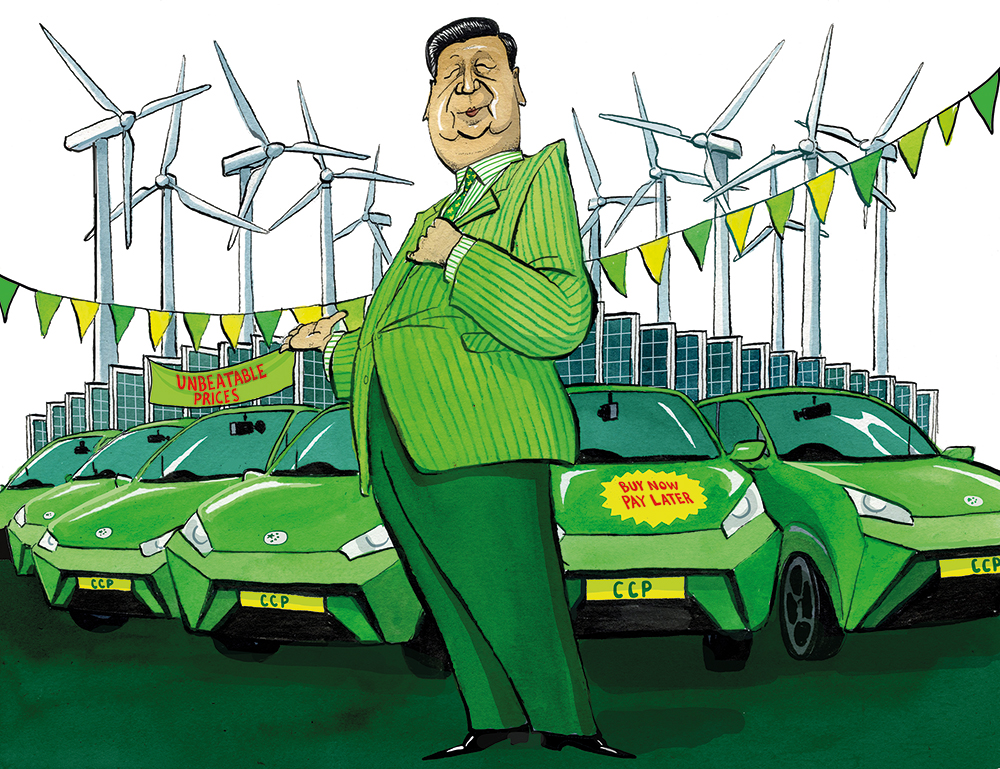
The CCP’s stated objective is to create a world dominated by China and its technological systems
Less obvious but more serious in my professional view, and that of those whose task it is to watch our potential enemies, is the growing reliance within our electricity energy infrastructure on cellular modules made in the People’s Republic of China (PRC). You find them in wind turbines, Chinese electric vehicles and switching mechanisms in the grid. They are part of the Internet of Things and they can, after installation, be reprogrammed by the Chinese manufacturer.
As the market is flooded with Chinese EVs at subsidised prices, so our roads and cities become arteries for thousands of Chinese computers on wheels over which the driver does not have ultimate control. Instead, it remains with the manufacturer and the driver has no means of blocking that interference, indeed probably has no awareness that it is happening until the vehicle no longer responds.
Imagine, if you will, a situation where the PRC invades Taiwan and the West finds itself in a military confrontation. All Chinese companies are subject to the control of the leadership, so within a few hours of a decision by the Chinese Communist party (CCP), every motorway and every city in the UK could be blocked with immobilised Chinese EVs. Similarly, the grid could be unbalanced as its switching mechanisms are disrupted from computer centres in Beijing.
Does this all sound fanciful? If only it were. Here, too, we have a warning example. The tractor-maker John Deere has used a remote ‘kill switch’ capability (installed for good reasons) to allow it to immobilise agricultural vehicles stolen by the Russians when they invaded eastern Ukraine.
The Chinese leadership does not conceal its ambitions: it publishes them. Should you care to read the mass of impenetrable documentation which supported the 20th Party Congress, you would find that the CCP’s stated objective is to have created by the mid-21st century a world dominated by China and its technological systems. The clear implication is that our social and political values should be displaced by theirs – no ifs and buts but an unqualified hostile intention, expressed without equivocation. This is Xi Jinping’s ‘China Dream’.
How deluded were those British politicians who persuaded themselves that the Great Outsourcing was a new golden age. China’s world view is stark. It is populated only by clients, rivals and adversaries. Xi’s vision is of an accelerated development of science and technology deployed to gain communist China’s global ascendancy.
The PRC has been adept at creating global dependencies through the aggressive marketing of its technologies, knocking out its competitors by subsidising its sales. No free market for them! We have watched the global rise of Huawei in telecommunications. I openly lobbied against it and at the last moment the UK, following the US and Australia, just avoided handing over to that company the development of our 5G.
Similarly, we have witnessed China’s growing dominance of the EV market. That the PRC bans Tesla EVs in China from areas which house sensitive national security assets underlines the fact that the Chinese leadership understands very well the potential security threat that EVs may have built into them. We are sleepwalking into danger by allowing significant parts of our critical national infrastructure to become vulnerable to hostile disruption.
A pillar of our national security is energy security. The supply of abundant, consistently reliable and inexpensive power, whatever the weather, is vital for the modern nation state. It guarantees that civil society does not fall apart. The idea of building an energy system designed to meet a set of ideological targets, which can at points be disrupted by a hostile government, is symptomatic of an extreme condition of political dystopia. It turns the concept of a secure energy policy on its head and destroys the logic of being focused on self-sufficiency.
So with Starmer locked in his cabin, it is Captain Miliband, with the wind in his sails and the sun on his back, who is steering the British ship of state directly on to dangerous reefs. There is a fanaticism in his eye to match that of Captain Ahab as he obsessively hunted the great white whale Moby Dick.
And for reasons akin to a religious belief, Miliband chooses to ignore all the risks of his energy policies. Do not discount either the possibility that the Chinese Ministry of State Security’s United Front Work Department – once described by Xi’s as China’s magic weapon – is engaged in measures to foster such beliefs in gullible minds.
Anticipate the moment, not too far away, where the keel grinds on the rocks and the British ship of state is holed and wrecked by net zero. It will be to the amazement and delight of our enemies worldwide, rubbing their eyes in disbelief at their luck.