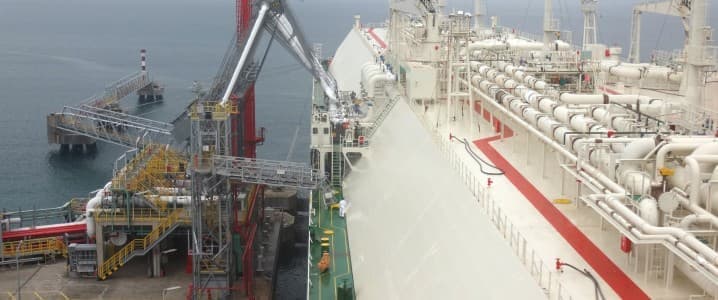
Three years ago, Germany led an EU-wide offensive against Russian pipeline gas imports. These imports were no longer wanted in Europe because of the war in Ukraine. They would be replaced with LNG—for a short while—because the EU, and Germany, were firmly on their way to net zero. Now, Germany is in the LNG game for the long haul, building import terminals with a target of over 70 million tons annually—including from Russia.
Reuters this week published an overview of Germany’s efforts to boost imports of liquefied natural gas, to replace the flows from Russia via the blown-up Nord Stream and the Ukrainian route, which got shut down by the Zelensky government, which did not extend a transit deal with Gazprom that expired last year. Besides LNG, Germany has access to Norwegian gas via the continent’s pipeline network, and, theoretically, pipeline gas from Azerbaijan via Turkey and Italy along the Southern Gas Corridor.
To date, Germany has five LNG import terminals featuring floating storage and regasification units. They are not all in operation yet, but when they are, they will provide the EU’s biggest gas consumer with an import capacity of 70.7 million tons of liquefied gas annually by 2030. This will make Germany the world’s fourth-largest LNG importer, after South Korea, China, and Japan. It would also prove that the net-zero push was doomed from the start, as no matter how many wind turbines and solar panels Germany puts up, it still needs a lot of gas.
Related: Pakistan to Launch Artificial Offshore Island To Jump-Start Oil Exploration
To be fair, Germany has succeeded in one thing it promised back in 2022 – to reduce gas consumption. Indeed, gas consumption in the country has fallen steadily since that year. Unfortunately, it was not for the reasons hoped for, namely, greater energy efficiency and a turn towards alternative sources of energy. No, gas consumption is down because industrial activity is down, and industrial activity is down because the gas available is mostly rather expensive.
This is not going to change, by the way, unless the predictions of a mega-glut of LNG on the horizon come true. LNG has always traded at a premium to pipeline gas because its production involves a much more complicated process than piping gas through a pipeline. On the spot market, LNG costs even more, which is why Germany broke another promise it had made even earlier than 2022 – to never again shackle itself to long-term gas delivery contracts. At the time, it looked achievable. Wind and solar were thriving, and soon, Europe’s industrial powerhouse would power itself with the sun and the wind. Alas, it couldn’t happen, and it didn’t. Long-term contracts are back in fashion.
Because of those long-term contracts, Germany plans to keep ramping up its import capacity for liquefied gas. One site, for instance, in the Baltic Sea, is scheduled to have a regasification capacity of 13.5 billion cu m by 2027. After that, the Mukran site could get another 5 billion cu m in import capacity annually, per plans drafted by its operator, Deutsche ReGas.
Another site, at Wilhelmshaven, is being prepared for alternative uses at some point. Operator Uniper, which built Germany’s first FSRU there in 2022, has plans to build an ammonia import facility there and a wind power installation with a capacity of 200 MW to produce green hydrogen. Germany is not giving up on its net-zero dream so easily, regardless of how many LNG import facilities it must build to keep the lights on and the factories going.
Meanwhile, transition activists are speculating that there is too much LNG import capacity in Europe already, and it will end up stranded as demand for gas declines under the onslaught of wind and solar output. This is what one such outlet, the Institute for Energy Economics and Financial Analysis, reported recently, saying the buildout of LNG import terminals had slowed down since 2022.
This, of course, is only natural as no country could be expected to keep building LNG import terminals at a constant pace until it has no more space left to build more. Yet the line of argument that outlets such as IEEFA use is that the energy transition would eventually destroy gas demand, leaving these structures, floating as many of them may be, useless after billions of euros were poured into their installation.
Before that happens, however, the billions would be flowing westward as Europe turns into the biggest buyer of U.S. liquefied natural gas—under long-term deals, no less. Energy Intelligence reported this week that some of the deals that European energy companies are signing with LNG producers and traders are as long-term as 25 years, even though there is an option to sell them on if demand declines and the volumes are no longer needed.
For now, the volumes will be needed. U.S. LNG exports to Europe have soared in recent months as the continent rushes to stock up on the fuel for winter peak demand. In October, flows hit an all-time high of 10.7 million tons, up from 8.66 million tons a month earlier. Europe—and Germany—needs gas. If it can’t or won’t have it in pipeline form, it will need all the regasification terminals it can build.
By Irina Slav for Oilprice.com
More Top Reads From Oilprice.com