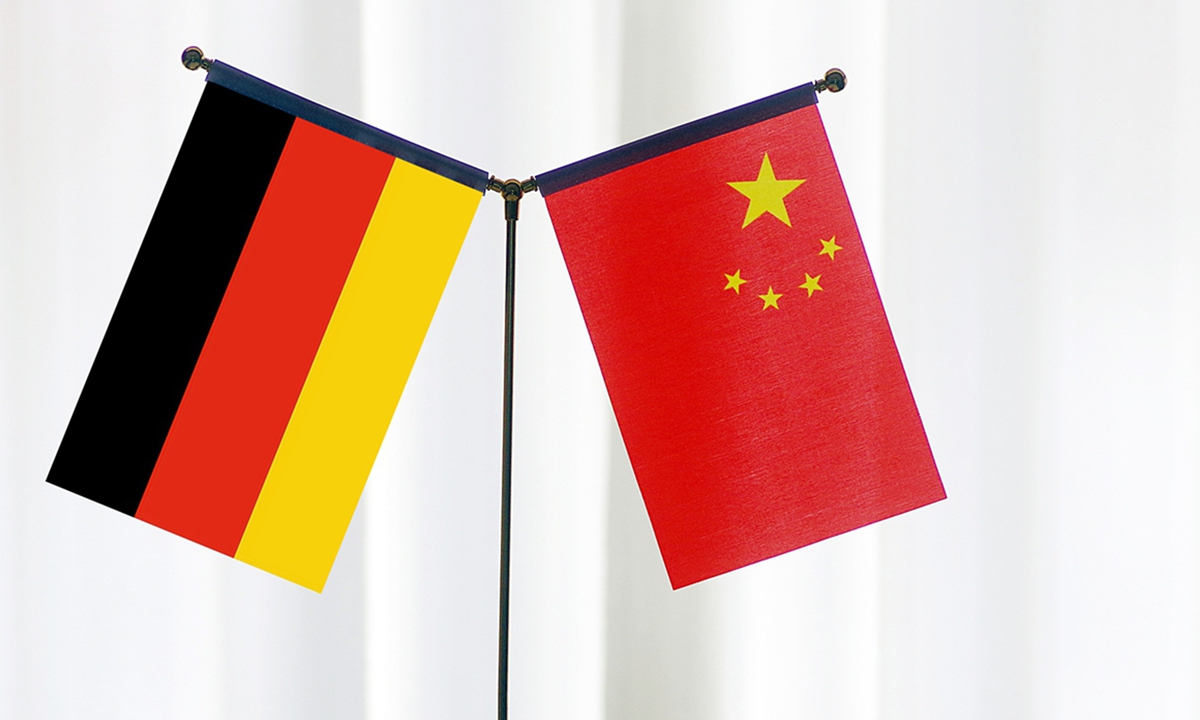
China Germany Photo:VCG
German Finance Minister Lars Klingbeil claimed in his China trip that he does not want to “see the German steel industry suffer because of Chinese steel that is state-supported,” Reuters reported on Wednesday. But he nevertheless said that “this partnership with China – despite all the differences, despite all the competition, despite the rivalry – can work reasonably well,” the report noted. A Chinese analyst told the Global Times on Thursday that Germany should correct its misperception on Chinese industrial competitiveness and take a more pragmatic, open approach in its engagement with China.
According to the Reuters report, Klingbeil said in Shanghai on Wednesday that competition must be fair and if industries are subsidized, the European market must be protected.
He spoke about the challenges faced by European steel producers and the European Union’s proposal for new tariffs on imports, including from China, to protect its domestic steel industry. “I am in favor of free and open markets. But I do not want us to end up being the losers in Europe and Germany,” Klingbeil was quoted as saying in the Reuters report.
“I do not want to see the German steel industry suffer because of Chinese steel that is state-supported,” Klingbeil said.
Jian Junbo, director of the Center for China-Europe Relations at Fudan University’s Institute of International Studies, dismissed Klingbeil’s accusations of so-called Chinese government subsidies as a cliché and a convenient excuse to avoid taking responsibility for the lack of competitiveness in German industry.
“The rise of Chinese industries is not because of subsidies, but a mix of factors including innovation capacity and complete industrial chains. Meanwhile, rebuilding the competitiveness of German industries won’t be achieved simply by blaming others and erecting barriers,” Jian noted.
“Klingbeil’s remarks reflected the two-faced nature of Germany’s China policy,” the expert further noted. On one hand, it acknowledges the two economies’ close ties and Klingbeil’s visit itself is a positive signal for maintaining and expanding this cooperation momentum; on the other hand, some Germany politicians are taking a tougher stance on China-related issues, with some calling for reducing dependence on Chinese market, Jian pointed out.
“If Germany continues to indulge in preconceptions and biases against China, it will only miss the opportunities for deeper cooperation and common development with China,” Jian warned, while also taking note of Germany’s severe economic situation.
Klingbeil is the first representative from the current German coalition government to visit China. Ahead of his trip, Klingbeil told the German Press Agency that “we should not talk about China, but talk with China.”
His visit is also warmly welcomed by the German business community in China. Oliver Oehms, executive director and board member of the German Chamber of Commerce in China, told the Global Times that the chamber’s member companies are having high expectations for the visit and “look forward to the high-level exchange between the two governments.”
According to data released by the Federal Statistical Office (Destatis) on Wednesday, China reclaimed its position as Germany’s largest trading partner in the first nine months of 2025, the Xinhua News Agency reported.
Germany’s total trade with China reached 185.9 billion euros ($215.13 billion) from January to September, up 0.6 percent from the same period last year, Destatis said.
Given the two economies’ close economic ties and that China is now Germany’s largest trading partner, Berlin needs to realize that “decoupling” or “de-risking” from China is simply not feasible, Jian said, noting that German instead should brace for closer bilateral economic relations and achieve mutually beneficial cooperation with China, which truly serves the interests of the economy and companies.