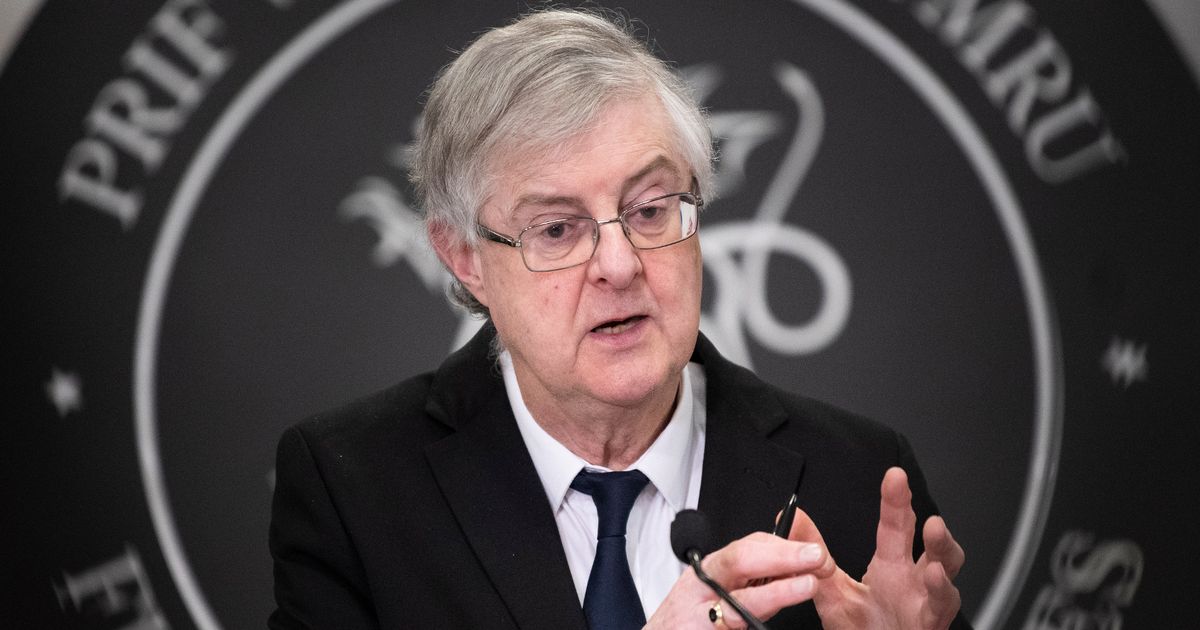
The former First Minister missed a crucial meeting but was called ‘considerate’ elsewhere in a major report Mark Drakeford speaking during the pandemic(Image: Getty Images)
Mark Drakeford’s handling of the pandemic in Wales is heavily criticised in a major Covid inquiry report covering the response of the four governments in the UK. Baroness Heather Hallett’s report on the way administrations in all parts of the UK handled the pandemic finds that the four governments were too slow to appreciate the level of risk the UK faced when the pandemic hit, and that people died as a result.
She makes specific criticisms of the Welsh Government’s handling of Covid and the decisions made by then-First Minister Mark Drakeford and then-health minister Vaughan Gething.
In the early part of the pandemic, Ms Hallett’s report highlights the First Minister’s decision to attend a St David’s Day celebration in Brussels on March 4, 2020. While travelling to Europe, he missed a Welsh Government cabinet meeting about Covid. For our free daily briefing on the biggest issues facing the nation sign up to the Wales Matters newsletter here
“It should have been equally apparent… that, by this point, Covid-19 was the most pressing issue,” the report says.
Ten days later, the report also notes that the Welsh Government went against the scientific advice from Public Health Wales to call off the Wales v Scotland Six Nations game in Cardiff on March 16, even though it had the power to do so.
It was not until hundreds of Scotland fans had already travelled to Cardiff that the WRU stepped in and called the game off.
But the most serious questions about Mr Drakeford’s leadership relate to his handling of the pandemic as Covid cases rose in Wales to the highest level in the UK between August and December 2020.
As winter approached, Wales had the highest age-standardised mortality rate of the four nations.
The report highlights that, despite being advised on October 5, 2020, that further restrictions were needed, the Welsh government did not implement a two-week “firebreak” until October 23.
From August to December 2020, Lady Hallett suggested a combination of failed local restrictions, a firebreak that was too late and the decision to relax measures too quickly all contributed to these deaths.
She criticises the Welsh Government for not planning better over the summer for the reintroduction of restrictions in the autumn and said that the laxness of rules after the short lockdown contributed to the nation having the highest death rate in the UK that winter.
Her report says: “The Welsh Government relaxed restrictions too quickly following the firebreak.
“This quickly led to the benefits of the firebreak being lost and to the need for the reintroduction of stricter restrictions at the beginning of December.
“From August to December 2020, Wales had the highest age-standardised mortality rate of the four nations.
“It is likely that a combination of failed local restrictions, a firebreak that was too late and the decision to relax measures too quickly all contributed to the higher mortality rate.”
She also criticises all four governments for being too slow to recognise the impact of the emergency of the more quickly spreading Alpha (or Kent) variant that autumn.
The report says: “The emergence of a more transmissible variant was entirely foreseeable, but all four governments failed to take decisive action in response.”
A number of Welsh Government witnesses, including Mark Drakeford, the former first minister, told the inquiry the provision of funding from the UK government had affected the Welsh government’s decisions on the timing and length of the firebreak.
This reasoning was dismissed in the report, noting that Mr Drakeford did not raise the question of additional economic support for a Wales-only lockdown.
In relation to the slow adoption in Wales of facemasks, there is criticism of the chief medical officer for Wales Sir Frank Atherton on whose advice the Welsh Government delayed changing its stance.
The inquiry concludes: “In any future pandemic where airborne transmission is a risk, the UK government and devolved administrations should give real consideration to mandating face coverings for the public in closed settings.”
However, elsewhere, the report praises Mr Drakeford and says he was recognised as a conscientious leader.
It says: “By contrast, the Welsh Cabinet was fully engaged throughout the pandemic, with decisions mostly being made through consensus. Mr Drakeford was recognised by his ministers as a careful and considered leader. He maintained positive relationships throughout the response.”
The report has renewed calls for a Wales-specific inquiry into the response of the Welsh government.
James Evans, Conservative shadow cabinet secretary for health and social care, said: “These findings prove we still need a Wales-specific independent inquiry.
“The report found, at times, there to be an ‘absence of any real strategy’ pursued by the Welsh government. This requires further investigation.
“Sadly, significant failures led to Wales having the highest death rate in the UK, despite the Welsh Labour government enacting stricter lockdowns and depriving Welsh pupils of more school days than elsewhere in the UK – lessons must be learned.”
First Minister Eluned Morgan said: “I welcome the publication of the second report by the UK Covid-19 Public Inquiry.
“I would like to thank the inquiry chair, Baroness Hallett, and her team for their work and for today’s report.
“It is important that we remember the immense loss and suffering of so many people due to Covid-19.
“Today, our thoughts must first and foremost be with them.
“We will take time to read the report and will work with the other UK governments over the coming months to carefully consider and act on its recommendations.
“We are committed to learning lessons from the pandemic and continue to be actively involved in the UK inquiry.”
Heledd Fychan, a Plaid Cymru Senedd member, described the report as a “damning condemnation” of the government.
She said: “Today’s report is a stark reminder of the human cost of the Covid pandemic here in Wales.
“It’s also a damning condemnation of both the UK and Welsh governments’ response and how both fell woefully short of what was required to keep people safe.
“Neither Labour nor the Conservatives took decisions quickly or effectively enough – and people in Wales paid the price.
“Crucially the report finds that the decisions taken by Labour ministers were the ‘likely’ reason Wales suffered the highest mortality rate, which will be devastating to all those who lost a loved one at this time.
“Bereaved families still don’t have the answers they need or deserve. This report – and the wider inquiry – does not and cannot give them that clarity or comfort.
“The truth is we will never fully understand the true impact of the pandemic on Wales because Labour refused time and again to hold a Wales-specific inquiry, and blocked Plaid Cymru’s attempts to establish one.
“A Plaid Cymru government in 2026 would conduct a dedicated ‘gap inquiry’ to properly scrutinise the Welsh government’s decisions at the time – providing the transparency and accountability that this inquiry could not deliver.”