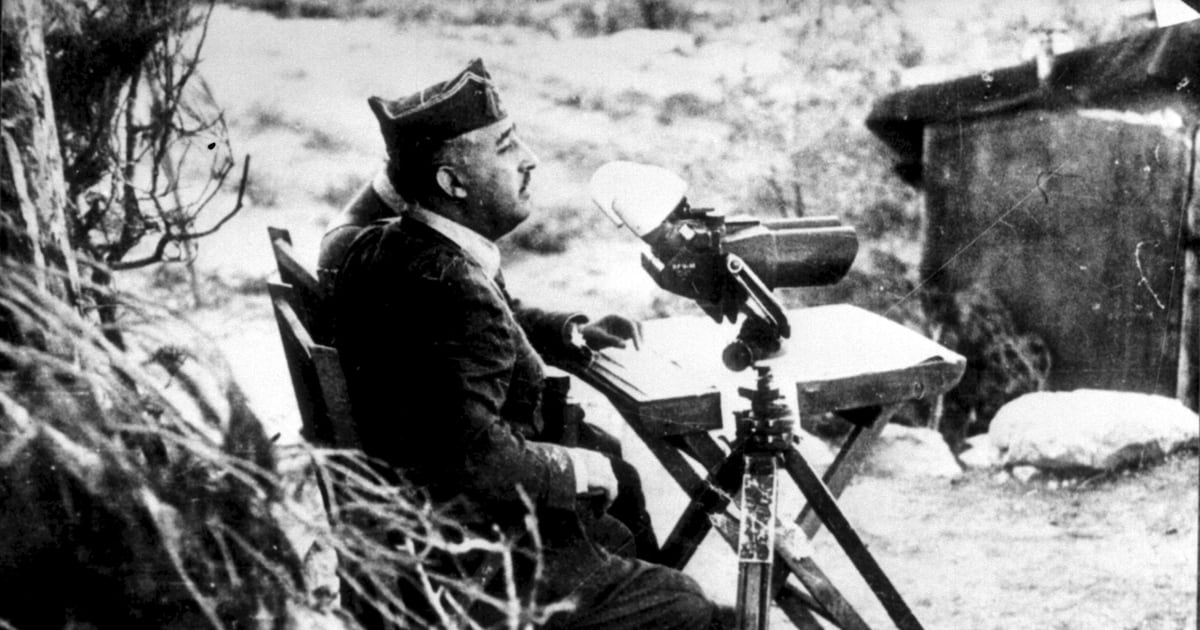
November 21 1975
It will probably be at least a hundred years before commentators as a whole will be able to write dispassionately about the man who has dominated the Spanish scene for the past thirty-six years, General Francisco Franco.
In a most remarkable way the Spanish Civil War of 1936-9 became a kind of catalyst for opposing political philosophies in Europe; and even more remarkably has lingered on as a kind of touchstone of one’s views, especially among the intellectuals.
Today, nearly forty years since the Spanish agony it is like touching a raw nerve to mention a subject which might reasonably be expected to exhaust its interest. There is no longer the acuity of reaction about the war in Abyssinia which was roughly contemporaneous. The terrible tragedies of the struggle in Greece towards the end of World War II have passed from our columns. Indeed the very recent and ghastly Nigerian civil war seems to have left the public memory entirely.


Not so Spain. And not so the man who, in the minds of the media at any rate, has represented all that Spain means for so long.
As a consequence any attempt to assess General Franco, the man and the political figure, is bound to be interpreted as the expression of an attitude which must either infuriate or delight. What the Spanish people themselves think and have thought of their leader seems almost irrelevant; or else it is dragged in to support one view or the other.
In fact the Spanish, a most sophisticated and highly intelligent people, have had as many and widely differing views of their controversial head of state as might be expected of such a gifted race.
They have given him full credit for his many extraordinary achievements. He restored stability to his country which had been in a political ferment for at least a decade or more before the Civil War began. He guided post-Civil War Spain through the most painful and difficult period in her history for many centuries. He achieved an “economic miracle”, as one quite non-partisan commentator put it recently, in building up prosperity in a basically underdeveloped country and bringing Spain into line with the rest of modern Europe.
They have also been deeply critical of his implacable post-war attitudes to former enemies. And they have been, as Spaniards have been now for many generations, bitterly divided about the Basques; about their claims and about the reaction of General Franco’s government to them.
Irish News editorial on the then still very raw feelings about the Spanish Civil War following the death of the Spanish dictator Francisco Franco.