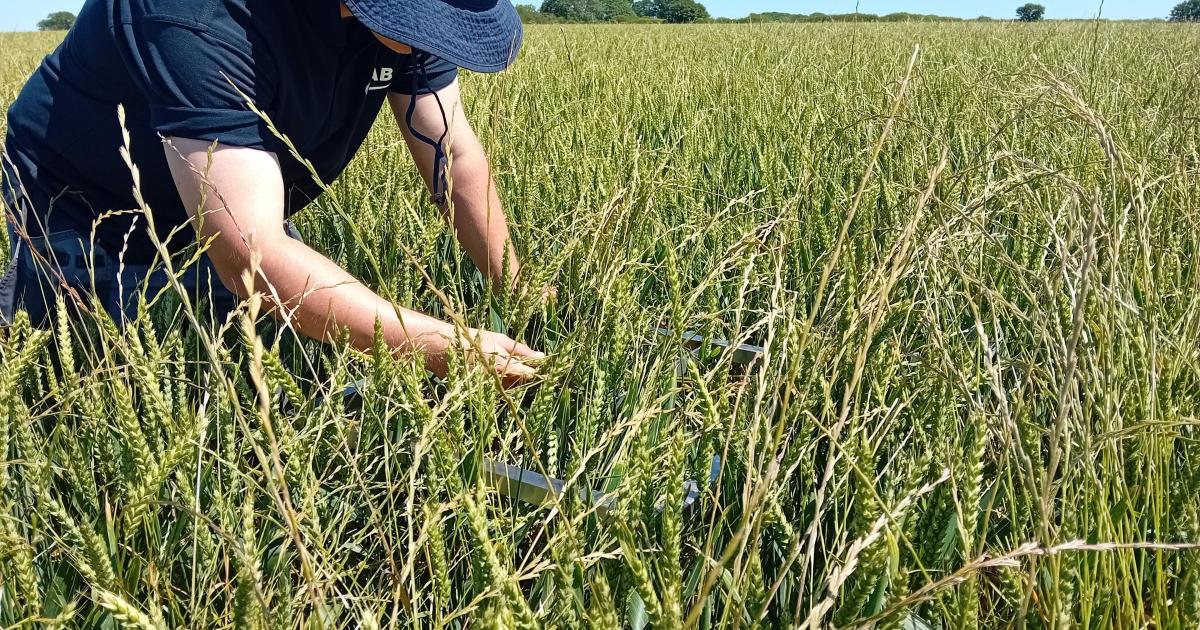
Morley Farms, near Wymondham, which farms land owned by the Morley Agricultural Foundation (TMAF), is also an AHDB Strategic Cereal Farm – one of only three in the country.
The farm hosted a meeting to discuss the second year of its partnership with the Agriculture and Horticulture Development Board, which aims to put scientific research into practice on commercial farms.
Morley Farms near Wymondham hosted a meeting to share the progress of its research as the AHDB Strategic Cereal Farm East (Image: Newsquest)
The Strategic Cereal Farm East trials fall under three “work packages”, including exploring non-chemical ways to control Italian ryegrass – to reduce the weed population and its impact on yield and production costs.
NIAB research trials agronomist Jack Poulden said weed seedbank monitoring had been shown to be a potentially valuable tool to improve decision-making on the farm.
He said five “problem” sites had been identified in different parts of the farm’s rotation, from where seeds had been collected at soil depth bands of 0-5cm, 5-10cm and 10-20cm. These seeds were counted and cultivated in plastic trays in a polytunnel.
The data gathered showed how the number of viable grass weed seeds varied at different depths, and how this number changed from field to field – giving valuable insights on how the cultivation of each plot should be approached in order to prevent seeds being brought to the surface to germinate.
“Think about this as a 3D approach to where your weeds are,” said Mr Poulden. “It is not just about which patch of weed is where, it is about what is going on through the soil profile.
“Ultimately it is about managing the seed return – where that seedbank builds up is where we might have problems in the future.
“Soil seedbank sampling could potentially be a tool for growers. It might not give you the whole answer, but it could give you a greater understanding of where that seed bank is.”
Another key finding, from studies of incubated seeds, showed that in winter cropping, Italian ryegrass seeds mature very quickly – from very low viability to high – between the end of May and the end of the first week in June.
“Maturity in spring crops is later, but also slower,” said Mr Poulden. “It is interesting to note that the final seed per plant from winter and spring crops is actually similar – reinforcing findings from elsewhere about how spring cropping as an approach [to Italian ryegrass] isn’t as robust or reliable in this species as others.”
David Jones, farm manager at Morley Farms near Wymondham, which is the AHDB Strategic Cereal Farm East (Image: Newsquest)
Farm manager David Jones said: “I was shocked how quickly the seed became viable at the start of June. I think it is fascinating information which can be used to help our decision-making.
He added: “This is developing a technique which others can potentially use – to do their own studies to guide their own decisions.”
The meeting also discussed the other two work packages. One is BYDV (barley yellow dwarf virus) management using less insecticide, and the other is nitrogen use efficiency (NUE) – using long-term spatial data and alternative sources of nitrogen to see if less artificial fertiliser can be used while still producing good yields,