Gerald Knaus, architect of the 2016 EU-Turkey deal, and founding chairman of the European Stability Initiative (ESI), was in Athens a few days ago, invited by the Friedrich Ebert Foundation for a lecture on “Germany, Greece and the Future of European Borders.” In his opinion, similar agreements with safe third countries should be signed again.
 This time, however, unlike 2015-2016, the crisis is not so much about migration, but politics, since the European far-right attributes every social problem to migrants, Russia fuels these fears, and the systemic parties have not found a convincing answer.
Four EU member-states – including Greece and Cyprus – were assessed this week as “eligible” by the European Commission for access to the so-called “solidarity pool” under the Migration and Asylum Pact, set to take effect in June 2026. At the same time, Poland, Hungary and Slovakia are refusing to contribute to this mechanism, either by taking in refugees or by paying not to do so. That is why Knaus believes that the European Pact on Migration and Asylum, decided on last year, will fail, and this is where our discussion begins.
Why you think the EU pact will fail, and what do you think is the alternative?
It is two things the German parties now say will be the solution for irregular migration in the next three years. I am certain both will fail. One, the border controls inside Schengen. Germany introduced them. They are already not working. I mean, they’re not having an impact. And they are also against EU law. So they will fail. And the Pact on Migration will not solve the two essential questions: to make [the] Dublin [Regulation] work better because there are no incentives to make it work better. I mean, there will be no different incentive for Hungary, Greece or Italy to take more people under Dublin. There is actually nothing in the pact that will change this. And if Dublin doesn’t work, then the solidarity will not work. Because why would countries like Austria or Germany or Sweden – which already have more [migrants] per capita than Italy or Greece or Spain – take more people?
So why do you think we’re playing these theatrics in Brussels?
The second failure of the pact is to stop irregular migration into the EU. If you can’t stop them at the national borders, which is what the German experiment now shows, and you can’t distribute them in a way that they will stay where they are distributed – we saw that already in 2016, 15, 16 – then the only thing that really will produce a different situation is less people coming irregularly into the EU. And that means safe third country agreements. A lot of people don’t like the idea of safe third country solutions, especially on the left and center-left. On the center-right, a lot of people like the idea of just national controls or more returns because it sounds tough. But the center-left has no alternative to safe third country solutions, and the center-right proposes things it cannot do. So, they have been negotiating for years on something that, in the end, each country made sure that its own interests are safeguarded. And so it will not work.
So, can you explain your proposal?
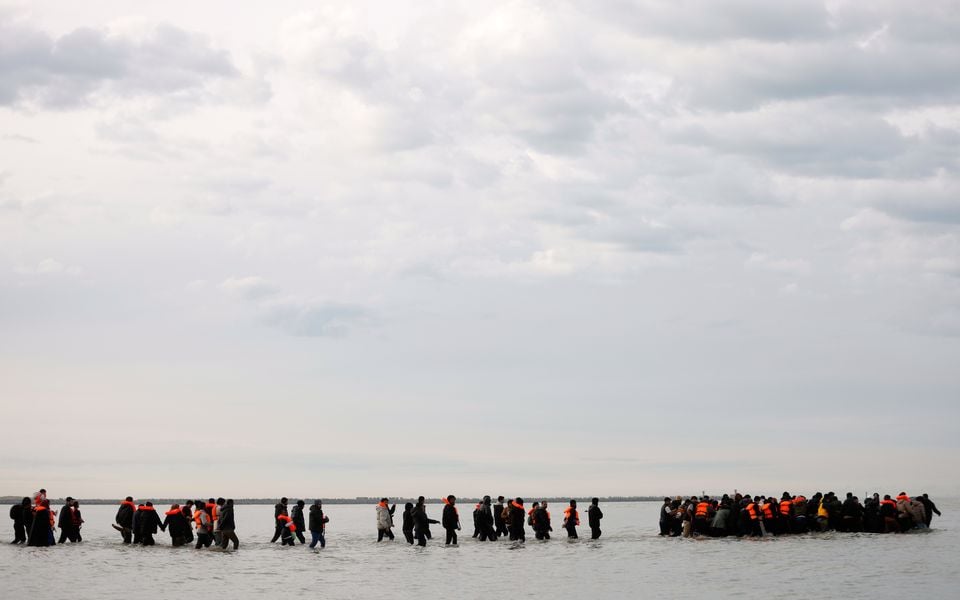
The proposal is that in the next year, we should aim to have five safe third country agreements on the five major routes of irregular migration. And you look at the Frontex table from this year and you see from outside, you have the West Mediterranean, which is Spain, the Central Mediterranean, which is Italy and Greece from Tunisia and Libya, the Eastern Mediterranean, which is basically Turkey, and the eastern border, which is Belarus, to the Baltic states and Poland. The fifth one is the [English] Channel, which is people leaving the EU to the UK, which is devastating for UK politics and devastating for us who want the UK as a reliable ally in the next 10 years. Because if we don’t solve the Channel, we will lose the UK to Trump.
Do you mean it will fall into the hands of far-right leader Nigel Farage?
Yes, on each of these five routes, we need to find a way to have a cutoff date [for irregular migration]. [We need] a country that says, “From now on we will take everyone,” and the country must be a safe third country. And we start in the Channel this winter. So we need a little bit of courage from European leaders, from the Greek prime minister and the German chancellor and the Danish prime minister, to say we are going to offer to the UK that we will take everyone after December 1.
What about the “one in, one out” scheme between France and the UK?
That doesn’t work. France didn’t want to announce it in a big way. Nobody noticed that it began to be implemented on August 6. The EU-Turkey agreement, everybody knows this. The whole world came, journalists came. So, there was a message that now something is happening. On August 6 this year, nothing happened. I’ve been to Moria and I’ve been to the reception centers on Kos. I mean, it was awful. But the one thing that did work well [in 2016] was that moment in March when he said, “Now something is different,” and it was believable. People immediately stopped getting into the boats, the numbers went down. That’s the key. Have very few returns, very few deportations, and immediately open up a legal route for people in need of protection so that people know there’s an alternative.
In 2015-16, you presented this proposal to European politicians. Did you do the same now? What is the feedback?
My favorite European policy-maker is Jean Monnet. And he wrote this great book where he says that for any really innovative idea, the idea needs to be ready. But the most important thing is there needs to be a sense of crisis, because only then do top leaders mobilize. This is something for ministers or prime ministers, like the EU-Turkey agreement.
So back in 2015, did you meet Chancellor Angela Merkel?
No, I didn’t meet Merkel. And that is the big misunderstanding. I met the Turks and the Dutch. I met lots of Germans. Of course, I met the German ambassador in Ankara early on. And I talked to the Foreign Ministry, I met all the people. And then Sigmar Gabriel supported the proposal. And I met Merkel’s advisers. But the key actually wasn’t the Germans – it was the Turks and the Dutch.
…that needed to be convinced?
Yes, because the Dutch held the EU presidency, and they said, “Oh, we want to do that.”
Would you say that there is no migrant emergency now?
No. Now there is an emergency, and the real emergency is in the UK in the [English] Channel. And the real interest is, I think, in a country like Denmark, which holds the EU presidency, not to lose the UK. The loss of reliability of the US is a strategic disaster for Europe. To lose the UK as well would be disastrous for Germany. What I tell EU policy-makers is that what they are now doing will fail and will give more arguments to the enemies of the EU at a moment when, for the first time since the 1940s, the US helps or wants to help the enemies of the EU to win elections.
But maybe that’s why it’s difficult to negotiate a deal, because it’s not actually an emergency. The emergency is political: the rise of Alternative for Germany, Marine Le Pen’s party in France, etc.
You know, they started with this totally crazy idea 10 years ago, that an elite in Europe wants to replace our population, that Germans will disappear or the British will disappear or the French will disappear. These ideas had been around [backed] by the far-right for a long time, and then they were written up by a French writer who was a far-right extremist who was isolated, Renaud Camus, [who wrote] “Le Grand Remplacement.” But the people who realize the power of this idea in Germany translated them into German. They created a publishing house, Antaios, where they published all this far-right literature. They created an institute in Saxony-Anhalt, to have meetings of all these lawyers and experts from across Germany. Today I watched the leader of the AfD in Saxony-Anhalt, and he said: “There’s a hospital being closed. You know why are they closing the hospital? Because they give all this money to refugees.” On every issue, they link it to this big myth.
Why not just bust the myth? Though when the German chancellor himself goes on TV and makes the comment…
It’s silly what he’s doing. But it’s also a desperate act. The reality is that, of course, the number of migrants in Germany did increase. It gave protection to 1.5 million Muslims. Why? We shouldn’t run away from this, you know, because people see it. We see it in the schools. So we should say, “Yes, we did that.” And the reason was the war in Syria.
You mentioned that. What about the infighting in the German government now about Syrian refugees. Do you think Syria is a safe country, because Foreign Minister Johann Wadephul went there and he thought that the conditions are terrible.
And this debate shows us how smart the far-right has become, because we are talking about a few hundred criminals. Perhaps it’s only 500. So this debate is completely, at the moment, hypothetical. But the media in Germany that are interested in a far-right-CDU alliance brought it up, and I’m not sure what their motivations are for some of those.
However, like Greece, Germany also needs immigration to solve its demographic problem, its social security problem, and the gaps in the labor market…
Germany needs migration. And Greece, Italy and Poland. But it’s not an argument for irregular migration, which is deadly and politically toxic. If the same people could apply and come – and we have a refugee reception program – everything would change completely in politics.