Amnesty is acting as an intervener in the coming judicial review of the UK government’s proscription of Palestine Action, who prior to being banned as a terrorist organisation were a direct action protest group.
The government outlawed Palestine Action under terrorism laws, with membership carrying a maximum sentence of 14 years in prison.
Home Secretary Yvette Cooper said violence and criminal damage had no place in legitimate protest, and Palestine Action’s activities, including breaking into an RAF base and spraying two aircraft with red paint, justified the ban.
Palestine Action has increasingly targeted Israel-linked companies in Britain.
It accuses the government of complicity in Israeli war crimes and genocide in Gaza.
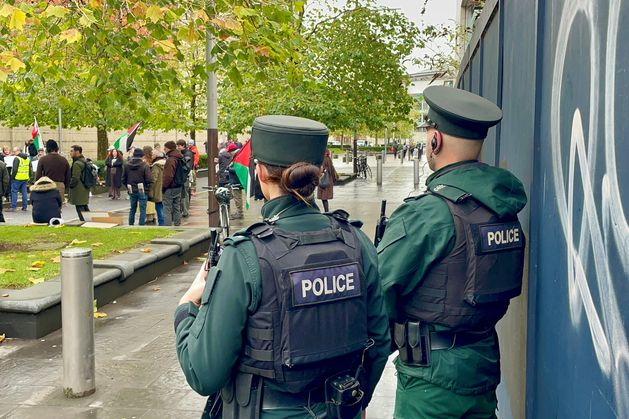
Patrick Corrigan, Northern Ireland Director of Amnesty International UK, was a human rights monitor at today’s protest in Belfast.
He said: “We welcome the approach by the PSNI today to facilitate peaceful protests against the genocide in Gaza and the proscription of Palestine Action.
“This stands in marked contrast to the ‘arrest everyone’ response by the Metropolitan Police at the Defend our Juries protest in London.
“The differential approach by police forces to identical protests held simultaneously in different parts of the UK underlines the utter absurdity of UK terrorism law and the disproportionality of proscribing a group like Palestine Action.
“This proscription not only undermines people’s right to peaceful protest, it has proven to be a huge waste of police time where Chief Constables have chosen to enforce the ban. Previous arrests now need to be rescinded, charges dropped and prosecutions ended.
“The government can end this farce by overturning the proscription and restoring freedom of expression to all who wish to protest peacefully.”
Speaking at a rally in Derry, veteran civil rights activist Eamonn McCann said there are people on remand in British prisons for alleged offences related to Palestine Action.
“Surely here in Derry above all places we should be taking a stand on that,” he said, “and we should remember also that people who hold up these placards have been told, ‘you are risking imprisonment.’
“Well, we’ve been told not to raise slogans, more than 50 years ago in this town, more than 100 years ago, this has been going on – ‘don’t dare raise slogans which threaten the integrity of the British state.’ But we did it. We did it. And that is a tradition of which Derry people are proud.
“And we shouldn’t let that tradition down now by allowing internment across the water. There are people in jail for over a year.
“Do we all know this? because there hasn’t been given much publicity. There are people in jail without charge, without trial, in Britain at the minute. End internment.”
This week, investigative news website The Detail reported that the PSNI is facing fresh questions about consistency in policing.
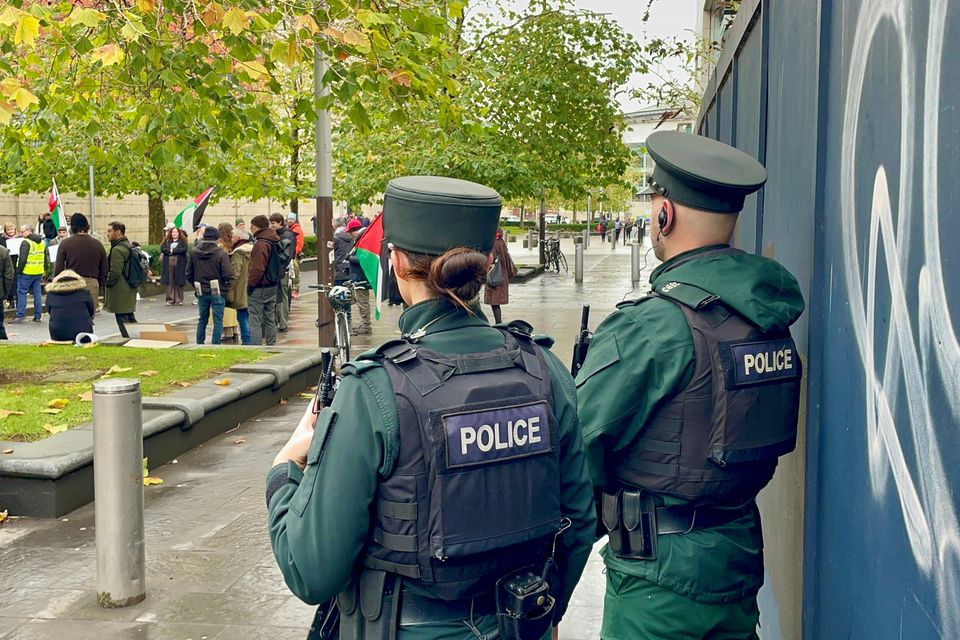
Officers from the PSNI observe a Defend Our Juries protest in support of Palestine Action in Belfast (David Young/PA)
Police arrest almost 500 people over Palestine Action support
Since Palestine Action was banned in July, the PSNI has made three arrests and sent six files to the Public Prosecution Service (PPS).
In addition to arresting Palestine Action supporters, the police have also issued ‘advisory letters’ to 13 individuals in Derry.
The cases relate to Section 13 of the Terrorism Act, which makes it an offence to wear clothing or display items that indicate support for a proscribed group.
Over the same period, however, the PSNI took no similar action against public displays linked to proscribed loyalist or republican groups, despite several high-profile incidents.
These included parades honouring UVF killer Brian Robinson in Belfast in September, and another in Portadown in August for Harris Boyle, a UVF member linked to the Miami Showband Massacre.
A PSNI spokeswoman said its “role is to apply the law fairly and proportionately, regardless of the issue or organisation involved. The proscription of groups is a matter for Government; police act to ensure public safety and uphold the law.
“We are clear that people have a right to protest and express their views, and we will continue to facilitate that. We simply ask that those taking part do so peacefully and within the law, so that everyone can make their voices heard safely.”