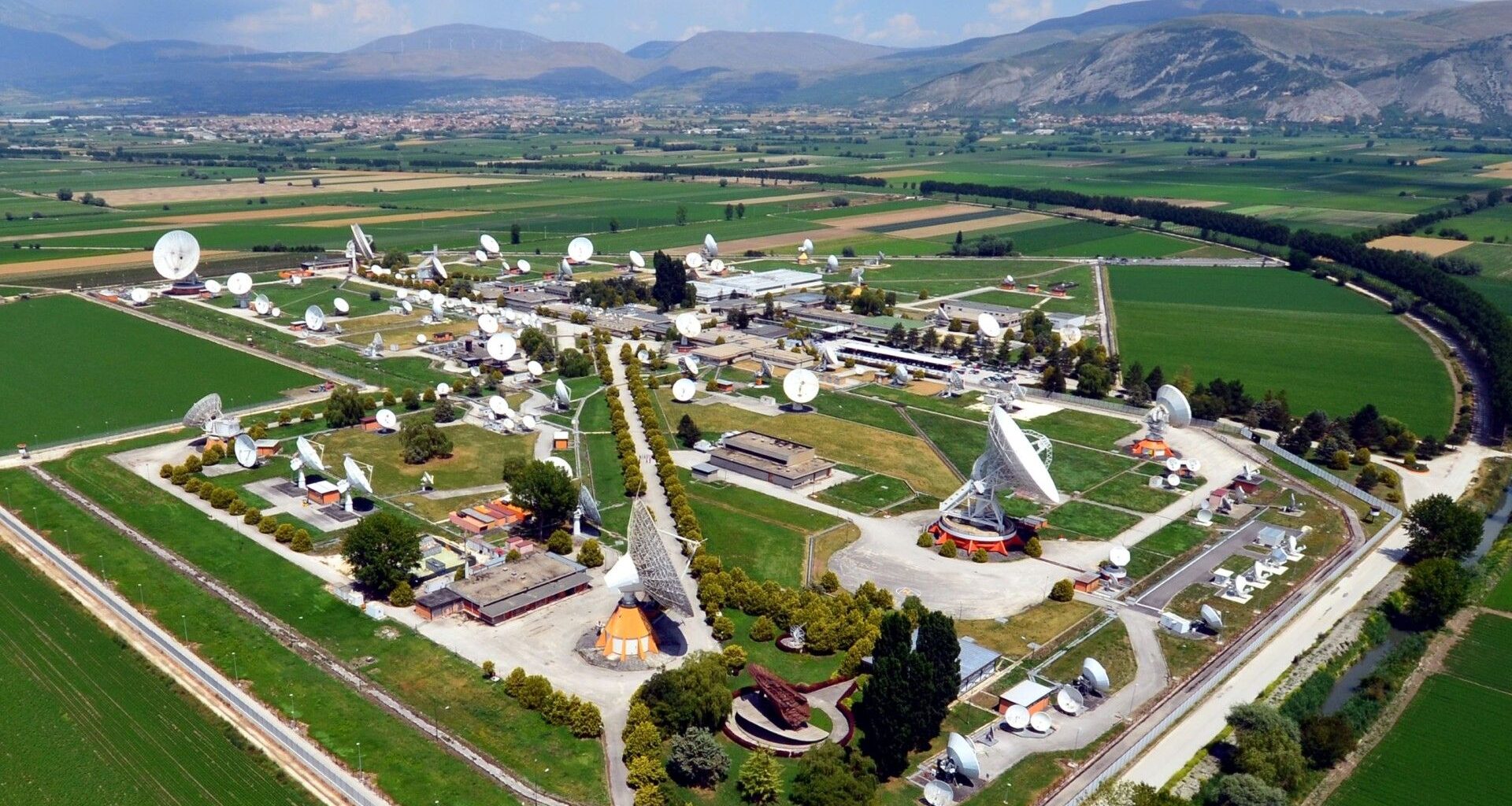
Telespazio Fucino Space Center, Italy, for in-orbit satellite control, space mission management and telecommunications, television and multimedia services.
Photo. Telespazio/Leonardo
The Italian-Polish Aerospace Forum 2025 brought together representatives of public institutions, industry and research centres. The Space24.pl managed to talk to Giuseppe Lenzo, Vice President of Leonardo Space Division, who spoke about the company’s experience and offerings, as well as his insights into the future of the European space sector.
Wojciech Kaczanowski, editor of Space24.pl: What areas of space activity are most important to Leonardo today, and what role will the company play in shaping the European space ecosystem in the coming years?
Giuseppe Lenzo, Vice President of Marketing and Sales at Leonardo Space Division: At Space Division, we truly have an excellent perspective and insight into space activities. We have the potential, based on user knowledge and needs, to create everything our customers need – from upstream to downstream, from satellites to the ground segment and applications. We do this within our own organisation and in collaboration with our affiliates and subsidiaries.
Together with Thales, we formed the Space Alliance, which gave rise to Thales Alenia Space and Telespazio. This allows us to cover everything that is extremely important, as we have a comprehensive perspective. It enables us to understand the end customer’s needs, define the mission’s objective and architecture, and ultimately provide services that are perfectly tailored to their requirements. We have extensive experience in delivering a wide range of products and services to both European countries and the rest of the world.
Recently, there have been reports in the media about the signing of a Memorandum of Understanding between Leonardo, Airbus and Thales. What was the motivation behind this decision?
The three partners have clearly emphasised that this is the right way to increase value, ensure greater opportunities for investment in technology in Europe, and build the critical mass necessary to compete effectively in the space industry market. Each partner is a leader in its field, and together they form a strong team that can become a true leader in the global space sector. Together, the partners can generate real value for institutions and European citizens and create new development opportunities for employees and the supply chain.
What about competition from players outside Europe? Today, companies from the United States and Asia play a really big role in the space market.
A larger scale of operation and critical mass provide significantly greater opportunities for investment, keeping up with the latest developments and driving technological development and innovation. Of course, competition today is global in nature, and it is necessary to face large rivals in other markets, such as the United States.
Companies from the Far East are also becoming increasingly interesting and influential players. It is therefore clear that competition is constantly growing and maturing, becoming more reliable and advanced. I believe this is a very positive phenomenon – competition motivates companies to develop, improve quality and strive for continuous improvement.
In which areas of space technology does Europe currently have a real competitive advantage?
I think we should be very proud of what we are doing in Europe and what we have achieved in the field of space. We have a great deal of knowledge and experience. For example, the Galileo navigation system is an entirely European programme – every component was manufactured on our continent. We started from scratch and now we provide services with the highest precision and reliability in the world. We should be proud of that.
As Leonardo, we are making a significant contribution to this programme by manufacturing some of the second-generation satellites through Thales Alenia Space, we have built atomic clocks that are the most accurate clocks in space, and one of the Control Centres for the European satellite positioning and navigation system Galileo is located at the Telespazio Fucino Space Center in Italy.
Galileo, european programme for navigation and position. Many of the technologies are built and provided by Leonardo and its joint ventures Telespazio and Thales Alenia Space.
Photo. Leonardo
The Copernicus Earth observation programme is also proving successful. For this programme, we have built a constellation of satellites with various sensors, providing high-quality information. In this area, Leonardo, together with Thales Alenia Space, Telespazio and e-GEOS, is a partner in this European programme, providing not only satellites, but also innovative payloads and satellite services and data analysis.
It should therefore come as no surprise that other countries around the world are also using data from the Copernicus programme. This proves that we, as Europeans, are the leading players in this market in terms of technology. At Leonardo, we firmly believe in the strategic importance of Earth observation and, as I mentioned earlier, we recently announced the creation of our own Earth observation constellation, which will be fully integrated with digital technologies such as artificial intelligence and supercomputers directly in space.
As Europeans, we should start thinking with conviction and awareness that we are very good at building space technologies and solutions. We need international cooperation, which is a natural phenomenon in space. And with this awareness, we can do a lot of good.
In discussions about Europe’s future in space, the term „strategic autonomy” is often used. What does this mean in practice for companies such as Leonardo?
From an industrial perspective, „strategic autonomy” is a key aspect of the ability to operate without the risk of stoppages or delays due to reliance on others, and to continue developing innovative technologies and solutions. From an industrial perspective, this is a natural way of operating.
From a geopolitical point of view, however, the situation is different. This means that Europe must maintain its technological capacity to act. For example, we sometimes hear about IRIS² as a response to European autonomy.
This issue of strategic autonomy is so important that the European Space Agency plans to ask Member States at the November Ministerial Council to fund technology programmes aimed at ensuring Europe’s autonomy in all these areas. I believe this is the right approach, because we need to be realistic, choose the right priorities at the right time, but at the same time think about development and growth, which will ultimately give us full autonomy.
Thank You!