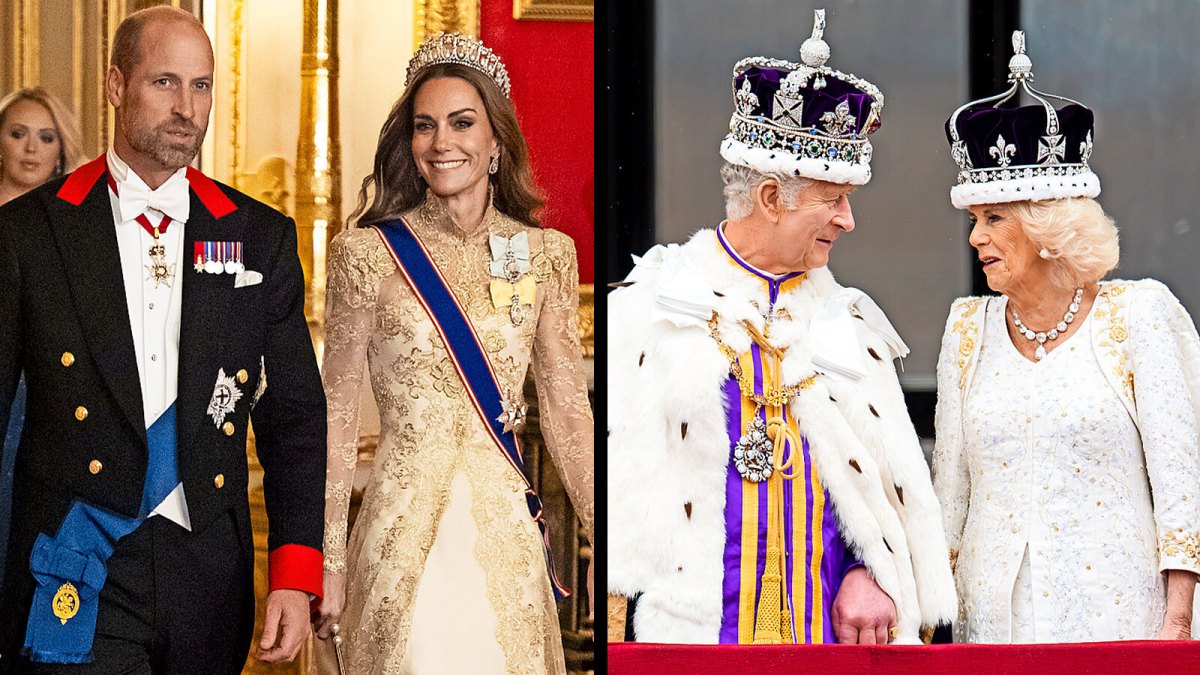
As the monarchy entered the 21st century, there will have been many, royalists included, who recognised that it needed to modernise, to slim down.
Nobody wanted to say much while Queen Elizabeth was alive, out of respect for her and perhaps reassured by steers from Charles that he too wanted a slimmed-down monarchy. The expectation of change was in the air.
We do now have fewer working royals, but by default. Queen Elizabeth and Prince Philip have gone, Harry and Meghan have exiled themselves, and Andrew is disqualified from any public role. Yet nothing much else has changed. In fact, matters have got worse in terms of the vast sums of public money now being directed to this, one of the richest families in the country.
Generally, people have been willing to cut Charles some slack. He has, after all, been struck with cancer, yet admirably continued to discharge his duties. There is also an acknowledgment that he is now quite an old man, 77 this month, and although his family tend to have long lives, his reign will inevitably be far shorter than that of his mother.
Attention has thus turned to William. Will he modernise and reduce the costs of the monarchy in the way many thought his father would?
The signs are not good. If anything, he gives the impression of being even less likely to be open than Charles. He has, for example, unilaterally decided to end his father’s practice of making public the tax he pays annually on the money he takes from the Duchy of Cornwall, a real backward step. In fact, as the payment of income tax is “voluntary” under the monarchy’s 1993 agreement with the Treasury, this leaves open the possibility that he has decided to pay nothing.
• Norman Baker: How much does the royal family really cost the British public?
In an interview in early October, William said that he intends to bring in changes, but also made it plain that these would be limited. He seems quite comfortable with some of the sclerotic imperial elements of the monarchy that look so out of place in modern Britain. In particular he has shown no indication that he wants to reform the royal finances or end the increasingly indefensible tax arrangements from which the family uniquely benefits.

Price William on a tour of Dartmoor
CHRIS JACKSON/PA
He also appears to be rather too interested in micromanaging the Duchy of Cornwall and boosting its profits — his personal income (£23.6 million in 2024) — to the detriment of the time he devotes to public engagements. He carried out just 166 in 2024 — compared with, for example, the 474 undertaken by the 74-year-old Princess Anne and, despite his cancer treatment, the 372 by Charles.
There is an increasing disconnect between the vast sums of public money collected by William, not least through the Duchy of Cornwall, and the level of work he puts in to justify this. He has explicitly stated that he wants to spend more time with his family, and while that is an admirable sentiment, it is difficult to reconcile with the role of heir to the throne.
William relies on a high level of support for himself and his wife, as measured by polling surveys where he comes in as the most popular royal. There is public sympathy for the cancer diagnosis given to Kate.
• The modernising monarch: what to expect from Prince William as king
He also counts on a consistently good press, and to date he will not have been disappointed. Harry and Meghan are the pantomime villains, William and Kate the knights in shining armour. But he will have to have a care.
William would be wise, in the interests of the “firm” itself, to embrace a genuine modernisation of the monarchy and initiate tangible moves to cut the cost to the public. People are unlikely to show him the same patience they showed to the late Queen and are broadly showing to his father.
The warning signs are there, not least from a succession of varied opinion polls. In a December 2024 survey, 75 per cent said the royals should pay corporation tax and capital gains tax on the Duchies, something Charles and William have adamantly refused to countenance. The figure actually rises to 86 per cent among those over 65, normally the age group most supportive of the monarchy.
On the big question of support for the monarchy as an institution, a British Social Attitudes survey reported in the press in September this year revealed that the percentage of the population who favour the royals over having a republic has fallen to 50 per cent, its lowest level since the question was first asked in this survey in 1983, when the figure was 86 per cent.
A YouGov poll in 2023 showed that among 18 to 24-year-olds there was a clear majority for a republic — 40 per cent to 37 per cent. Within this age cohort, only 30 per cent said they felt the monarchy was good for the country. It may be that this generation will become favourable to the royal family as they age. Or it may be a warning sign that time is running out for a monarchy that steadfastly refuses to make fundamental changes to the way it operates.
• Jeni Russell: The royals are still relevant, unlike the Church of England
The royals ignore public opinion at their peril. There are strident republicans in Britain. There are also strident monarchists, who do not want anything to change and who are prepared to pay for the monarchy, whatever the price. Ultimately the fate of the royals is likely to be decided by those in the middle who can be swayed one way or the other. Many in this group are not persuaded that the monarchy should be abolished, but are nevertheless unhappy with the enormous cost, with the imperial mindset, with the obvious excesses, with the hangers-on.
Here are my 25 recommendations for reform. They should be embraced not just by critics of the royals but by anyone who wants to see the monarchy survive.

1. The Ministry of Defence should stop providing officers to serve as royal servants.
2. The planned 2026 Sovereign Grant review should abolish the Sovereign Grant and replace it with a new Royal Duties Support Grant, designed and calculated to enable a small group of working royals to carry out their functions, and with the sum required to be voted on annually by parliament.
3. Ahead of the 2026 review, the Public Accounts Committee should carry out a full analysis of royal funding, including securing full declaration of the royal wealth held by Charles and William, so that this can be taken into account when setting future support payments.
4. The Duchies of Cornwall and Lancaster should be subsumed into the public Crown Estate, would henceforth receive all profits on behalf of the taxpayer through the surrender by the royals of the hereditary revenues. Royal involvement with the duchies would thus end.
5. Pending the incorporation of the duchies into the Crown Estate, a transfer of money should be made into the Treasury by making the duchies liable for corporation tax and capital gains tax and backdating that liability by seven years. At the same time, all income from bona vacantia [ownerless property, eg of people who died intestate] into the duchies should be directed to the Treasury with immediate effect.
6. All leases issued by the duchies that are with bodies delivering public services or with charities should be amended to reduce rents to a peppercorn level.
7. The conventions of King’s Consent and Prince’s Consent [allowing the monarch and the Prince of Wales to object to legislation that affects their interests] should be immediately terminated.
8. All exemptions in legislation relating to the private property and practices of the royal family should be repealed.
9. The royal family should henceforth as a minimum pay the living wage to all its employees.
10. The practice of holding coronations should be ended in its present form and instead be wrapped up in an enhanced Accession Council event.
11. The oath the new monarch takes should be recast, based on that taken in other European monarchies, whereby the new monarch takes an oath to uphold democracy and respect parliament.
12. Equally, the requirement for newly elected MPs and appointed lords to take an oath of allegiance to the monarch and his or her heirs and successors should be replaced by an oath similar to that taken by the elected members of the Northern Ireland Assembly. That oath requires elected members to pledge to serve the people of the province equally, promote the interests of the whole community and uphold the rule of law.
13. The ability of the king to demand properties owned by the Crown Estate be handed over to him for use as grace and favour properties should be ended, save for those within the curtilage of royal palaces, and existing lease arrangements transferred to the Crown Estate.
14. A full list of grace and favour properties presently controlled by the royal family should be made available, and commercial rents applied to each, with the money going to the Crown Estate.
15. The Royal Collection Trust, to be renamed the National Collection Trust, should publish a full inventory of what it holds in two lists, one clearly showing what is held in right of the Crown and one showing what is held privately for the king, in each case showing the date and circumstances of acquisition. In respect of the second list, items contained therein that were given in the past but would constitute official gifts under the present-day rules should be transferred to the first list.
16. All ticket proceeds from buildings held by the Crown, such as Buckingham Palace, should henceforth be received by the Treasury. In the unlikely event that this creates a shortfall in funds needed to maintain the Royal Collection, selected sales of a very small number of items from the million held should take place to cover this.
17. The Royal Warrant Holders Association should publish a full list of the criteria used to determine whether a warrant should be awarded or withdrawn.
18. Henceforth, warrants should only be awarded for produce and products manufactured in this country.
19. The royal family should treat produce or products received free of charge or at a substantial discount from warrant holders as official gifts and declare on a public register all such gifts worth in excess of £150.
20. Any gifts worth more than £150 received by a member of the royal family, other than official gifts or personal gifts from other family members, should be declared and recorded on a public register.
21. A list of all gifts received before the guidelines on official gifts were introduced in 1995 and that would now qualify as official gifts should be compiled and made public, with steps taken to ensure those gifts are retained in right of the Crown.
22. Jewellery and other valuables looted from other countries during colonial times and held by the royals as personal possessions should be returned to their country of origin.
23. A royal register should be created to require members of the royal family to register their business interests, based on the register that exists for MPs.
24. The unique exemptions that apply to the royal family in the Freedom of Information Act 2000 should be removed so that the same tests apply to them in future as apply to other public bodies.
25. Material held in the Royal Archives should be reclassified as public records and responsibility transferred to the National Archives.
Royal Mint, National Debt by Norman Baker (Biteback £22 pp272). To order a copy go to timesbookshop.co.uk. Free UK standard P&P on orders over £25. Special discount available for Times+ members