Summerhall: Sat 22/Sun 23 Nov 2025
Review by Julia Amour
Set one year before the Haitian revolution of 1791, Placeholder at the EAS Studios @ Summerhall, powerfully evokes women’s lost voices in a piece that honours the lives of those who were stolen.
Catherine Bisset’s one-person show, produced by Fronteiras Theatre Lab in association with the Colonial-Era Caribbean Theatre and Opera Network, demonstrates exceptional work in reimagining academic research on Caribbean Theatre and Opera for a wider audience. It has every potential for its ideas to blossom more fully into theatrical life in a future act.
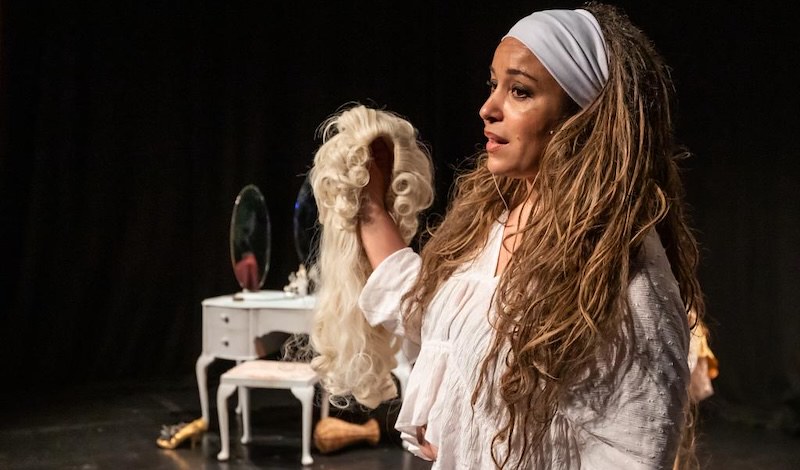
Catherin Bisset in Placeholder. Pic: Fronteiras Theatre Lab.
Placeholder provides a fictional episode around real-life Creole opera singer, Minette, defined by the authorities as a ‘free person of colour’.
Minette is found working as a Placeholder, holding a seat for her mistress in the theatre. The drama centres on her inner monologue and a series of imagined conversations with her Mother, one of half a million enslaved people on the island that was then known as Saint-Domingue.
Writer-performer Catherine Bisset has a magnetic, open-hearted sincerity as both Minette and Mother, all the more impressive since she only began training as an actor in 2019 and this is her first piece of creative writing. It is a testament to the support of Dramaturg Jaïrus Obayomi that there is abundant eloquence and empathy in a piece that is still principally a play of ideas – though occasionally more ideas than the solo format and length can easily support.
Fascinating as the material is, an account of the Chevalier de Saint-Georges (another real-life Creole musician who became a superstar in France despite lifelong discrimination) lacks room to breathe, as does Mother’s encounter with travelling players in mocking blackface. There are also occasional tonal shifts that feel anachronistic, such as describing ‘resistance’ rather than rebellion or uprising.
fully convinces
Overall though, Bisset fully convinces in both roles. As Minette, with refined girlish tones, and Mother, who speaks in low rich Creole accents. Transitioning between the characters is technically taxing, but there is only a momentary character slip at a point of unnecessary complexity where Bisset is also required to embody gossiping women at the theatre.
Director Flavia D’Avila makes good use of a very basic stage with a triple-mirrored dressing table allowing her to present different perspectives on the actor’s face, and a tailor’s dummy standing in for various character transitions.
The marking of these transitions with Afro-Caribbean song, drums and dance (choreography by Yamil Cuedo Herrera) is a dynamic way of energising the piece as well as enriching the cultural reference points, especially as sight-lines in the Edinburgh Acting School venue are very limited when the performer is seated.
touching
Some of the most touching sequences resonate down the centuries: the characters argue about following a path of rebelliousness or assimilation; and warn of freedom being a precarious thing that can be taken away. Finally, Minette takes courage from her Mother’s indomitable spirit and reflects on whether she could make a mark on history after all through her life on the stage.
This piece is a remarkable achievement by a small cross-disciplinary team enabled by research funding. At this stage in its life, creative development support could enable a larger-scale drama to emerge. This would bring the hidden stories it has reclaimed to a wider audience still, and prompt important reflection on the Placeholders of our own time.
Running time: One hour (no interval)
EAS Studios @ Summerhall, 1 Summerhall, EH9 1PL
Sat 22-Sun 23 Nov 2025
Evenings: 6pm.
Tickets and details: Book here.
Director Flavia D’Avila’s link tree: @flavstheatrethings
The Placeholder script is available from Æ’s page on Bookshop.org:
ENDS