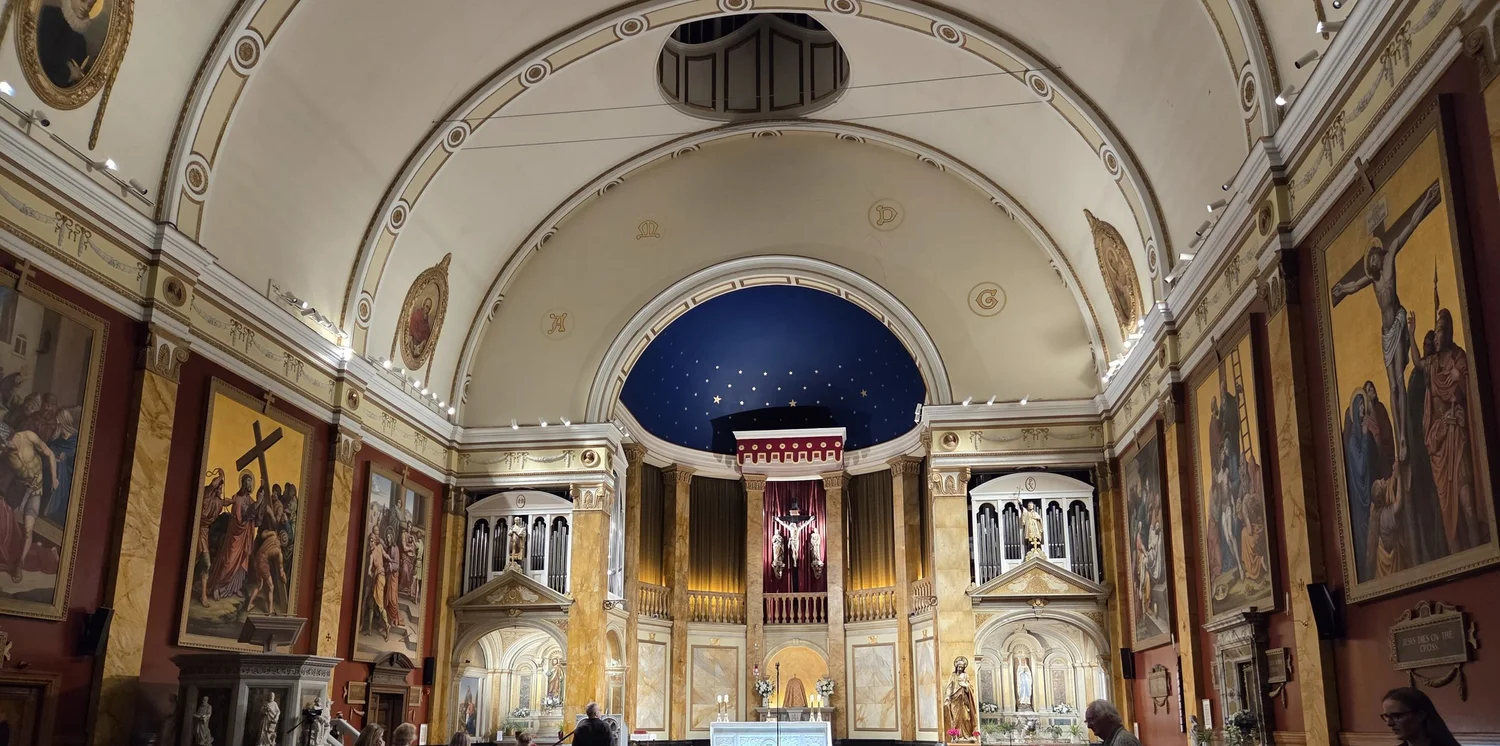
Church of the Sacred Heart, Lauriston Place 22/11/25
Edinburgh University Renaissance Singers, David Coney, director
A Celebration of Palestrina in his 500th Anniversary year
Giovanni Pierluigi da Palestrina was born, almost certainly, in the year 1525 and so, 2025 is his 500th centenary. Acknowledged to be the most important Italian composer of the 16th century, his influence has been felt throughout the 500 years since his birth, and this concert was a timely celebration of his genius, featuring some of his finest works, and music by contemporary and later composers, clearly following his polyphonic lead.
The Edinburgh University Renaissance Singers was founded in 1967, just at the beginning of the great explosion of discovery and interest in the pre-classical era, and has continued ever since to offer opportunities for students and citizens of Edinburgh to sing the music of the Renaissance, and for the concert-going public to hear and understand more about this awesome period in the history of music. I met my wife in the St Andrews equivalent, the St Andrews Renaissance Group, 50 years ago, a choir that is celebrating its 70th anniversary this year, and by a delicious quirk of serendipity, she has just joined the Edinburgh group herself, as a female tenor.
I went along as a loyal husband to the concert on Saturday 22nd November, and was blown away by the terrific singing, the beautiful music and the staggering venue. I must have driven past the Church of the Sacred Heart in Lauriston Street hundreds of times without having the slightest idea what riches lurked behind the doors. You walk into a glorious church, built in 1860, a Catholic building run by the Society of Jesus, the Jesuits, an Italianate space designed by the Jesuit architect, Richard Vaughan. It is high and wide, unencumbered by pillars, decorated with large frescoes depicting the Stations of the Cross, and it has a phenomenal acoustic, perfect for the performance of a capella choral music.
The Singers offered a programme of sacred music, by Palestrina, his contemporaries and by some 19th century composers who had been strongly influenced by his music. The choir, numbering about 30, meet regularly at the University Music Department, and have been well trained by their director, David Coney, a young post graduate. He introduced all the music in a pleasant and humorous style which told the decent audience about what they were hearing, and with a clear beat and a good sense of the balance and harmonies of the polyphony, allowed the singers to perform the music very satisfactorily over a period of about an hour and a half. As with all such groups, the women dominated in terms of numbers, but the basses formed a fine basis for the sound, and the small tenor section held its own. The glory of the choir was the soprano section, whose voices soared wonderfully through the generous acoustic with clarity and warmth.
Stand out pieces for me were the sections of Palestrina’s mass, Missa Ut re mi, the motets ‘Tu es Petrus’ and ‘Sicut Cervus’ and the motet ‘De Profundis’ by the Austrian composer, Johann Joseph Fux (1660-1741). Fux was a musician and pedagogue, whose lasting contribution to history was his treatise on counterpoint, ‘Gradus ad Parnassum’, the single most influential book on the Palestrinian style of Renaissance counterpoint. Another highlight for me was the motet by Anton Bruckner, ‘Os Justi’ (The Mouth of the Righteous), written for the choirmaster of the fabulous baroque monastery, Stift Sankt Florian near Linz, in 1879. Bruckner wrote much of his music, both choral and symphonic, with the wonderful acoustic of St Florian in mind; it is a place I have returned to many times over the years, a place where you can still feel the spirit of Bruckner lurking in its gilded baroque splendour. The Renaissance Singers and the warm acoustic of the Church of the Sacred Heart served Bruckner’s beautiful polyphony wonderfully well.
The choir will be performing again in the same venue on Saturday 21st March 2026, and I would encourage you to put the date in your diaries.