Although falling into a massive black hole would certainly be deadly, it isn’t really something most people need to worry about.
However, scientists say that there could be smaller hidden black holes lurking in our solar system that could pass right through you at any time.
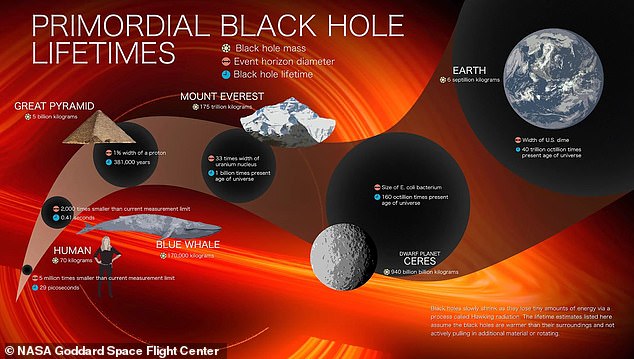
These so-called ‘primordial’ black holes have masses ranging from 100,000 times smaller than a paper clip to 100,000 times greater than the sun.
But what would happen if you walked into one of these miniature monsters?
According to Professor Robert Scherrer, a physicist from Vanderbilt University, the results would be gruesome.
The gravitational forces of a primordial black hole would be so strong that they would tear the cells of your brain apart from the inside out.
Professor Scherrer says: ‘A sufficiently large primordial black hole, about the size of an asteroid or larger, would cause serious injury or death if it passed through you.
‘It would behave like a gunshot.’

A scientist has revealed what would happen if you walked into a black hole, and his calculations show the gruesome effects it would have on your body
A primordial black hole is a type of black hole that formed in the very first moments of the Universe as vast clouds of matter collapsed directly into singularities.
Although they are currently only theoretical, these black holes might have been drifting around the universe and slowly shrinking for the last 13.8 billion years.
Today, scientists think that any remaining primordial black holes probably have roughly the same mass as an asteroid, crushed into a point the size of an atom.
Despite being incredibly small, Professor Scherrer’s calculations suggest that being hit by one of these strange objects could very well be deadly.
When the black hole collides with a body, it will start to transfer huge amounts of energy in two forms: a supersonic shock and tidal forces.
A supersonic shock occurs when something moves faster than the speed of sound and produces a blast of energy radiating out in a cone.
In the case of a black hole, these shockwaves would spread out from its path as it passed through the body’s tissue.
Professor Scherrer compares the force of this impact to being hit by a large-calibre bullet, which dumps energy into the body as it passes through.

Entering a massive black hole would be deadly, but a researcher has now calculated that a tiny ‘primordial’ black hole could also produce a strong enough force to tear the cells of your brain apart from the inside (stock image)
What are primordial black holes?
Primordial black holes are microscopic pieces of ultra-dense matter, just like normal black holes but smaller.
Scientists think they may have been formed at the very beginning of the universe rather than out of collapsing stars.
Their masses could range between 100,000 times less than a paperclip to 100,000 times greater than the sun.
We haven’t found proof that they exist, but they might form part of the ‘dark matter’ which makes up a large part of the mass of the universe.
If the black hole has a big enough mass, that energy would be enough to cause death by rupturing the internal organs and triggering massive bleeding.
The other way in which a black hole might kill you is through the creation of tidal forces.
Tidal forces occur when gravity pulls more strongly on one part of an object than another, tearing it apart.
This is the same process that causes planets to crumble into pieces when they fall too close to their host stars.
Since a primordial black hole is so small, the area affected by its gravitational pull is quite limited.
However, if it passed through the brain, these tidal forces could be strong enough to kill.
Professor Scherrer predicts that a primordial black hole could produce a tidal force of 10 to 100 Newtons across the entire brain.
In his paper, published in the International Journal of Modern Physics D, he explains that this ‘would be sufficient to pull apart human brain cells’.

Scientists believe that the universe might be filled with tiny primordial black holes (artist’s impression) left over from the very earliest moments of the Big Bang. If one of these hit you, it would be like being struck by a high-calibre bullet
Although this sounds gruesome, Professor Scherrer’s calculations suggest that it is the shockwave which is most likely to kill you.
A black hole with a mass of roughly 140 billion tonnes would deliver a shock equivalent to the muzzle energy of a 0.22 calibre rifle, which could be fatal.
For the tidal forces to be deadly, the black hole would need to be several orders of magnitude larger, with a mass of roughly seven trillion tonnes.
That is comfortably within the mass that scientists expect from primordial black holes, but Professor Scherrer maintains there is no real reason to worry.
He says: ‘A smaller primordial black hole could pass through you, and you wouldn’t even notice it.
‘However, the density of these black holes is so low that such an encounter is essentially never going to happen.’
In reality, the fact that no one has ever been killed by a black hole could be an important piece of scientific evidence.
Some scientists think that primordial black holes might make up a chunk of the Universe’s dark matter.
However, since primordial black holes are so small and rare, the chances of actually being hit by one are almost negligible
This is the unobservable extra mass that makes up most of the known universe and helps galaxies stay together.
However, since we can’t see these primordial black holes, it’s almost impossible to know how much dark matter they make up.
Professor Scherrer’s calculations show that even the smallest, asteroid-sized primordial black holes would cause serious injury or death if they hit someone.
So, the fact that this has never happened means primordial black holes can’t be that common – putting a limit on how much dark matter they represent if they exist at all.
What would happen if you fell into a black hole?
A black hole is a point of matter so dense that not even light can escape its gravitational pull.
If a human fell into one of these cosmic monsters, the forces of gravity would be so strong that they would undergo ‘spagettification’.
Since a black hole’s gravity is so strong, there is an extremely steep ‘gravitational gradient’.
This means the forces affecting your feet nearer the black hole would be much more powerful than those affecting your head.
That means your body would be yanked into a long line like a piece of spaghetti being sucked up by a black hole.
At the same time, the intense radiation from orbiting material in the ‘accretion disk’ would blast you with incredibly powerful X-rays.
Strangely, as your elongated body approaches the black hole, your perception of time would start to radically diverge from anyone observing from outside.
Due to a process called time dilation, your passage through time would halt to a crawl.
While you experience time passing normally, you would slow down from the perspective of anyone outside.
Once you hit the event horizon, the point of no return, you would slip past the point where conventional physics can make sense of your situation.
From your view, all directions would lead towards the centre of the black hole as you are compressed to an infinitely dense point.
However, from the perspective of anyone watching from afar, you would essentially cease to exist.