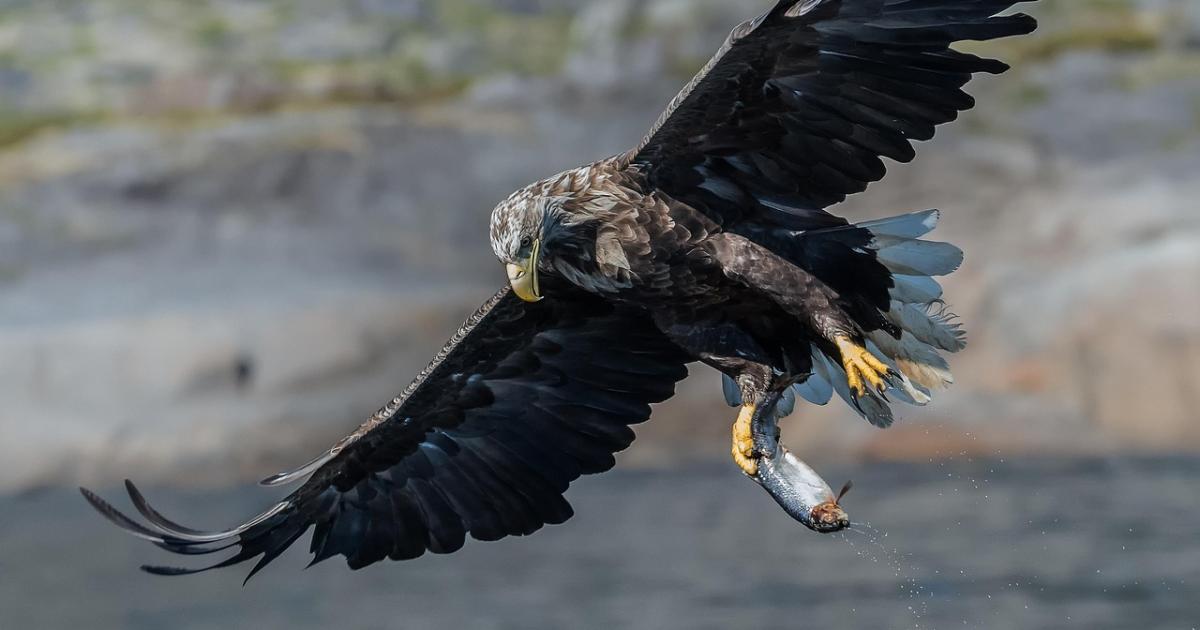
The Cumbrian White-Tailed Eagle Project (CWTEP), led by The Lifescape Project charity, has spent several years assessing whether white-tailed eagles – once native to the region – could be successfully reintroduced to the Lake District landscape.
The species disappeared from Cumbria around 150 years ago, and despite reintroduction programmes in Scotland, Ireland and the Isle of Wight, the birds have been slow to disperse naturally.
Cumbria has been identified as a strategic link between established populations, with the species included in the Cumbria Local Nature Recovery Strategy and the Lake District National Park Partnership’s Nature Recovery Delivery Plan as one suitable for restoration.
A white-tailed eagle flying low over water (Image: Kathy Buscher)
The project says consultation has involved public drop-in events, webinars, workshops, questionnaires and ongoing discussions with farmers and landowners.
However, the proposals have prompted concerns from within the farming community and from Westmorland and Lonsdale MP Tim Farron, who has written to the Lake District National Park Authority urging it to rethink the plans.
Mr Farron said the move, though well-intentioned, could pose ‘a threat to animal welfare’. He said evidence suggested that while sea eagles may not target many farms, those they do focus on “they will return over and over again and decimate flocks”.
He added: “These animals fly long distances and will of course move towards sources of food.”
NFU Cumbria chair John Longmire said members were also worried about the impact on livestock. “Species recovery efforts should firstly focus on supporting species that are already present in England before reintroductions are considered,” he said.
“We have had feedback from members who are worried that sea eagles could prey on livestock, as has been seen in Scotland, impacting the countryside, farm businesses and food production.”
The white-tailed eagle, Europe’s largest bird of prey, standing on ice (Image: Penny Ash – Pixabay)
But conservationists say experience elsewhere has shown that coexistence is possible. The Lifescape Project points to the Isle of Wight, where 45 eagles have been released over the last five years with no recorded livestock predation, and to Ireland, where similar concerns eased after more than 200 birds were reintroduced.
Irish sheep farmer Donal Casey, from the Black Valley in Co. Kerry, said his community was initially apprehensive but had witnessed no issues.
“I’ve been farming sheep in the Black Valley since before the eagles were first released in 2007, and my family have been farming here for generations,” he said. “While some were sceptical or even opposed to the reintroduction, what we have seen since is that the eagles have had no negative impact on lambing in the hills. It’s great to see that farming and eagles can coexist, and we are delighted to see the project succeed.”
White-tailed eagles are distinguished by their pale yellow beak and uniform brown plumage (Image: Murray Lees)
Amid the debate, the Lake District National Park Authority (LDNPA) – which sits on the project’s steering group – said engagement with local communities would continue.
Tim Duckmanton, LDNPA Team Leader for Strategy and Environment, said: “The project is still exploring the possibility of white-tailed eagle reintroduction in Cumbria. We understand the concerns of the farming community and over the coming months we will continue to support conversations to ensure all stakeholders have a voice in this ongoing dialogue.”
The project is supported by a steering group including the University of Cumbria, Cumbria Wildlife Trust, RSPB, the Wildland Research Institute, the National Trust, and local estate owners and managers.