 Digital terrestrial television (DTT) is becoming increasingly popular in Germany, with usage rising sharply thanks to renewed growth in mobile viewing.
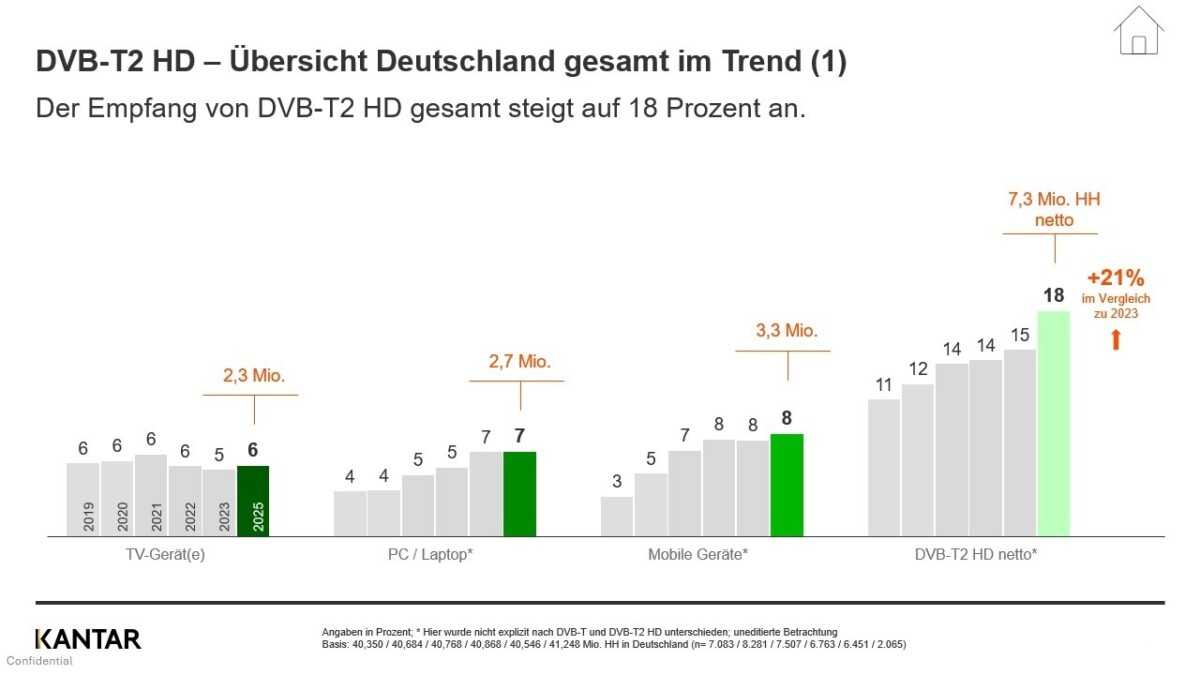
According to a new study from Kantar commissioned by DTT platform operator Media Broadcast, 18% of German households – equivalent to 7.3 million homes – now watch television using the country’s DVB-T2 network. This marks a 21% increase compared with the previous survey in 2023.
The study shows that DTT, combining both stationary reception on traditional TV sets and mobile use via PCs, laptops or portable devices, is currently used by a net total of 18% of households. Mobile usage in particular continues its long-term upward trajectory: in 2025, 14% of households (5.8 million) used DVB-T2 on portable and mobile devices, up from 4.4 million in 2023. Stationary reception on TVs also increased, reaching 2.3 million households.
The findings indicate that DTT’s appeal increasingly lies in its flexibility and mobility. The study notes that, unlike TV streamed over mobile networks, the DVB-T2 technology does not consume data volumes on mobile devices, making it a more robust and cost-efficient option for consumers. Media Broadcast argues that this trend underscores the relevance of future broadcast technologies such as 5G Broadcast.
“The current figures on DVB-T2 usage are significant in several respects,” said Francie Petrick, Managing Director of Media Broadcast. “Terrestrial television continues to reach millions of viewers and is meeting the growing demand for mobile use. This confirms that we are on the right track with 5G Broadcast as ‘TV to go’. Terrestrial distribution will thus continue to ensure the consumer-friendly, crisis-proof, and energy-efficient distribution of high-quality audiovisual content in the future.”
The company emphasised that the study was commissioned using the same methodology as the long-running Kantar surveys historically used in the German media authorities’ video trends and digitisation reports. While state-by-state coverage data is no longer included, Media Broadcast says the results remain representative of the population.
Related