

Felix | Pixabay
A major new TRAFFIC analysis, Beyond Skin and Bones: A 25-year Analysis of Tiger Seizures reveals an uptick in seizures and sharp shift towards the trade in whole tigers, both dead and alive.
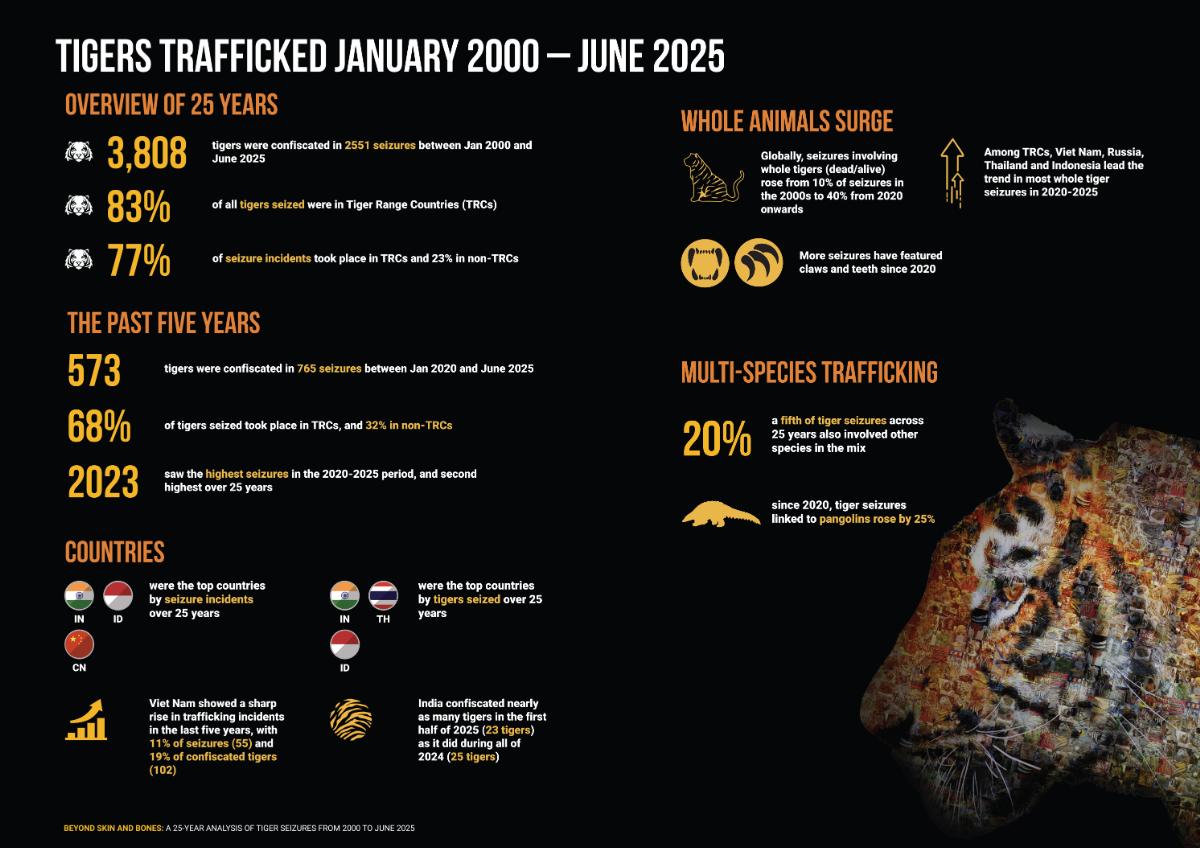
Covering global tiger seizure data from 2000 to June 2025, the report documents 2,551 seizures incidents involving equivalent of at least 3,808 tigers seized.
Most of these seizures over 25 years took place in the world’s 13 Tiger Range Countries (TRCs), which also accounted for most of the tigers seized globally.
Despite decades of international commitments, enforcement efforts and conservation investment, 2023 marked one of the worst years on record with 139 tiger seizure incidents – second only to the peak of 141 seizures in 2019. Over 75% of these seizures occurred in TRCs.
This rise reflects improved enforcement efforts but also signals persistent and, in some areas, escalating criminal activity and a widespread demand for tigers and their parts”
Ramacandra Wong, co-author of the report and Senior Wildlife Crime Analyst
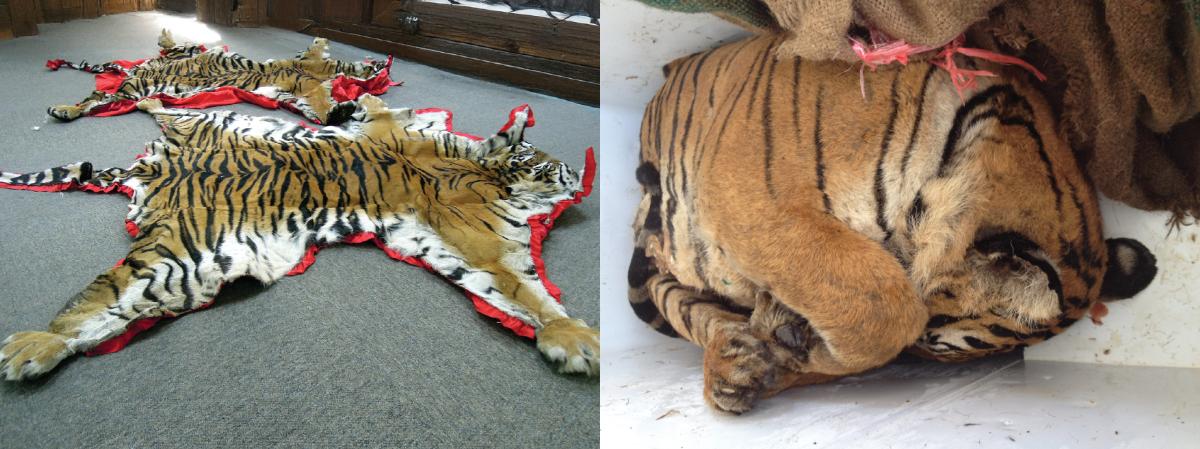 Tigers and parts seized over the past years in (left) Malaysia and Thailand (right)
Data from the most recent period shows a rise in whole-animal seizures. Among countries making those seizures, 65% were in TRCs. This included countries without a viable wild population, signalling a captive supply into illegal trade or unnoticed cross border trade.
The shift was largely seen in Viet Nam, Thailand, Indonesia and the Russian Federation — where whole tigers now made up more than 40% of confiscations — as well as non-TRCs where tigers are often kept as pets.
It’s a twin attack on tigers. Wild strongholds are taking a big hit while captive tigers leak into the illegal trade chain. CITES must address this as a priority. We are well past the point where this can be ignored,”
Kanitha Krishnasamy, co-author of the report and Director for TRAFFIC in Southeast Asia
The report warns that persistent illegal trade, fuelled by both wild poaching in some of the world’s premier tiger habitats and the trafficking of tigers from captive sources, continues to undermine global recovery efforts, threatening the long-term survival of the species across its range.
This report is a wake-up call. The surge in tiger trafficking and the alarming rise in whole-animal seizures show that criminal networks are adapting faster than our collective response. We must urgently scale up investment in tackling illegal trade of tigers from both captive and wild sources across the tiger range countries. Without this, decades of conservation gains risk being undone.”
Heather Sohl, Tiger Trade Lead, WWF Global Tiger Program
Authors said without immediate and coordinated action, global efforts risk falling short. The actions include intensifying law enforcement across the trade chain, closing captive loopholes, increasing transparency and data sharing, and reducing consumer demand.
The report was released on the sidelines of the CITES Conference of the Parties in Uzbekistan, a key global forum where countries determine global rules for trade in endangered species.
HIGHLIGHTS
-
Shift in trafficked commodities: Tiger parts in seizures went from 90% in the 2000s, down to 60% from 2020 onwards, while the prominence of whole tigers trafficked rose.
-
Trafficking hotspots persist: Over 1,600 locations recorded seizures with activity concentrated in Tiger Range Countries (77%). Hotspots in the last five years were in India and Bangladesh’s tiger reserves, Indonesia’s Aceh, key Viet Nam–Lao PDR border provinces and some of Viet Nam’s urban consumption centres.
-
Species convergence: In almost one-fifth of incidents, tigers were trafficked alongside other species—most commonly leopards (34% of seizures), bears (26%) and pangolins (16%)
Download the high-res infographic