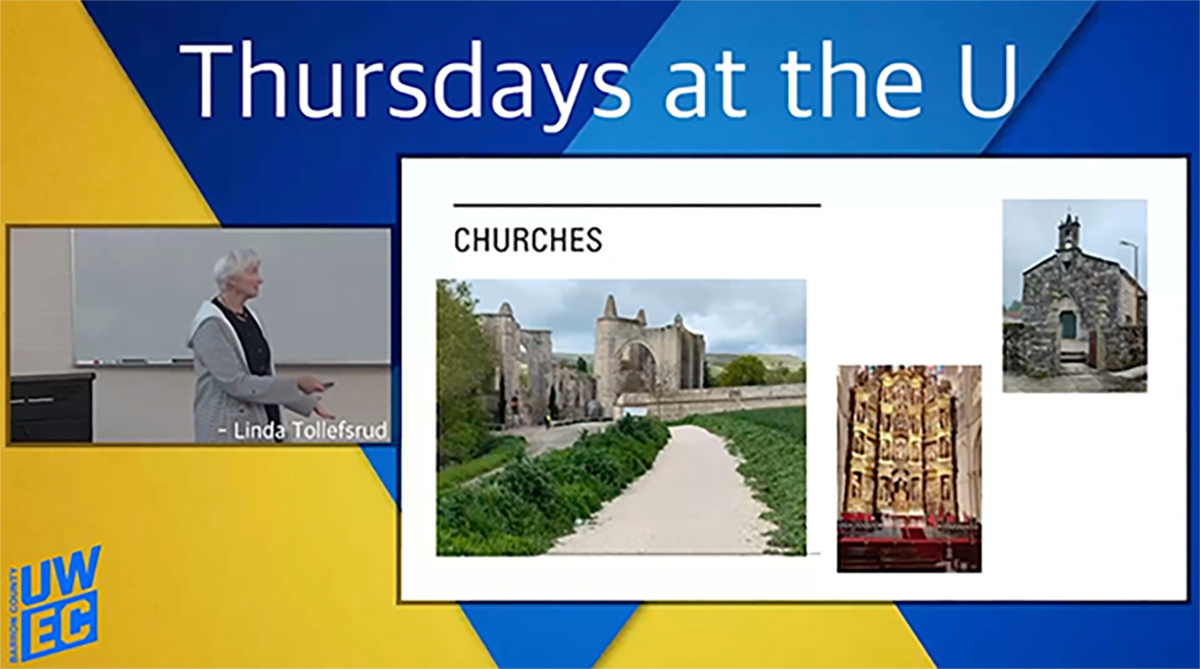
The “Thursdays at the U” series — an open lecture with a speaker, partially funded by the UW-Barron County Foundation — explores topics from a variety of different fields.
Held in-person from 12:30-1:30 p.m. every Thursday at UW-Eau Claire Barron County’s Blue Hill’s Lecture Hall, each “Thursdays at the U” lecture is also livestreamed and a video is uploaded.
On Nov. 20, speaker Linda Tollefsrud — a former psychology professor at UW-Barron County — presented “Backpacking 500 Miles Across Spain.”
Tollefsrud has been involved with “Thursdays at the U” for the past 10 years and said she was always envious of the presenters who talked about their adventures. She decided she wanted to go on an adventure of her own and walk the Camino de Santiago.
Story continues below advertisement
“I stepped on the trail on my 70th birthday,” Tollefsrud said. “Not exactly a spring chicken.”
Many of Tollefsrud’s friends said they were worried about her walking on the trail, saying they were afraid “she would die.” Tollefsrud said she was confident in her ability to walk on the trail and was determined to succeed.
“(The Camino de Santiago) is a pilgrimage to the tomb of Saint James the Apostle,” Tollefsrud said. “And that’s in the City of Santiago. In Spanish, camino is the path, the way, the road.”
Saint James’ bones were found around 824 AD in Northern Spain by a hermit. However, Saint James was beheaded in Jerusalem in 44 AD, Tollefsrud said. Two of the theories for explaining how his bones traveled are that either the Virgin Mary transported them or Saint James’ followers did.
The pilgrimage was — and still is — a path that holds a lot of religious significance, Tollefsrud said. Thousands of years ago, pilgrims would walk the path to the burial palace of Saint James, some carrying bricks to build the cathedral that now stands in the city of Santiago.
“However you get to Santiago is a camino, right? It is a way to get to Saint James,” Tollefsrud said. “The path I took (was) from Saint-Jean-Pied-de-Port in France through these cities and up to Santiago.”
Tollefsrud said that one experiences all sorts of things walking the trail. From a variety of different terrains to beautiful rural landscapes, the path has something for everybody. Tollefsrud said she was able to meet people from all around the globe walking the sacred path.
One receives a certificate, Tollefsrud said, if they walk at least 60 miles to the destination of Santiago. Walkers also receive a stamp book when they begin the walk, receiving stamps every day. Each stamp serving as a souvenir and memory of the Camino de Santiago.
The Camino de Santiago has varying terrain with lots of uphill and downhill walking, Tollefsrud said. She said that the downhills were especially difficult for her because she has an arthritic knee. Walking downhill causes the knee to flare up.
To avoid any knee flare-ups, Tollefsrud said she walks downhill in what she calls the “drunkard’s walk.” She walks diagonally downhill, zig-zagging down any slopes she encounters.
“A pilgrimage (is) going to a particular endpoint for a particular reason,” Tollefsrud said. “For myself, I focused on being in the present. That was going to be my spiritual goal.”
Hirata can be reached at [email protected]