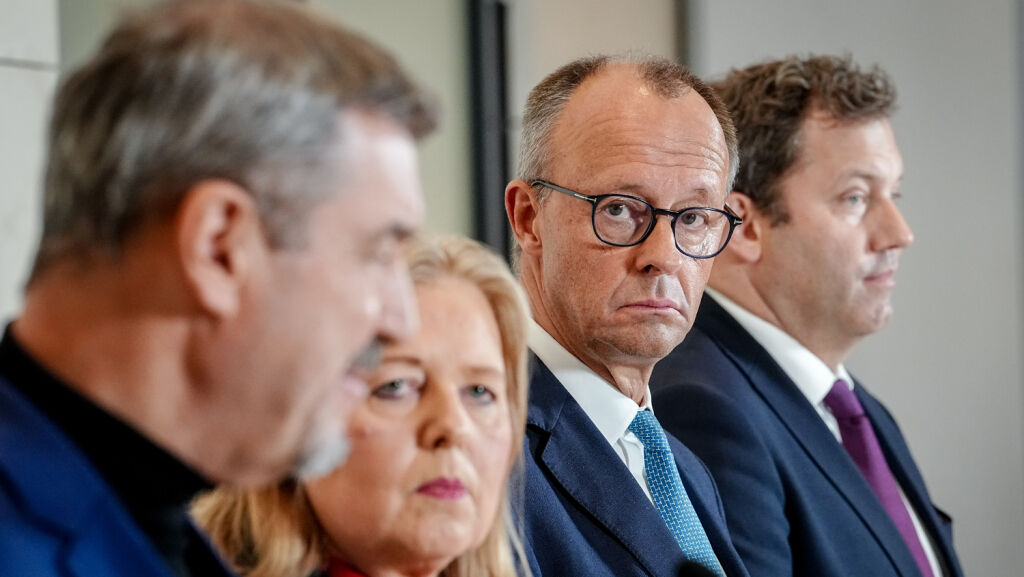
German Chancellor Friedrich Merz’s honeymoon is over. He came to power promising bold, decisive reform. He quickly transformed the German military and promised the country’s most sweeping reforms in a generation. The nation waited to see what revolution would follow.
It is still waiting.
A Soaring Military
Merz has brought dramatic changes to the military. The Telegraph’s headline from a fortnight ago could have come from the Trumpet: “Germany Is Arming Itself to the Teeth to Transform Europe Again.” It said:
In the face of Russian aggression, the German war machine is now rising once again—and showing it is a force to be reckoned with.
Under radical reforms pushed through by Friedrich Merz, the chancellor, Berlin has this year thrown off all fiscal constraints on defense expenditure to build Europe’s most powerful army.
The overhaul has paved the way for massive equipment purchases of tanks, artillery, fighter planes and warships costing hundreds of billions of pounds, as the Bundeswehr prepares to face up to the threat posed by Vladimir Putin.
Politico, also, is almost sounding a trumpet, declaring “Germany’s Rearmament Upends Europe’s Power Balance.” It states:
For decades, the European Union ran on an unspoken understanding: Germany handled the money; France handled the military. Now the tables are turning.
As Germany aims to become Europe’s predominant military power, the political balance is shifting. In France, there’s a scramble to stay relevant, while in Poland, Germany’s rearmament is stirring old ghosts and creating a sense that a Berlin-Warsaw alliance might be the most effective way to keep Russia at bay.
“Everywhere I go in the world, from the Baltics to Asia, people are asking Germany to take on more responsibility,” said Christoph Schmid, a German Social Democratic lawmaker on the Bundestag’s defense committee. “The expectation is that Germany will finally step up and match its economic weight with defense power.”
Both news outlets admit Germany once invested heavily in American weapons, but for this massive buildup, it is Germany first. Where American purchases are unavoidable, Germany generally insists that at least part of the production be shifted to Germany.
Germany isn’t just spending slightly more than France—it is on course to double France’s spending. One official of the European Union told Politico it was “telluric,” or earthshaking. Another said, “It’s the most important thing happening right now at [the] EU level.”
“It could be frightening, no doubt,” one EU diplomat said.
Meanwhile, America wants to bow out of nato and leave Germany in charge. “I look forward to the day when Germany comes to the United States and says that we’re ready to take over the Supreme Allied Commander position,” Matthew Whitaker, U.S. ambassador to nato, told the Berlin Security Conference last week. “I think we’re a long way away from that, but I look forward to those discussions.”
In wartime, the supreme commander controls the deployment of hundreds of thousands of troops and perhaps even nuclear weapons. Since U.S. troops and equipment form the backbone of these forces, the supreme commander has always been American. Whitaker is suggesting that nato get a new backbone.
While America is ready to hand the keys to Germany, it is completely ignorant that Berlin stands on the brink of a massive political transformation.
Back Down to Earth
The trouble first began over plans to enlarge the German military from 180,000 to 260,000 personnel. Defense Minister Boris Pistorius wanted to shift gently toward conscription, having all men, and any women who wanted, fill in a questionnaire assessing their fitness for military service. It was supposed to nudge young Germans toward signing up.
The Christian Democratic Union (cdu), the largest party in the coalition, is in a bigger hurry. If too few people volunteer, it wanted a lottery system to draft young men at random to make up the shortfall. To stop that, Pistorius torpedoed his own bill, threatening to lead Social Democrats in voting against it.
A compromise was hammered out, with the new bill opening the door to a lottery. Another vote in the Bundestag will be necessary to implement it. This showed that the government is far from a well-oiled machine.
Germany’s current crisis over pensions could be more serious. The Social Democrats want to fix pensions at 48 percent of average earnings. But with the number of those in work shrinking and the number of pensioners growing, this places a growing burden on workers. Merz doesn’t like it, but he supports the change as part of doing business in a coalition.
Eighteen of Merz’s fellow cdu members under the age of 35 disagree: They’ve stalled the government for weeks, refusing to support the compromise.
This isn’t about pensions. This coalition will have the same issue with anything it tries. Merz leads a coalition of the mainstream left and right—Germany’s equivalent of Democrats and Republicans. Yet support for both parties has plummeted so much that this “grand” coalition has a majority of just 12 in the 630-seat Bundestag. A handful from either party can block anything.
“We are not surprised that this coalition is acting the way it is,” wrote EuroIntelligence. “We had three grand coalitions under [Angela] Merkel, during which the country laid the foundation of its economic decline. Why would grand coalition number four be any different?” It condemned Merz’s “lack of leadership quality, poor negotiation skills, and … tendency toward flippancy.”
“We are not ruling out that a future German government might pass reforms, but we can rule out that it will happen under this coalition,” it wrote. “We can also rule out that it will happen under Merz no matter what coalition he leads.”
And it’s not just economic analysts getting fed up.
Who Leads Germany?
Poland was irate at former Chancellor Angela Merkel for approving undersea gas pipelines with Russia. When confronted privately over the issue, Merkel said she was “helpless” in the face of German business leaders who wanted the pipelines built. “The German businesses have a lot of power, and … they even overruled the chancellor of Germany,” commented Trumpet editor in chief Gerald Flurry on a Key of David.
“Those leaders that keep rising and sometimes even overthrow the chancellor,” he said. “That’s how powerful they are, because they all get their corporation powers together, and do they ever have a big clout!”
But the businesses they lead are struggling. Volkswagen Group, Germany’s biggest company, posted its first lost since covid-19 in the third quarter of this year—losing $1.25 billion.
The German economy once revolved around buying cheap raw materials and fuel from Russia, creating high-quality machinery, and selling it around the world. That economic model no longer works, and the only big German businesses not struggling are weapons manufacturers.
On September 22, leaders from four top business associations made their disappointment clear at a secret meeting with Merz. Bild reported that they “gave the chancellor a thorough grilling for an hour and a half” and that the “key demand made of Friedrich Merz was to pick up the pace on social reforms, reducing bureaucracy, and modernizing the state.”
This month, 32 business associations signed a joint letter opposing the pension reforms. The German Council of Economic Experts also gave its verdict on the German government: It does not expect the economy to improve next year. “We see the report as a vote of no-confidence in the government by a non-partisan panel,” wrote EuroIntelligence.
Merz came to power promising massive pro-business reforms. Six months into his government, those reforms are nowhere to be seen.
This week, Die Familienunternehmer—the family entrepreneur group—broke a major taboo by openly talking to Alternative für Deutschland (AfD), the far-right group that is currently Germany’s most popular political party. The Pioneer reported that others are talking to the AfD more discreetly. “For a long time, business leaders struggled with the AfD,” it wrote. “Now lobbyists are reaching out—some subtly, others quite openly.”
Is Die Familienunternehmer breaking a taboo for other, bigger industry groups to follow? Is it a warning to Merz that German industry has other leaders if he disappoints them?
This isn’t really a Merz problem. A different chancellor would have the same difficulty getting anything through this hostile coalition. Nor would fresh elections change much. The AfD has grown in popularity, but an election seems likely to be just as inconclusive as the last one.
There seems to be no democratic way to get the reform that business leaders desperately want.
A Strongman
“As dramatic as the fulfilled prophecy in America is, we also need to pay close attention to events in Germany,” wrote Mr. Flurry after Donald Trump was reelected—exactly as he had forecast. “This nation’s future is weak if something doesn’t change. But Bible prophecy forewarns us that Germany is about to shock the world with its power. To accomplish this, it needs a strong leader—something it sorely lacks right now.”
He wrote that Germany’s February elections “seem unlikely to solve Germany’s leadership crisis. Polls suggest they will only produce another weak, divided government.” In the one area of the military, Germans are broadly united. They want to step up and spend more. Yet in other areas, this government is just as divided as the ones that went before.
“There is a big leadership vacuum,” wrote Mr. Flurry. “Germans know something dramatic must be done, and quickly! You see this in recent election results with the rise of fringe parties like the Alternative für Deutschland. Voters are showing themselves willing to embrace out-of-the-ordinary politics. They are clamoring for a strong leader!” Business leaders are now adding their voices to this clamor.
In a 2009 Key of David program, Mr. Flurry said this coming leader could perhaps “take advantage of a weak coalition.” As the last few weeks have made clear, we are back to weak coalitions in Germany.
Daniel 11:21 states that this coming leader will not be given “the honor of the kingdom”—he doesn’t come to rule the usual way. Instead, he shall “obtain the kingdom by flatteries.” He maneuvers his way to power through backroom deals.
It also states that he shall come in “peaceably.” Daniel 8:25 states that he “by peace shall destroy many.” Lange’s Commentary notes this man will destroy “with suddenness, by a malignant purpose.” Mr. Flurry wrote: “Presenting himself as a man of peace, suddenly he destroys you. This will shock the world!”
America is empowering Germany to lead and dominate all of Europe. But Germany is on the cusp of a radical shift: A strongman is about to break Germany’s coalition paralysis before suddenly turning on America.
You don’t have to be caught by surprise. Our free booklet A Strong German Leader Is Imminent shows what is happening, who this man could be, and why God is allowing him to come to power.